
What Is SOAR?
Brain-First Learning for an AI World
WHAT IS SOAR?
The Study Skills Curriculum That Builds Executive Function
Executive function is the brain’s operating system for every subject. Most students were never taught it directly — and the ones who learn it hold the skills AI can’t replace.
The Pattern
You know the student.
Studies for hours, then freezes on the test. Sharp in conversation, lost on the page. Trying — visibly trying — with nothing to show for it.
Over time, a quiet conclusion settles in: some students are just wired to struggle. That conclusion was never carelessness. It was the honest read of what was in front of you, because the part that actually breaks down happens somewhere you can’t see it.
The whole field worked this way for decades. We measured what students produced and tried to fix the output, while the real system — how a brain organizes, prioritizes, and holds onto what it learns — stayed out of view. When the mechanism is invisible, “inevitable” is a reasonable conclusion.
It just isn’t the right one.
The Reframe
Here’s what changed: we can see the mechanism now.
The skills that look like personality, aren’t fixed traits: focus, follow-through, organization, the ability to read something hard and actually absorb it…
They’re executive function: the brain’s system for managing attention, organizing information, prioritizing tasks, and moving from passive memorizing to active, independent learning.
That system develops with the right instruction and stalls without it. Most students were never taught it directly. They were handed information and expected to supply the operating system themselves.
That gap was always the real problem. Now, AI is making that gap impossible to ignore.
When a tool can produce the information in seconds, the value is not in having the information — it’s in the brain that can read it critically, judge it, organize it, and learn from it. The students who don’t build this capacity risk becoming increasingly dependent on the tool rather than learning to think with it.
And that makes building executive function capacity far more relevant in an AI world, not less. In fact, it’s the whole game.
What this means for your classroom — and your students’ futures →
The Curriculum
What SOAR Is
SOAR® Learning & Soft Skills is an executive function / study skills curriculum that teaches that operating system directly — explicitly, in a brain-friendly sequence.
It starts at motivation: helping students explore their strengths and superpowers, then understand how their own brain learns, so the strategies feel like leverage instead of one more thing to comply with. We call it The Brain Circuit™ — short, visual models of what’s happening inside the learning brain. Once a student can see it, they buy in.
The Brain Circuit™ — how learning physically works in the brain.
From there, SOAR teaches the full set of executive function and strategic learning skills directly — eighteen lessons, sequenced the way the brain actually builds them:
The SOAR curriculum, lesson by lesson
- 1Why Study Skills?
- 2What Are Your Strengths & Superpowers?
- 3How Does Your Brain Learn?
- 4Identify Your Priorities
- 5Create Your Goals
- 6Manage Time & Take Action
- 7Organize Your Papers & Digital Files
- 8Organize Your Space
- 9Organize Your Time & Manage Your Energy
- 10How to Read Nonfiction (hardcopy & online)
- 11How to Communicate with Teachers & Peers
- 12How to Listen & Take Notes
- 13How to Study & Learn New Terms (includes “How to Study Math”)
- 14How to Take Tests
- 15How to Write Paragraphs & Essays
- 16How to Learn Correct Grammar & Punctuation
- 17How to Give a Presentation
- 18How to Track Progress & Keep Moving Forward
These are the skills that don’t transfer to a machine. A tool can hand a student the answer. It can’t hand them the capacity to think — and that capacity is precisely what SOAR builds.
By Grade Level
Built for every level — see how SOAR adapts
The same foundation, taught the way each age needs it.
Elementary
Building the first habits of organization and focus — when the foundation goes in strong, every grade above is easier. Includes the 5th Grade Literacy Lab.
Study Skills & EF for Elementary – 5th Grade Literacy Lab →Middle School
The transition years, when students go from having “just one” teacher to seven… and the wheels fall off.
See Middle School →High School
Executive function for success in school now, while actively preparing for college, career, and an AI-driven world.
See High School →College & Career
Independent learning that holds up without the scaffolding — and the competitive, distinctly human skills that keep a graduate relevant in an AI world.
See College & Career →Implementation
And here’s what makes it usable on Monday.
SOAR is turn-key. The Presentation Tool carries the instruction — slides, scripts, and assessments built in — so a new teacher can learn alongside students while an experienced one customizes freely. Minimal prep. No theory you have to translate into a lesson plan yourself.
Students learn through the software app, the workbooks, or both. Either way, the structure is done for you — you’re delivering a proven sequence, not assembling one.
This is the difference between an integrated, scaffolded curriculum and a pile of worksheets: SOAR was built to be deployed across a classroom, a grade, or a district, not printed one lesson at a time.
Need support implementing? Professional development and training →
The SOAR Presentation Tool
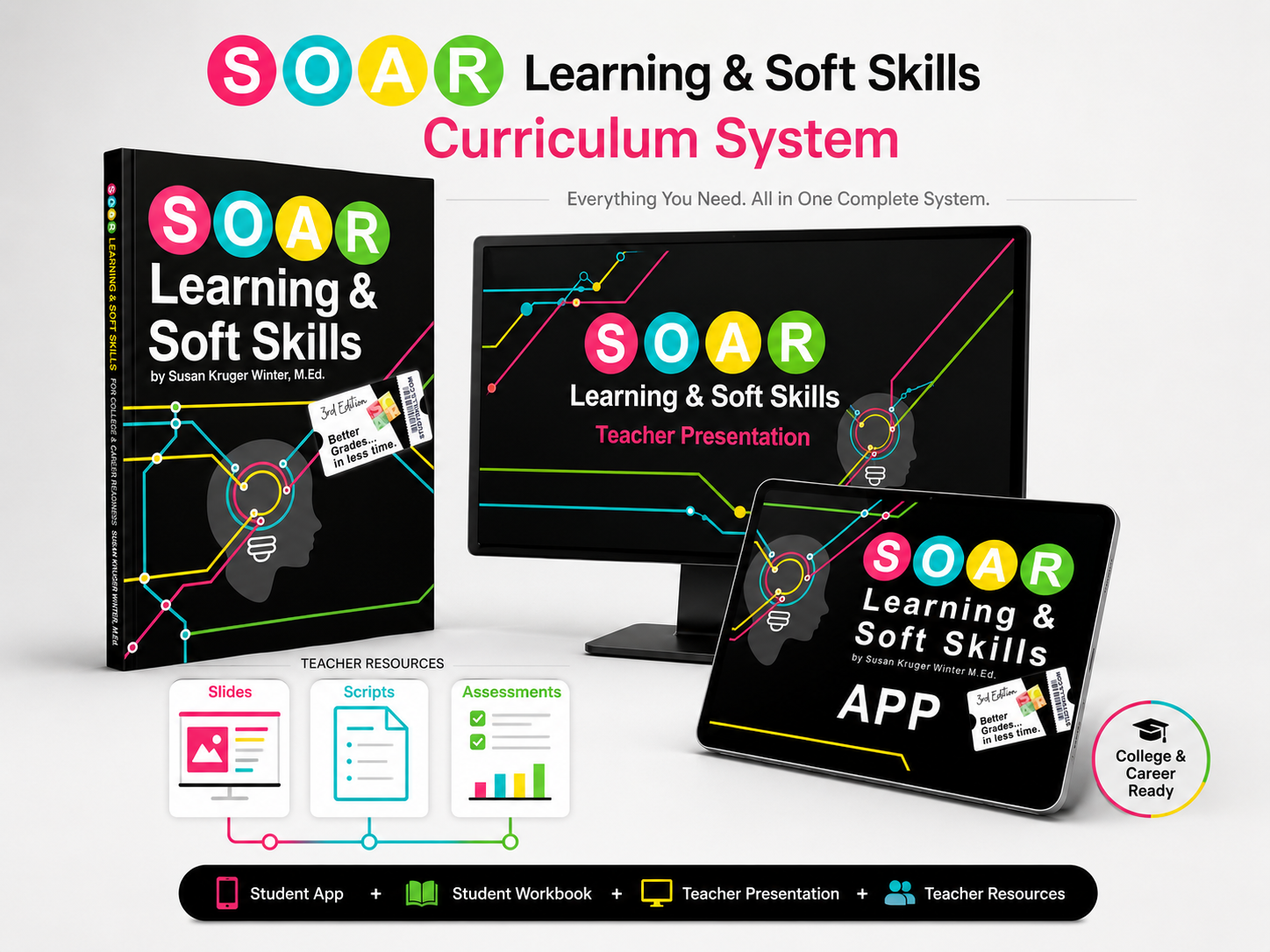
Turn-key enough that a new teacher can learn right alongside students — flexible enough that a veteran can customize it freely.
See it in action
What’s inside?
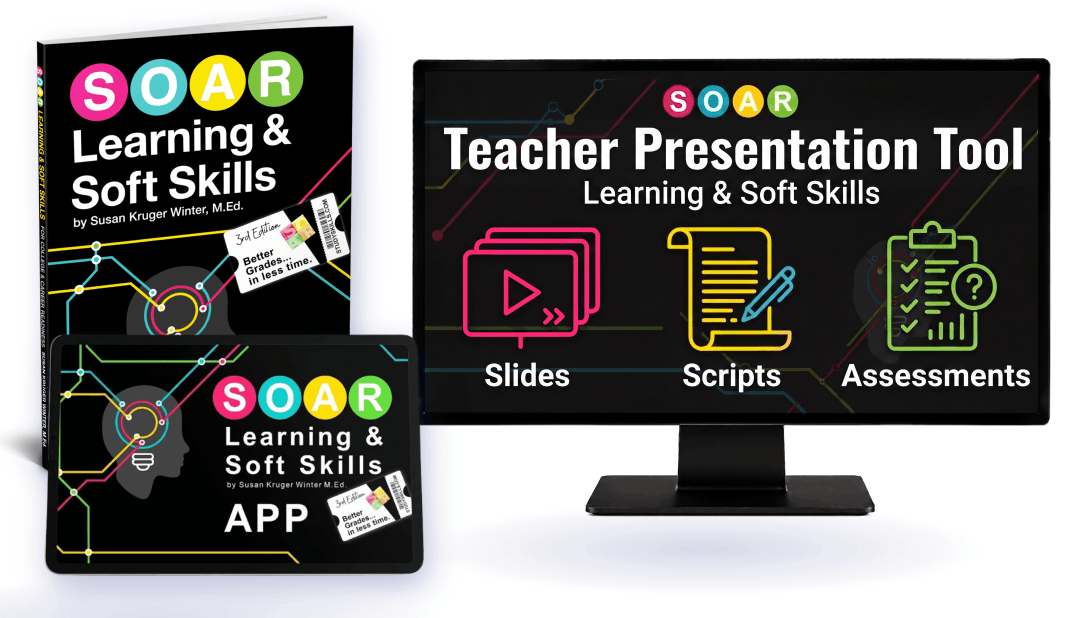
Student materials are modular — book, software, or both. The teacher presentation tool brings it together with slides, scripts, and assessments.
Get My Review CopyThe student workbook PDF is yours immediately — or look inside one live lesson first, no sign-up needed.
Track Record
This isn’t new, and that’s the point.
SOAR has been the best-selling study skills program since its launch in 2007 — now in 5,100+ schools across 53+ countries. It was here long before “executive function” was a common term and long before AI made the stakes obvious. Susan Kruger Winter built it from her own experience as a student who struggled, then spent 25+ years as a certified K–12 learning & ELA specialist proving why the strategies work.

We found the bottom of the pool while the field was still treating the water as bottomless. The frame is finally catching up to the work.
Fitting It In
So how does SOAR fit into your schedule?
It’s the first question every educator asks. The good news: SOAR slots into places you most likely already have.
SOAR works as Tier 1 instruction for every student and scales up to serve all three RTI/MTSS tiers. It’s a natural fit for a freshman seminar or an orientation course — the “how to do school” class many schools already run, finally with real content behind it.
The instruction is built on Self-Regulated Strategy Development (SRSD), the evidence-based model that makes strategy instruction transfer across subjects and hold up over time — not just for the class it was taught in.
SOAR can even earn ELA credit! The reading, writing, note-taking, and comprehension skills listed above aren’t “adjacent” to ELA standards; they’re baked directly into them. The strategies align with Science of Reading instructional principles: systematic, explicit instruction in the skills that make comprehension possible, not just the content it’s applied to. So SOAR can earn credit as core instruction, where the same lessons that build executive function teach students to read closely, write clearly, and reason through what they read. See the full ELA case →
Three resources show exactly how it can fit in your schedule:
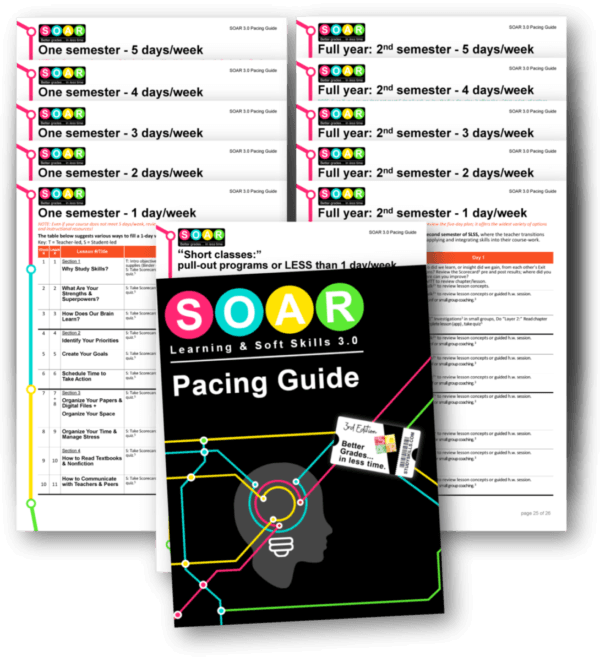
11 sample schedules — from a single-period pull-out to a full-year course.
- Standards alignments — SOAR maps to the standards you already report on, so it reinforces your existing requirements instead of adding to them.
- SOAR as an ELA credit — the full case for counting it as core ELA instruction, earning a place in the schedule rather than competing for one.
- The Pacing Guide — 11 sample schedules, from short pull-out sessions to a full-year course, so “how do I fit it in?” has a concrete answer for your situation.
Good to Know
FAQs
What’s included in the SOAR curriculum?
For students: SOAR comes as a software app, a print workbook, or both. Both cover the same content — the software simply delivers it more dynamically. Many schools use both: the app to introduce and teach each strategy, and the workbook as an ongoing reference students reach for as they apply those strategies in their other classes.
For teachers: the Multi-Media Teacher’s Guide includes the Presentation Tool, prior-knowledge and engagement activities, apply-and-practice activities, writing and discussion prompts, and eight types of assessment — pre/post inventories, quizzes, portfolio development, rubrics, anecdotal observation checklists, a final exam, and an exit presentation. It’s more than any one class could use, by design — options to cover any need.
What grades and subjects is SOAR for?
SOAR works from upper elementary through college. Because the academic tasks students face are the same across subjects, SOAR teaches one set of essential, 80/20 skills that apply everywhere — instead of different study skills for every class. Our Grade-Level Continuum shows which skills to master at which age.
See how SOAR fits with your level:
Solutions by Focus shows how SOAR fits specific needs — RTI, executive function, ELA credit, multi-year pathways, and more.
Do students need devices, or can SOAR be used without technology?
No device required. The workbook and the software app cover the same content — the only difference is the medium. The app delivers SOAR more interactively; the workbook needs no technology at all. So a one-to-one device classroom and a no-tech classroom get exactly the same curriculum.
Does SOAR come with a guarantee?
Yes. SOAR is backed by a 100% money-back satisfaction guarantee for schools that implement it with fidelity. See the guarantee details →
What does SOAR cost?
Pricing is flexible, based on the materials you choose and your number of students, with discounts for larger groups. See pricing options →
How do I get started?
Start with a demo — explore a sample lesson and request a full-access trial — or talk through the details with a SOAR consultant. Get Your Review Copy →
The Result
SOAR makes the invisible, visible.
In the past, the thing that determined whether or not a student would thrive was invisible — to the student, to the teacher, to The System built around them. We couldn’t fix what we couldn’t see.
Students see how their own learning works and start running it on purpose. Teachers see exactly where a student’s system is breaking and exactly how to repair it. And the problem that looked inevitable for so long turns out to have viable, tangible solutions after all.
Something teachable.

Free for Educators
Ready to look inside SOAR?
The student workbook PDF is yours immediately. Add the free 14-day software trial if you want all 18 lessons and the teacher portal.
Get My Review CopyNo credit card, either way.


