
Brain-First Learning for an AI World
EXECUTIVE FUNCTION · FOR EDUCATORS
Executive Function Curriculum
Every subject stands on it. Almost no one teaches it. SOAR® does.
WHERE IT STARTS
You already know these students
You can name them before you reach the end of this sentence. The one who lights up in discussion but never turns the work in. The one whose backpack is a landslide of loose paper. The one who studies for three hours and goes blank the moment the test hits the desk. Different students, different grades, different stories. The same invisible gap underneath all of them.
We’ve been using a word for this gap: executive function. The term shows up in IEP meetings, district initiatives, intervention plans, and professional development sessions because it names something real. Every educator has seen it.
But recognizing a problem and teaching a skill are two different things. When teachers go looking for support, they often find worksheets on one shelf and clinical assessments on the other. What’s missing is the bridge between them: a curriculum that makes executive function visible, teachable, and practical in a classroom.
THE INVISIBLE SKILL
The pattern we can see, but struggle to name
Executive function is unusual because we rarely see the skill itself. We see its absence:
- The missed deadline.
- The lost assignment.
- The student staring at a blank page.
We see the outcomes, but not the mental process that produced them.
That creates a challenge for educators. A skill that remains invisible is difficult to explain, difficult to measure, and even harder to teach systematically.
So executive function instruction often becomes a collection of disconnected strategies: a planner here, a reminder system there, a lesson on organization somewhere in between. Some of those tools help. But without a clear picture of the underlying process, they rarely add up to a coherent curriculum.
That’s not a failure of effort. It’s a visibility problem.
HOW LEARNING WORKS
When the circuit becomes visible, the teaching becomes clear
Executive function is not a fixed trait we are either born with or without. It’s a process the brain runs — and like any process, once we can see how it works, we can see how to teach it.
The Brain Circuit makes this process visible.
A ninety-second look at how the brain wires new learning. See the full Brain Circuit series →
The Learning Circuit shows the difference between learning and memorizing in about ninety seconds…
Memorizing
Facts cycle through short-term memory. The space is limited, so the moment it fills, older information gets dropped. Every student who blanked the day after the test has felt this.
Learning
The brain builds a permanent wire, connecting new information to something the student already understands. It holds, because it is attached to something.
…and executive function is what runs that process. It decides what to connect to. It holds the goal steady while the connection forms. It weighs whether the connection holds. Watch the wire form, and you’re watching the thing executive function governs. So we stop seeing a vague deficit and start seeing a sequence. And a sequence can be taught.
Executive function can be taught effectively. But only when we teach it brain-first — building from how the brain actually runs the process, not from a list of habits we hope students will adopt on their own.
THE LOAD-BEARING LAYER
Executive function isn’t an add-on. It’s the foundation.
Once the process is visible, something else comes into view with it. Executive function isn’t one more subject to bolt onto an already-full day. It’s the layer everything else is already standing on.
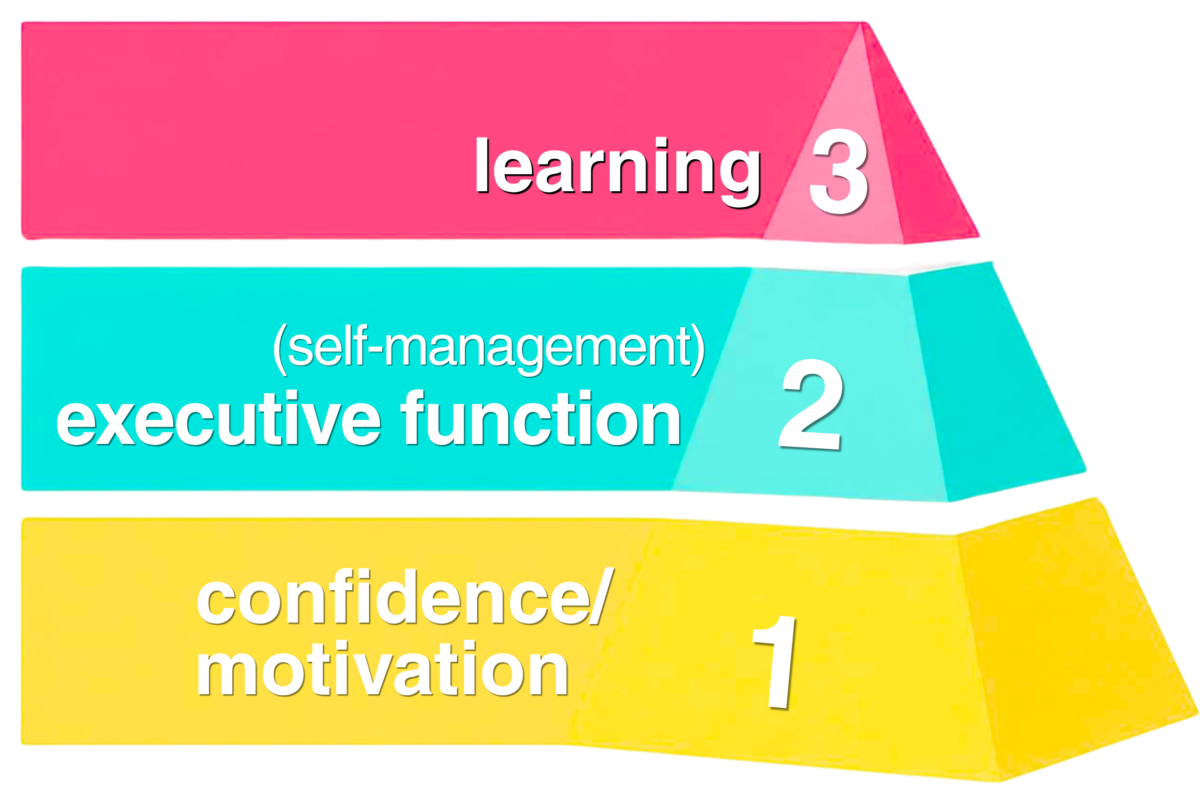
THE LEARNING SUCCESS PYRAMID
Three layers, built bottom-up
Learning sits at the top — but it can only bear weight once confidence and executive function are built beneath it first.
Look at what we ask students to do:
- Read a chapter and hold the thread of context.
- Plan a project that’s due in three weeks.
- Sit with a hard problem without panicking.
- Walk into a test and retrieve what they studied the night before.
…every one of those tasks rests on executive function.
When that foundation was never explicitly taught, everything built on top of it wobbles — and the wobble gets read as:
- a motivation problem, or
- an ability problem, or
- a character problem.
It was never any of those. It was a foundation no one had taught yet.
The Learning Success Pyramid shows us how to fix that foundation: establish confidence at the base, build executive function in the middle… and learning becomes the natural outcome, at the top.
Traditional instruction skips the bottom two layers; it simply throws information — from the top, down — at the third.
SOAR delivers instruction in the right order, to ensure the learning foundation is solid.
See it in action
What’s inside?
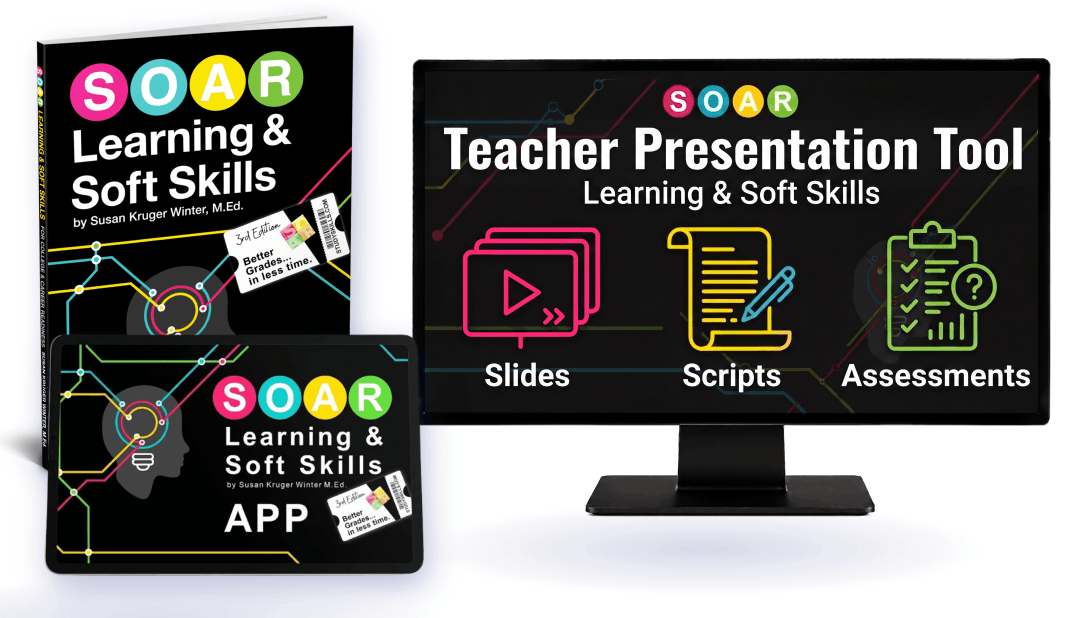
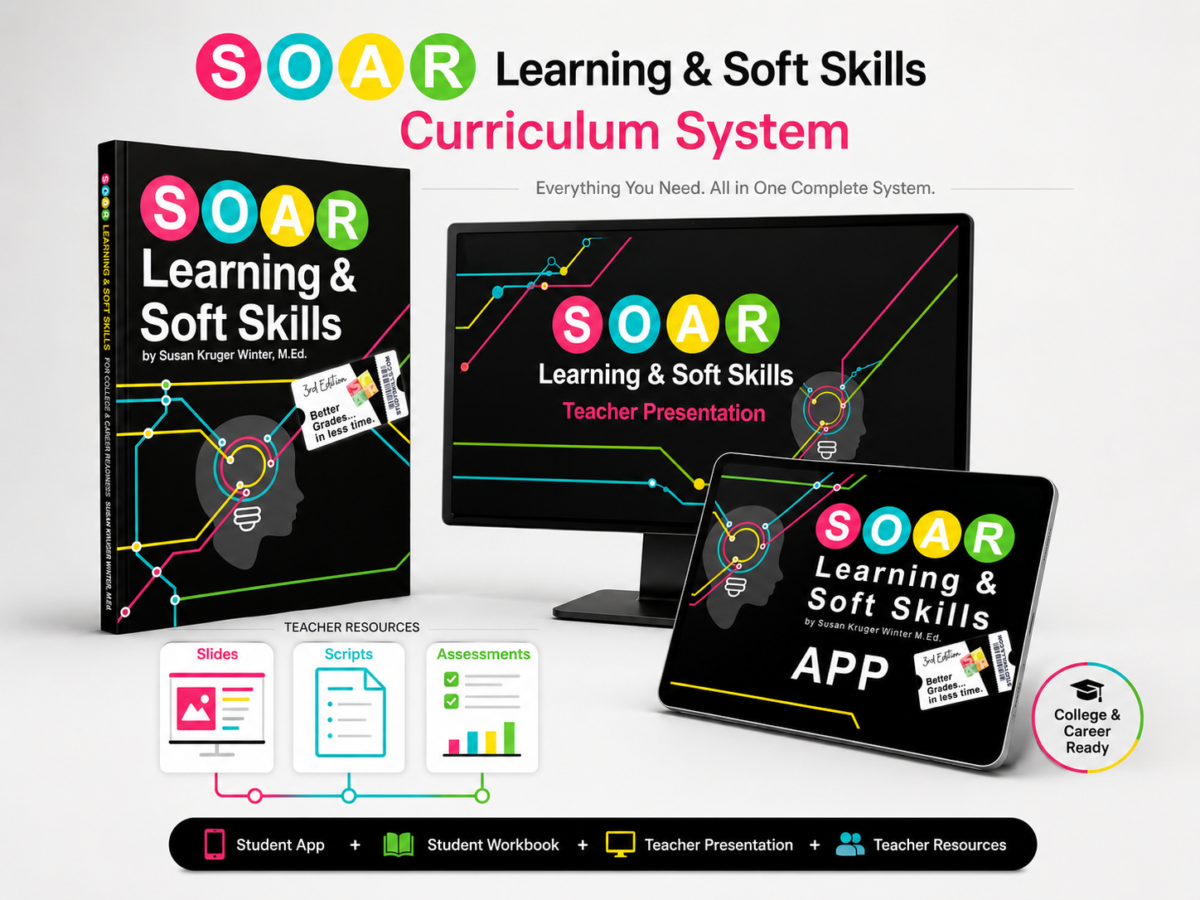
Student materials are modular — book, software, or both. The teacher presentation tool brings it together with slides, scripts, and assessments.
Get My Review CopyThe student workbook PDF is yours immediately — or look inside one live lesson first, no sign-up needed.
INSIDE THE CURRICULUM
What an executive function curriculum actually is
An effective “executive function curriculum” makes the invisible, visible. Using work the students are already expected to do, it delivers efficient, brain-friendly strategies that make learning faster and more effective, such as:
- How to read a textbook in a way that doubles both speed and comprehension
- How to learn the meanings of technical vocabulary, painlessly
- How to organize papers and digital files…so everything gets turned in…
- How to manage time and tasks so those assignments get turned in on time
- …and lots more!
When these strategies align to how the brain is designed to learn, friction is removed. The “pain” of learning vanishes. The joy of learning is unlocked. And students discover capacities they never knew they had!
We accomplish these outcomes by teaching students how their own brains learn. Every strategy in SOAR comes with the reason it works — what it’s doing inside the brain, and why. So students are never following rules they don’t understand.
Instead, they’re learning to operate their own minds on purpose. That’s executive function taught from the inside out. In SOAR, that explicit instruction is delivered across 18 lessons in our Study Skills Curriculum.
The lessons are turn-key, no prep — and they don’t necessarily need a period of their own. The first question we get is almost always the same: where does this fit in a day that is already full? SOAR runs inside the work students are already doing, so schools schedule it as a daily block, a weekly advisory, an intervention group, or a summer bridge.
The Pacing Guide lays those options out side by side. Pick the one that matches the time you actually have.
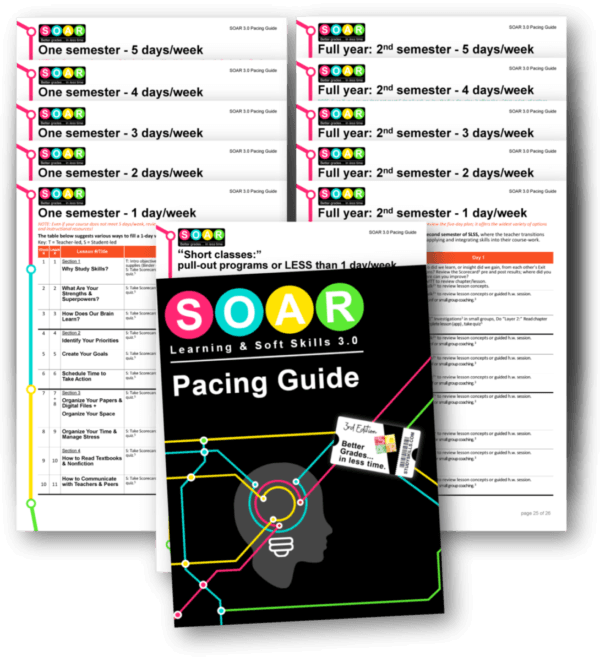
Open the full Pacing Guide (PDF) →
RTI/MTSS
Most tools do one job: a whole-group program, or a targeted intervention, or a specialist’s resource for the most intensive needs.
We built SOAR to do all three:
- Tier 1 — strategic instruction for the whole class
- Tier 2 — targeted support for students who need more
- Tier 3 — resources that hold up at the most intensive level
For a building working to align an entire multi-tiered system without buying, and training on, three separate things, that consolidation is the whole game.
See how SOAR serves all three RTI tiers →
By grade band: 5th–12th and beyond
Executive function skills are the same across grade levels; what changes is the content rigor. For that reason, SOAR scales across age levels:
Find it for your grade band Study Skills & EF for Elementary – 5th Grade Literacy Lab·Middle School·High School·College & Career
SOAR for ELA credit
SOAR covers the ELA standards — and that opens a scheduling door. It is not a substitute for literature and composition. It teaches the reading, note-taking, and writing processes those courses assume students already have. See the ELA-credit fit →
THE CLINICAL VIEW
The three EF domains, covered
Underneath the day-to-day, executive function resolves into three domains. Here’s where we meet each.
- Working memory — we give students external systems that carry the load the brain can’t hold alone: visible tracking, consistent organization, capture habits that keep information from evaporating between classes.
- Cognitive flexibility — students learn adaptable reading and problem-solving strategies, so a hard problem becomes a signal to switch approaches rather than a wall to freeze against.
- Inhibitory control — students build the prioritization and time-structuring habits that let them choose the next right thing in a high-distraction environment.
All three are taught the same way: explicitly. That is the same model behind Self-Regulated Strategy Development (SRSD) — direct instruction in the strategy, modeling, then scaffolded practice until the student runs it alone.
THE BRAIN-BIOLOGY SERIES
The brain biology behind every profile in your building
Executive function is one circuit in a larger picture. SOAR’s free video series, The Brain Biology of Learning, shows how learning, ADHD, autism, learning disabilities, and motivation each work at the level of the brain — the neuroscience most teacher prep never covered. Six short videos. Plain English. The same brain-first foundation, applied across the full range of learners you actually teach.
PROOF & TRACK RECORD
What the evidence shows
These Skills → Roughly One Full Letter Grade1
That finding comes from a meta-analysis of 70 studies — 2,400+ secondary students, across science, social studies, and English. On a 100-point test, that’s about a 20-point improvement — the difference between a 70 (C) and a 90 (A-minus). Same material. Same brains. The difference was being taught how to learn it.
And this isn’t only about students who are struggling. Research on study skills finds they’re foundational to academic competence2 — capable students at every grade level often fall short not because they lack ability, but because no one ever explicitly taught them how to learn. The gap is real even for bright students. It’s just rarely named.
Teaching the process works. That’s the whole premise of an executive-function curriculum.
CREDIBILITY
A proven track record
SOAR did not reverse-engineer itself to match a standards checklist. It was built on how the brain learns — several years before today’s anchor standards existed. Today SOAR covers 100% of the anchor, ELA, and NACE standards. See all of our alignments →

A real, proven curriculum. Not a worksheet pack with a clinical label. See proven results →
Rolling this out across a building or a district? See the executive function curriculum for districts →
THE AI SHIFT
Why this matters more in an AI world
AI can now produce the output — the essay, the summary, the answer. What it can’t do is the work executive function governs:
- deciding what matters
- holding a goal across time
- judging whether the result is any good
AI changes how students access information. It does not change how the brain learns to read and think. So the foundation that was always quietly load-bearing has become the visible differentiator. The goal isn’t to help students compete with AI. It’s to help them think clearly, learn confidently, and use tools wisely…
Because an AI world will reward exactly the skills this curriculum builds.
→ AI is pulling back the curtain to expose what The System has never measured: thinking
Common questions
FAQs
Is executive function the same thing as study skills?
At SOAR, yes. “Study skills” is the older label for the same set of skills: planning, organizing, holding a goal, managing time, deciding what matters. “Executive function” is the term the field uses now, and it is the more accurate one, because it names where the work happens. The skills did not change. The language did.
What training do teachers need before they can teach it?
None, to start. The teacher presentation tool carries the slides, the scripts, and the assessments, so a teacher can open lesson one and teach it. Schools that want their staff further ahead of the material — especially when several teachers are running it at once — can add training and PD.
How is a curriculum different from executive function coaching or an assessment?
An assessment names the gap. Coaching works the gap one student at a time. Neither one teaches the process to a room of thirty. A curriculum does: the same explicit instruction, delivered to every student, in the classes they are already sitting in.
Do students need the software, or can we teach it with the book alone?
Either works. The student materials are modular — book, software, or both — and the teacher presentation tool is the same either way. Schools with one-to-one devices tend to run the software; schools without them run the book. The lessons do not change.
The simple test
Does it make the invisible visible?
A packet of worksheets does not. It assigns more of the same invisible work and hopes the student finds the process on their own.
A curriculum built brain-first does the opposite: it shows students the process their brain is already running, then teaches them to run it on purpose. That’s the whole difference.
When we make the invisible visible, the student who looked unmotivated turns out to have been missing something no one had taught yet. And that, we can teach.

Free for Educators
Ready to look inside SOAR?
The student workbook PDF is yours immediately. Add the free 14-day software trial if you want all 18 lessons and the teacher portal.
Get My Review CopyNo credit card, either way.
More for Educators
Start Here·What Is SOAR?·Why SOAR Works·RTI/MTSS·Solutions by Focus·Training & PD·Pricing & Options
Research Sources
1 Scruggs, Mastropieri, Berkeley & Graetz (2010), Do Special Education Interventions Improve Learning of Secondary Content? A Meta-Analysis, Remedial and Special Education — a synthesis of 70 studies and 2,400+ secondary students across science, social studies, and English. The overall average effect size was 1.00 (a weighted standardized mean difference), described in the source as a large effect across studies — roughly a 20-point improvement on a 100-point test, the difference between a 70 (C) and a 90 (A-minus). One honest caveat: the 1.00 is an average across many different strategy types in special-education research. It is strong evidence that teaching this category of skill works — not a guaranteed result for any single technique or student. ↩
2 Gettinger & Seibert (2002), Contributions of Study Skills to Academic Competence, School Psychology Review. Reviews evidence that study-skills competencies underpin academic achievement across grade levels, including for capable students. ↩


