
Brain-First Learning for an AI World
Why SOAR Works
The Brain Science Behind the Curriculum
The Science of Reading & Learning point to the same mechanism. Learning is not the hard part. Powering the brain to do it — in the right order — is the whole game. The same mechanism applies for all ages.

The Learning Circuit
Years ago, my then seven-year-old son was struggling academically and emotionally — and we couldn’t find the bottom of it. My husband and I are both educators, but we were at a loss. Every professional we turned to seemed to be answering questions we weren’t asking. Out of sheer desperation, I did the only thing left to do: I started learning everything I could about the learning brain and what happens when learning breaks down.
One afternoon, I was explaining some of those insights to my son when he asked me a sharp, stopped-me-in-my-tracks question. Thinking deeply, I glanced upward, searching for the answer — and there they were: a string of party lights, still hanging over the kitchen window from a gathering weeks before.
That string of lights held the answer.
Learning is a circuit! I pointed to the lights and explained: “Your brain is built like this — a long strand of tiny connections, each one passing power to the next. New information connects to something you already understand. Once that connection is made, your brain can send power through it — and the idea lights up.” He got it instantly. So did I — far more than I expected.
I had accidentally discovered a model for learning. The brain is an electrical organ. If you can understand circuits, you can understand how the brain learns — and what to do when the learning circuit is blocked.
By then, my study skills curriculum had been the best-selling program of its kind for over five years. I knew it worked — it had worked for me, and it was already working in schools. What I’d never been able to explain — to myself or to anyone who asked — was why.
The string of party lights unlocked it all.
We don’t learn as differently as we think
Any new program raises the same question: Will this work for all of my students? The ones who struggle — and the ones who are already flying? It’s a fair question, and it comes from a real respect for the fact that our students are not interchangeable. They differ in what they already know, what interests them, their strengths, their backgrounds, their opportunities.
But go one layer beneath the surface — beneath preference and background and interest — and something surprising is waiting there.
We all learn the same way. Every brain runs the same circuit. New information connects to existing information, and the connection lights up. That mechanism doesn’t change from one student to the next. What we call “different kinds of learners” are really different inputs running through one shared system.
Which means the students we describe as “naturally good at school” haven’t escaped anything. They’ve usually just found their own ways to get by — following directions closely, reading the invisible cues most students miss, holding it together well enough that no one looked closer. That’s not a knock on them. It’s survival, and it’s clever. But “getting by” is not the same as truly understanding how to learn.
And no one has these skills by default — not the strugglers, not the high flyers. The ability to manage attention, organize thinking, and steer your own brain through hard material is something students are rarely ever taught. It’s assumed. And what we assume, we never build.
That’s not a student problem. That’s a problem with The System. The System throws content at students without ever powering the brain that’s supposed to receive it.
Make the Invisible, Visible
Picture the string of lights again.
This circuit is the simplest picture of how the brain learns. Every new thing a student encounters is a bulb looking for power. It lights up the moment it connects to something already understood — prior knowledge, a familiar example, a question that bridges the gap.
No connection, no light. The information can be “there” but if it doesn’t get wired in with a connection, it doesn’t get learned. This is why a student can read a chapter three times and retain nothing. The words went in. Nothing connected. The lights stayed dark — not because the student isn’t capable, but because nothing triggered the power to connect the new material to what they already knew.
And it’s why the single most powerful thing a learner can do is ask a question.
A good question is a wire. It reaches out from the new information, to something familiar, and completes the circuit. That’s the moment of learning — not when information is given, but when connection is made.
It’s also precisely what Science of Reading researchers describe when they trace how the brain builds reading comprehension — and what the broader Science of Learning confirms across every subject area: new information connecting to existing knowledge, one circuit at a time. → See how SOAR® applies to ELA and reading instruction
For the curious: this is the actual electrochemistry of it. Neurons fire and connect, and repeated connections become durable pathways. When we say a concept “clicked,” we are describing something physical that happened in the brain. That “click” is real! For everyone else, the lights are enough — new connects to known, the strand lights up, that’s learning.
But it raises the obvious question — the one my son’s whole story turns on. If learning is only connection, why doesn’t it always happen? Why can a student sit in the same lesson, with the same teacher, and stay dark?
Because the lights only work if power is reaching them.
See it in action
What’s inside?
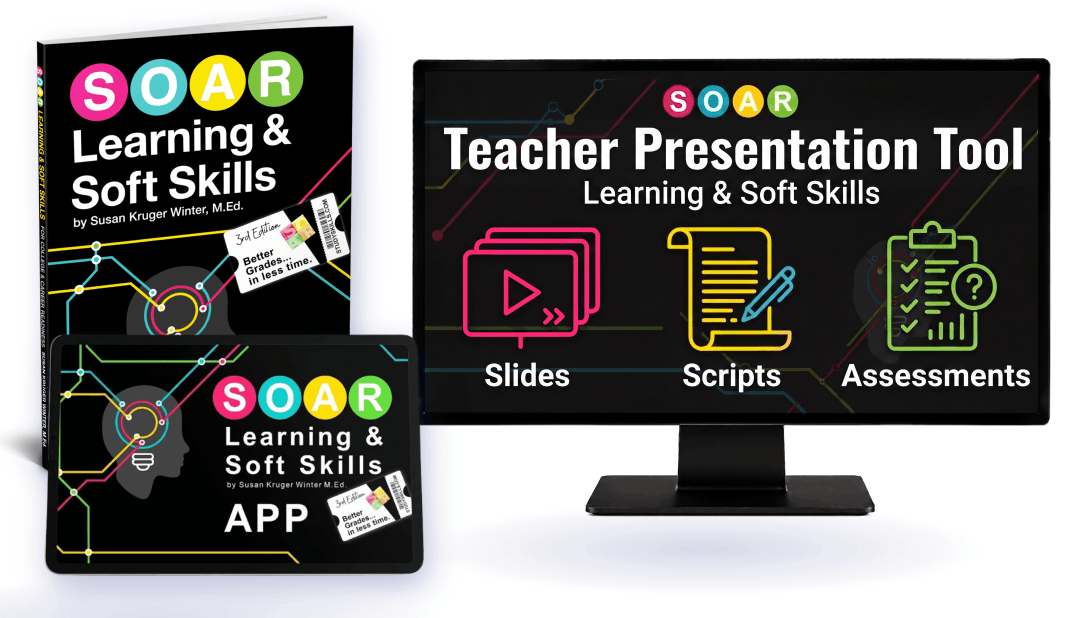
Student materials are modular — book, software, or both. The teacher presentation tool brings it together with slides, scripts, and assessments.
The student workbook PDF is yours immediately — or look inside one live lesson first, no sign-up needed.
The Learning Success Pyramid
THE LEARNING SUCCESS PYRAMID
Three layers, built bottom-up
The order the brain actually requires — and the order The System has always skipped.
Here is what I learned the hard way, watching my own son: a circuit can be perfectly intact and still not light up. The wiring isn’t the problem. The power is.
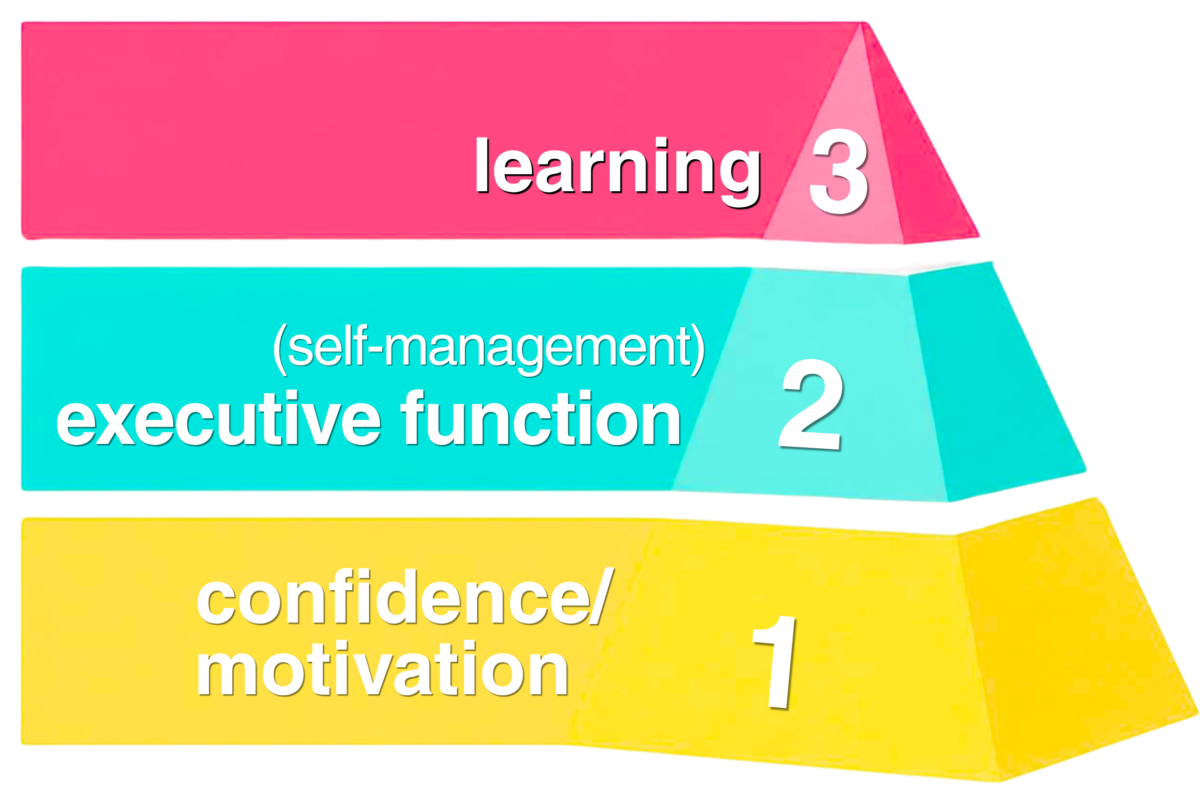
That’s the second half of the picture, and it’s the half the world usually skips. I call it the Learning Success Pyramid, and it has three layers, built from the bottom up.
At the base: emotional safety and confidence. When a student feels unsafe — afraid of being wrong, bracing against another failure — the brain diverts its energy to protection. Fight-or-flight pulls power away from learning, every time. It isn’t a character flaw. It’s biology doing exactly what it’s built to do. And no strategy on earth lands while the power is being spent on survival. We learned this with our son before we learned anything else: until he felt safe, nothing moved. And it took a while, but we eventually uncovered the source(s) of his anxiety at school.
In the middle: executive function. This is the layer most people sense but can’t quite name. If the base layer turns the power on, executive function is what directs it: starting a task, organizing the steps, holding the goal in mind, steering attention to the right connection at the right time. Without it, the current can be live. But if it’s unguided, the lights flicker on and off with no pattern, and eventually fizzle out.
That’s not a student who “won’t.” It’s a circuit with no instruction on how to aim its own power. This curriculum teaches how to generate and channel brain power.
At the top: learning. And here’s the part that surprises people. When the bottom two layers are powered — when a student feels safe, and knows how to direct their own brain power and attention — learning happens automatically. Learning is the passive result of that middle layer... executive function.
This is quite a paradox! We treat learning as the hard part. We pour our energy into the top of the pyramid — more content, more review, more effort. But learning was never the hard part. Powering the circuit, in the right order, is the whole game!
So, why does SOAR work?
SOAR works because it builds the Learning Pyramid in the order the brain actually requires. From the bottom up:
- It establishes safety and confidence first, so the power comes on.
- Next, it teaches executive function as an explicit set of transferable skills, not as something we “hope students absorb.” These skills direct the brain-power that ignites learning.
- Only then does it ask the brain to learn, which is the natural outcome of the first two steps.
Most approaches run the pyramid upside down. They start at the top by throwing content “down” on students, apply pressure, and hope it will “stick.” That’s how The System is engineered and has always worked.
But we all know that approach is “hit or miss.” It’s a “miss” when we add material to a circuit that was never powered to receive it.
It’s a “hit” when the layers underneath learning are powered and directed.
TWO SEQUENCES
Same three parts. Opposite order.
One route starts at the top and fades out. The other builds from the bottom and stays powered.
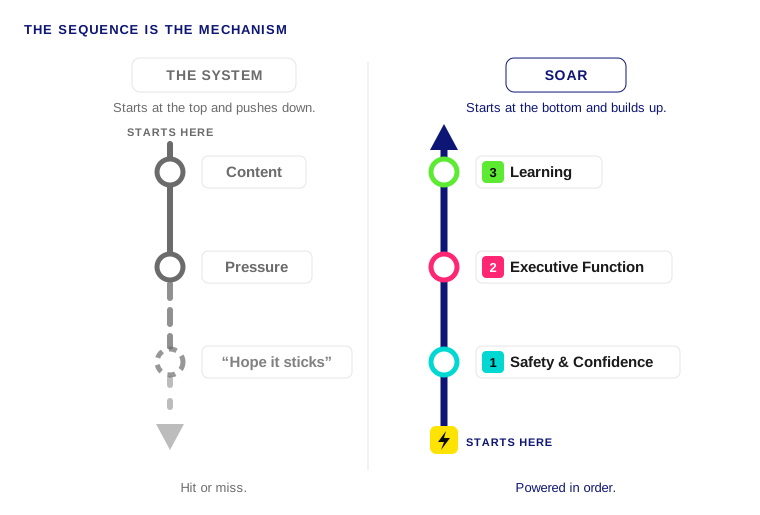
The sequence is the mechanism.
That single idea is what 20+ years and 5,100+ schools have been quietly confirming the whole time — long before I had the lights to explain it.
Meanwhile, our world is rapidly changing...
What AI changes — and what it does not
The Learning Circuit remains the same as always. But if we don’t teach students how to activate it, AI will do the thinking for them. This means that the skills that power learning matter more now, not less.
→ AI is pulling back the curtain to expose what The System has never measured: thinking
Researchers have a name for this approach. Explicit strategy instruction — what the research community calls Self-Regulated Strategy Development, or SRSD — validates the same sequence: teach the strategy explicitly, build the self-regulation layer, then let it carry the content. SOAR was built from the inside out the same way, before most schools had ever heard the acronym.1
The Science of Learning — across reading, math, science, and writing — confirms the same sequence every time. Build the circuit in the right order, and learning follows.2,3,4
What it looks like when the power connects
Not too long ago, my daughter and several of her peers were literally failing chemistry. Her frustration grew until she finally asked me for help. So, I sat down with her... once. One sitting. We did not cram more chemistry.
Instead, I showed her how to connect it — how to direct her attention, how to wire the new material to what she already understood. We powered the circuit, in order.
She took her next test and got an A. From failing to a solid A, all in the span of one test. Her peers begged for her secret, so we invited them over for a “popcorn study party.” (Obviously, the popcorn was simply a novelty that sounded more inviting than a “chemistry study party.”)
I repeated the same process with them... and they all passed their next test with a B+ or better. Later, one of the girls told me — with a look of awe that said something had fundamentally shifted in her soul...
“I thought I was stupid! Now I realize, I just didn’t know how to learn!” Nothing about her capability had changed overnight. What changed was access. No one had ever shown her — or any of them — how to reach it. Once the circuit had power and direction, “chemistry” went from “impossible” to “accessible.”
Every student who has decided they’re “not a math person,” “not a reader,” “not smart” — is sitting in front of an unpowered circuit. The capability is intact. Something simply needs to ignite the power in the right order. That’s what SOAR does.
FAQs
Is executive function the same as study skills?
They describe the same set of skills. “Study skills” is the older classroom label; “executive function” is the term the research community uses for the brain systems underneath — starting a task, organizing the steps, holding a goal in mind, and steering attention where it needs to go.
The distinction matters for one reason: executive function names the layer that powers learning, which is why teaching it explicitly changes outcomes at the top of the pyramid. → See how SOAR teaches executive function
What is the Learning Success Pyramid?
It is a three-layer model illustrating the foundation layers a brain requires before learning can happen. It builds from the bottom up: emotional safety and confidence at the base, executive function in the middle, learning at the top.
The order is the point. When a student feels unsafe, the brain spends its energy on protection rather than learning. When executive function is missing, the power is live but aimless. Build the bottom two layers and the top layer largely takes care of itself.
How does SOAR support the Science of Reading & Learning?
SOAR is aligned to how the brain learns: new information is learned when it connects to something already known. Every SOAR strategy is built to make that connection happen on purpose — and to build it in the sequence the brain requires, emotional safety first, then executive function, then learning.
Students see the mechanism for themselves in SOAR’s free Brain Circuit video series — six short videos on how the brain, learning, ADHD, autism, learning disabilities, and motivation each work at the neuron level. → See how SOAR applies to ELA and reading instruction
What research supports SOAR?
The research base is the wider body of work on explicit strategy instruction. Across 70 studies and 2,400+ students, explicit study skills instruction moved students up roughly one full letter grade — about a 20-point improvement on a 100-point test.1 Later meta-analyses in writing and reading comprehension found effects in the same range.3,4
SOAR itself has been in classrooms for 20+ years and is now used in 5,100+ schools across 53+ countries — two decades of schools confirming the same sequence this page describes. → See the full research behind SOAR’s design, and proven results from schools using SOAR

Free for Educators
Ready to look inside SOAR?
The student workbook PDF is yours immediately. Add the free 14-day software trial if you want all 18 lessons and the teacher portal.
No credit card, either way.
1 Scruggs, T. E., Mastropieri, M. A., Berkeley, S., & Graetz, J. E. (2010). Do special education interventions improve learning of secondary content? A meta-analysis. Remedial and Special Education, 31(6), 437–449. Across 70 studies and 2,400+ students, explicit strategy instruction produced a large average effect (ES ≈ 1.00). ↩
2 Analyzing the Impact of Study Skills on Academic Achievement. (2024). Education and Psychological Research. Study skills accounted for 92.9% of the variance in secondary student academic achievement (Multiple Correlation Coefficient = 0.964, F = 115.50, p < .01). ↩
3 Graham, S., & Perin, D. (2007). A meta-analysis of writing instruction for adolescent students. Journal of Educational Psychology, 99(3), 445–476. Explicit strategy instruction produced an average effect size of 0.82 for writing quality, moving students from the 50th to the 79th percentile. ↩
4 Berkeley, S., Scruggs, T. E., & Mastropieri, M. A. (2010). Reading comprehension instruction for students with learning disabilities, 1995–2006: A meta-analysis. Remedial and Special Education, 31(6), 423–436. Explicit reading comprehension strategy instruction produced effect sizes of 0.94 (visual strategies) and 1.18 (language-based strategies). ↩


