
Brain-First Learning for an AI World
COLLEGE & CAREER
Executive Function & Study Skills for College Students
Students arrive on your campus having survived K–12 without ever being taught how to learn. That gap is systemic, it is invisible, and it is yours to close — because no one else is left.
Where This Began
Nobody taught me how to learn. So I went looking.
I struggled all the way through K–12, quietly convinced I was stupid. I paddled harder than almost anyone around me… but my grades never reflected the effort. So when it came time for college, I wasn’t excited. I was terrified.
Then a voice in my soul said, “There’s got to be a better way…” So I started mining for one. Most of the “skills” and “strategies” I found were useless — too complicated to remember, or so much work they defeated their own purpose.
But a few “hacks” made intuitive, logical sense; they worked with my brain instead of adding to its load. And everything flipped!
I went from mediocre grades in high school to straight As in college. I graduated summa cum laude. And those As were far, far easier than the mediocrity of my K–12 years.
Then came the anger.
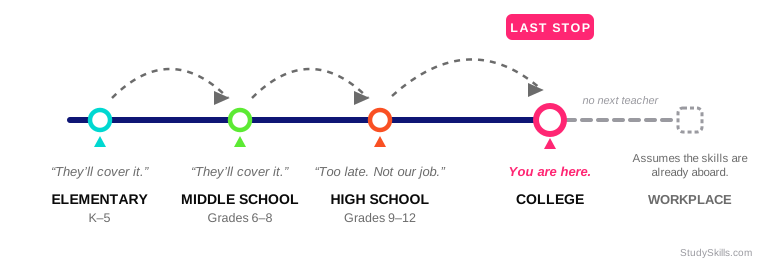
I realized I could have been using these skills since fifth grade. Thirteen years of school, and every teacher assumed someone else had covered it. Elementary passed it to middle school. Middle school passed it to high school. High school passed it to… no one. I had to find these skills myself, by accident, at the very last stop.
That’s not a story about negligent teachers. It’s a story about The System — a system where learning skills are everyone’s assumption and no one’s assignment.
I couldn’t change my own past. But I could change the future for other students. That is the entire reason SOAR® exists — and it has been my work as a learning specialist for twenty-five years since.
The hot potato stops at college. You are the last stop. After you, there is no “next teacher” to pass it to — only a workplace that assumes the skills are already there.
The Paradox
If these skills are so powerful, why isn’t everyone teaching them?
It’s a fair question. It’s the question — and the honest answer is the paradox at the center of this work.
These skills are simple. That is precisely why The System never taught them.
Nothing this foundational ever got a department, a dedicated course, or a teacher whose job it was. Reading has a department. Math has a department. Learning itself — planning, prioritizing, managing time and attention, monitoring your own comprehension — belongs to no one.
So it was taught by no one. You see the result on your campus every day:
- Students who can’t turn a syllabus into a plan
- Students discovering an exam exists the week (sometimes day) it happens
- Many who had IEPs, 504 plans, and structured support all the way through K–12 — and now sit in your office unsure what to ask for, because no one transferred the skills, only the accommodations
They are not unmotivated. They are not lacking intelligence. They are simply operating reactively because no one ever taught them to operate proactively — and no one can survive college in a purely reactive state.
This is the systemic gap. It is invisible on a transcript. It is enormous in a retention report.
The Learning Success Pyramid
The Learning Success Pyramid: the layers The System skipped
THE LEARNING SUCCESS PYRAMID
Confidence → executive function → learning.
Traditionally, The System simply throws content at students from the top down, rather than building a solid learning foundation, from the bottom, up. “Learning” itself, cannot be taught; it’s the natural outcome of executive function skills.
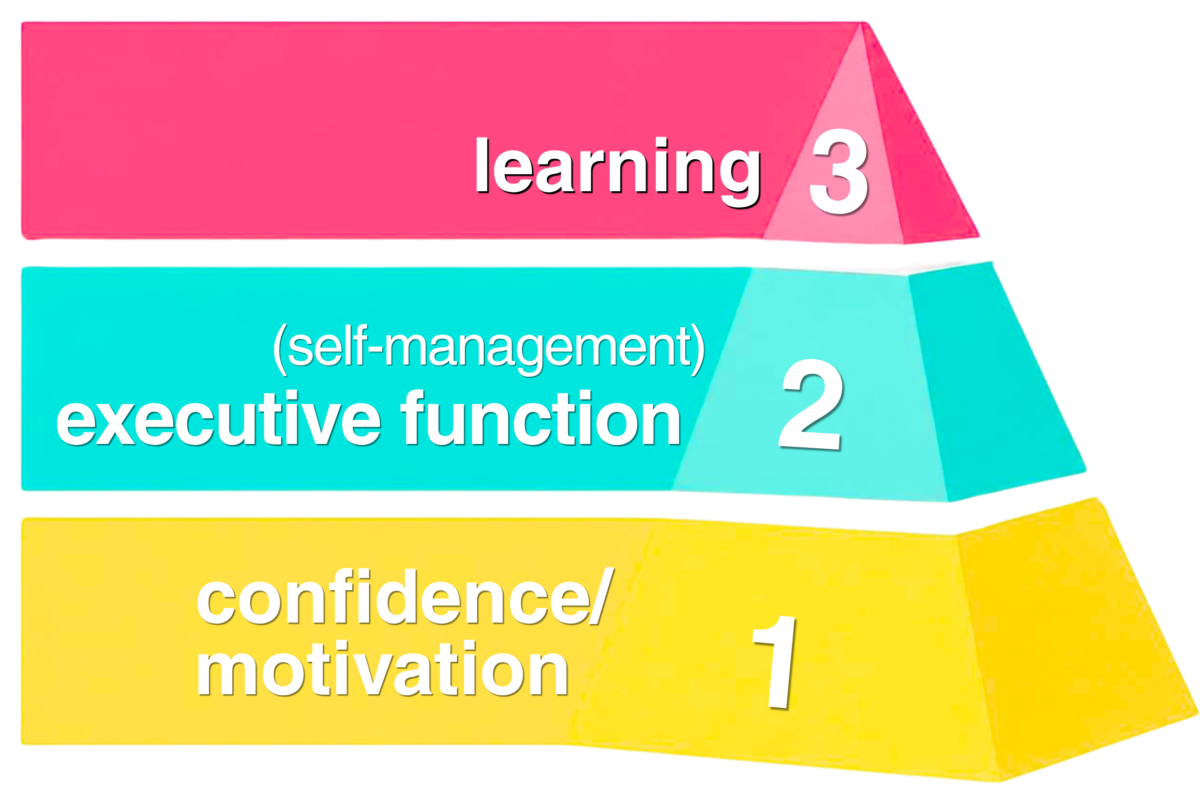
Learning is built in three layers: confidence at the base, executive function in the middle, learning at the top. Traditional education skips the bottom two and throws information at the top — then measures students on how well the information stuck.
For thirteen years, your incoming students were measured at the top of the pyramid while the foundation underneath them was never built. The students who succeeded did so because they intuited the bottom layers on their own, or someone at home supplied them. The students struggling in your office are not missing ability…
They are missing infrastructure. This is why tutoring alone keeps disappointing everyone. Subject tutoring patches the top layer — this week’s chemistry, this paper’s thesis. The leak reseals; the foundation is still missing; the student is back next month with a new subject and the same problem.
When we teach the middle layer — executive function — the whole structure holds: the planning, prioritizing, self-management, and self-monitoring skills that have always been called “study skills.” Confidence rises because competence is real. Learning accelerates because it finally has something to stand on.
We don’t have to rebuild students. We have to finish the foundation The System left incomplete.
See it in action
What’s inside?
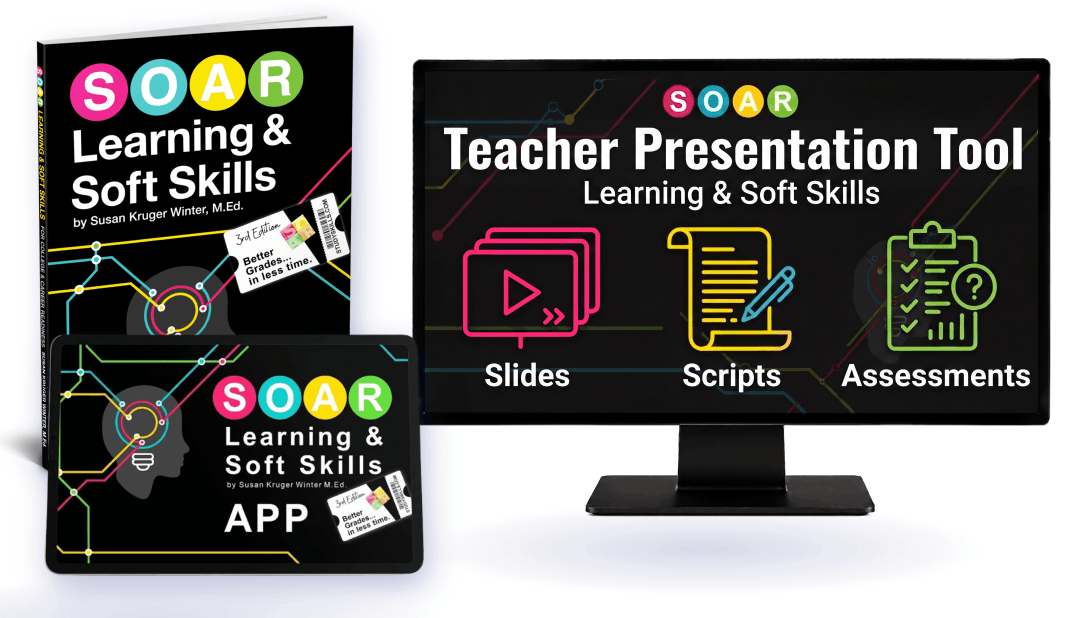
Student materials are modular — book, software, or both. The teacher presentation tool brings it together with slides, scripts, and assessments.
Get My Review CopyThe student workbook PDF is yours immediately — or look inside one live lesson first, no sign-up needed.
The Evidence
This is the most documented — and most overlooked — lever in college retention
The research here is not new, thin, or ambiguous. It is decades deep — and it points one direction…
- A college study-skills course measurably changed who stayed and who graduated. At The Ohio State University, researchers tracked 702 students — 351 who took a for-credit course on learning-and-motivation strategies, matched against 351 who did not — across their first four terms. Struggling students who took the course had graduation rates 50% higher than comparable students who did not. Average-ability course-takers had more than SIX times the odds of being retained across the four terms studied!1 This is independent corroboration from a major research university — not a SOAR study — and it is exactly the mechanism this page describes: teach the skills, and students stop drowning.
- Across 70 studies and 2,400+ students, explicit study skills instruction moved students up roughly one full letter grade.2 The method works at scale, across content areas, and most powerfully when skills are taught explicitly — with guided practice and feedback — rather than assumed.
- The same skills are what employers have been demanding for decades. The SOAR curriculum has 100% alignment to NACE standards3 — communication, problem-solving, self-management, adaptability. The skills that close your retention gap are the same skills that make your graduates employable. One intervention. Both outcomes.
- And it is already working at the postsecondary level — unsolicited. One of the nation’s top pharmacology graduate programs adopted SOAR on its own initiative, knowing the original curriculum was designed for grades 6–12, because the strategies stood on their own merit. Their students demanded it — because for the first time, they were being taught how to learn. (NOTE: That was back when we only had our second edition! Since then, our third edition was built with adult learners squarely in view.)
SOAR is now in use in 5,100+ schools across 53+ countries — 20+ years of school adoption.
A Fair Question
“How will my college students receive this?”
SOAR is not a workbook with cartoon backpacks. Plenty of “study skills” material was written for fourteen-year-olds… and even they find that condescending.
SOAR was built differently, on purpose:
- The writing is professional, yet accessible. Just like newspapers, we aim for middle-school readability levels (short sentences, familiar words).
- Students are addressed as professional peers. That has been the rule across every edition: speak to students as capable adults, regardless of age. A voice that respects a sixth grader doesn’t patronize a twenty-year-old — it often lands even better.
- The content was built to hold up in a workplace. Parents who see these strategies at our live events routinely ask for the program in their workplace! The pharmacology graduate program (referenced above) whose students demanded it… is one of the most elite in the country! The material has been embraced at every level from middle school through graduate school and the workplace.
And underneath all of it: every student, at every age, is fascinated to learn how their own brain works. That is the through-line of SOAR. Not tips. Not tricks. The mechanics of their own mind, made visible and usable. Relevance that deep — to the course they’re taking now, the career ahead of them, and the brain they will use every day of their lives — is what genuine engagement looks like.
Human Skills for an AI World
AI didn’t create the learning gap. It pulled back the curtain on it.
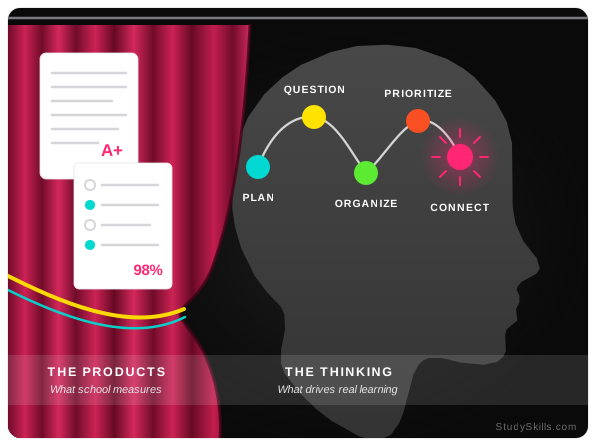
BEHIND THE FINISHED ASSIGNMENT
The output was always standing in for the thinking.
When the output can be generated in seconds, what remains to measure — and to teach — is the thinking that produced it.
Your students are asking whether there will be a job waiting for them. Your institution is asking harder questions than that. Both anxieties trace to the same root.
For decades, education measured outputs — tests, essays, projects — and trusted that outputs reflected learning. AI just ended that arrangement. When a machine can generate the output in seconds, the output no longer proves anything about the student. What’s left to measure, and to teach, is the thing the output was always standing in for: the thinking process itself.
The thinking process is exactly what study skills and executive function instruction has always taught:
- How to plan an approach
- How to evaluate sources — and your own comprehension
- How to direct a tool instead of being replaced by one, because AI generates the output, but a human still has to direct it, judge it, and own it
In an AI world, comprehension matters more — not less. The institutions that thrive in the next decade will be the ones that can demonstrate they build thinkers, not output-producers.
The skills AI can’t replace have topped employer demand lists for decades: communication, judgment, adaptability, learning how to learn, etc. That demand didn’t appear with AI. AI simply made it impossible to ignore.
This is what makes learning skills load-bearing for a college right now. They are far more than student-support garnish. They are the clearest answer your institution has to the relevance question every prospective family is now asking.
Fitting Your Campus
Flexible implementation: built for however support happens on your campus
Some campuses run a dedicated student-success course. Others deliver support through advising, a learning center, or tutoring. SOAR works in both structures — by design:
- Running a dedicated course? Teach the curriculum in sequence and it unfolds as a designed progression — each skill nesting into the next, like Russian dolls, from foundational self-management through advanced learning strategies. A full course arc, ready to deliver, with the structure already engineered.
- Running an advising office, learning center, or tutoring operation? Every lesson is also built to stand alone. A student who can’t manage a syllabus gets the planning lesson — today, in one session, prescriptively. No prerequisites, no “complete modules 1–4 first.” Your staff matches the lesson to the student in front of them.
Each lesson follows the same three-part build:
- An investigation that surfaces what students currently do
- New strategies connected to how the brain actually works
- Applied practice on the student’s own real coursework — not worksheets about hypothetical assignments
Sessions are short, concrete, and immediately usable, which is exactly what limited contact time requires.
And it meets the standards you’re accountable for — alignments, including the NACE career-readiness framework, documented and available on our alignments page.
The Last Stop
The hot potato stops with you
Every institution before yours assumed someone else would (or should) teach students how to learn. Elementary assumed middle school. Middle school was always upset elementary didn’t. High school assumed it was too late, or not their job, or already done.
It wasn’t done. And now those students are on your campus — bright, capable, and operating without the one set of skills everything else depends on.
You are the last educational stop before the workplace; this is the single highest-leverage position in a student’s academic life. The student who learns these skills with you doesn’t get a better semester. They get a different trajectory — through your institution, into a career, across a lifetime of learning that no longer feels like drowning.
I know exactly what that turn feels like. I had to find these skills by accident, at the very last stop. Your students can learn them on purpose.
The gap on your campus is real, but it is not mysterious, and it is not hard to close. The skills are teachable. The method is proven. The students are ready — more ready than anyone gives them credit for.
Start with the single most powerful lesson for college students — free. The demo includes our complete lesson on how to read a textbook — and any nonfiction. Even if you do nothing else today, review that one lesson, and you’ll walk away with something significant to share with your students this week.
We just have to make the invisible, visible!
Common Questions
FAQs
How do you teach college students how to learn?
Through explicit instruction in executive function and study skills: planning, prioritizing, managing time and attention, and monitoring comprehension. SOAR teaches these as short, logical strategies that support each other; students practice them immediately, on their own coursework, not hypothetical worksheets.
Do study skills courses improve college student retention?
In an Ohio State University study of 702 matched students, struggling first-year students who took a for-credit course on learning-and-motivation strategies had graduation rates 50% higher than comparable students who did not, and average-ability course-takers had more than SIX times the odds of being retained across the four terms studied!
Does SOAR align with NACE career-readiness competencies?
SOAR has 100% alignment to NACE standards, including communication, problem-solving, self-management, and adaptability. NACE does not endorse or certify curricula. Details are on our alignments page.
Is SOAR written for college-level students?
Yes. SOAR is written to be professional, yet accessible. Written in first-person, to a peer, its tone is understanding yet encouraging, never patronizing. It has been adopted from middle school through graduate school, including by one of the nation’s top pharmacology graduate programs.
How does SOAR fit an advising office or learning center?
Every SOAR lesson stands alone: staff can match a single lesson to the student in front of them in one session, with no prerequisites. The same curriculum also runs as a sequenced, full-arc student-success course.

Free for educators
Ready to look inside SOAR?
The student workbook PDF is yours immediately. Add the free 14-day software trial if you want all 18 lessons and the teacher portal.
Get My Review CopyNo credit card, either way.
Research Sources
1 Tuckman, B. W., & Kennedy, G. J. (2011). Teaching learning strategies to increase success of first-term college students. The Journal of Experimental Education, 79(4), 478–504. The Ohio State University; 351 course takers matched against 351 non–course takers, tracked across their first four terms, drawn from seven autumn cohorts (Fall 2000–Fall 2006). Independent corroboration of explicit learning-skills instruction; not a study of the SOAR curriculum. ↩
2 Scruggs, T. E., Mastropieri, M. A., Berkeley, S., & Graetz, J. E. (2010). Do special education interventions improve learning of secondary content? A meta-analysis. Remedial and Special Education, 31(6), 437–449. ↩
3 SOAR Curriculum × NACE 2026 crosswalk: 100% alignment to NACE standards. NACE does not endorse or certify curricula. Alignment performed and verified by SOAR Learning. ↩


