
Brain-First Learning for an AI World
SOAR as ELA Credit
The schedule is no problem… SOAR counts as the ELA credit.
The course that builds “AI-proof” literacy and thinking skills… counts as ELA credit.
THE FLIP
The anchor standards define the outcomes of a K–12 education…
…but they’re also executive function skills.
Flip them. Teach them earlier. Make everything easier.
That flip — recognizing the Anchor Standards as teachable skills — answers the question every educator asks next: “How can we fit SOAR® in our schedule?”
SOAR counts as the ELA credit. The thing you thought you'd have to make room for is the thing that fills the room.
No elective sacrificed. No “where do we put this” meeting. An effective Tier 1 curriculum that not only meets core curriculum standards, but makes all of them more accessible.
How It Counts
One course. The whole credit.
SOAR Learning & Soft Skills already teaches all ELA anchor standards. Add our “Book Club Module” to cover literature, and you have a complete, defensible ELA credit.
SOAR teaches the skills underneath every ELA standard while meeting the standards you're accountable for — documented strand by strand. No elective sacrificed to get there.
The Insight That Reorganizes Everything
The anchor standards aren't “content.” They're executive-function skills.
The anchor standards sit at the top of the ELA standards as the outcomes students are meant to reach by 12th-grade graduation: analyze, synthesize, organize ideas, sustain attention through a complex text, plan and revise.
Look closely at those “outcomes” and discover what they actually are — executive function skills! The anchor standards are far more dynamic than “outcomes”; they're the thinking skills underneath all content standards.
This single recognition flips the whole approach… and opportunity! EF skills can be taught explicitly, at any grade, from 5+. And when you teach them head-on instead of hoping they emerge from years of content exposure, every other standard beneath them becomes more accessible. Teach the anchors as skills, and the entire structure they sit atop gets easier to reach.
It's also why one course spans grades 6–12. Across those seven years the standards are essentially the same — what changes isn't the skill, it's the complexity of the material the skill is applied to. Master the skill once, and every escalation in content becomes reachable.
Build the executive-function layer, and learning finally has something to stand on! SOAR teaches those strategies directly — in a brain-friendly way; it's why the course doesn't merely cover the standards, it strengthens the structure they form.
Literacy Research
The Science of Reading points the same direction.
Scarborough’s Reading Rope — one of the most recognized models in the Science of Reading — weaves many separate strands into one strong rope: skilled reading. Word recognition and language comprehension each braid together from smaller skills — decoding, vocabulary, background knowledge, verbal reasoning — and every strand has to hold at once.
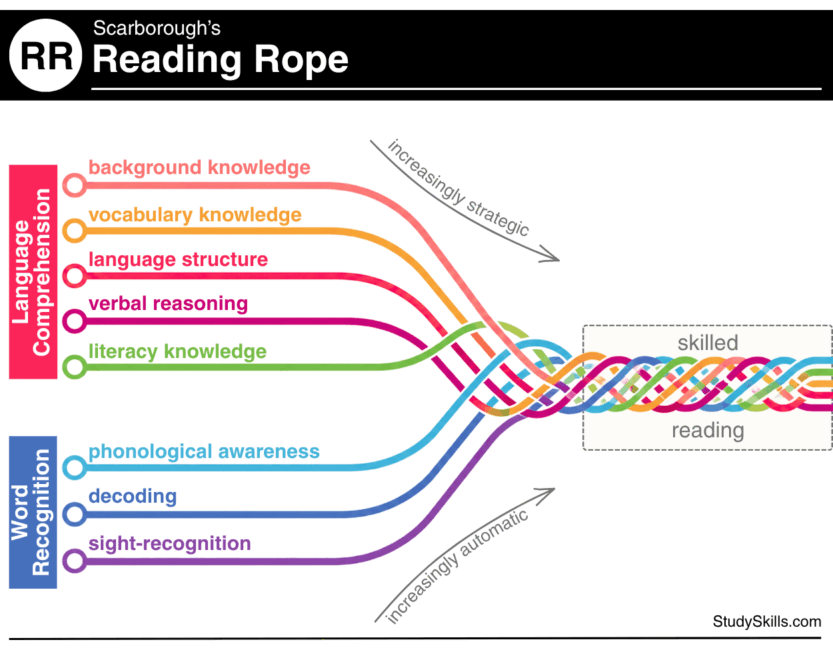
And executive function is what pulls all the strands of the rope together. The harder the text, the more executive function comprehension demands. Teaching those skills explicitly isn’t adjacent to literacy instruction. It is literacy instruction.
Literature Included
Book Club completes the set
Originally, SOAR taught 100% of the anchor standards completely and all ELA standards except the literature standards. Teachers told us they appreciated that SOAR filled many ELA gaps, especially in nonfiction reading.
Then, during the pandemic, Susan ran a homeschool co-op — and built Book Club to meet the literature standards in a way that was genuinely fun… for the students and fun for her, too! With the addition of the Book Club module, SOAR now meets the ELA literature standards as well.
Book Club uses the Fiction Story Map™ — a tool that guides students through any work of fiction: setting, character, point of view, story arc, and analysis. It drops into the texts your department already loves, rather than replacing them.
SOAR + Book Club covers
- Reading for information (nonfiction)
- Literature and literary analysis
- The complete writing process
- Grammar that holds
- The executive-function skills under all of it
How It Fits
You're not replacing literature. You're building the foundation under it.
The anchor standards hold steady across grades/credits 6–12, only the content (rigor) escalates. This means schools can spend one of those ELA credits on SOAR, then return to literature, as usual… now, with students equipped to access it well. Nothing is lost; the remaining years land more deeply!
When is the best time to introduce SOAR as an ELA credit? The earlier, the better. But better late than never…
Best: At Entry
An orientation course
Run incoming students — typically entering 6th or 9th grade, or any mid-year enrollee — through SOAR as their ELA course, so they're equipped to access the content ahead instead of dropped straight into it.
Flexible: A Foundation Block
Front-load the skills
Spend the first stretch of the secondary runway building the skills, then hand students back to your literature sequence. The standards are constant, so the foundation carries forward.
Rescue: Late
A senior seminar
For schools who want to help the students they have now, SOAR works as a college- and career-prep seminar. Earliest is best — but it's never too late to send a graduating class out with the skills.
See it in action
What’s inside?
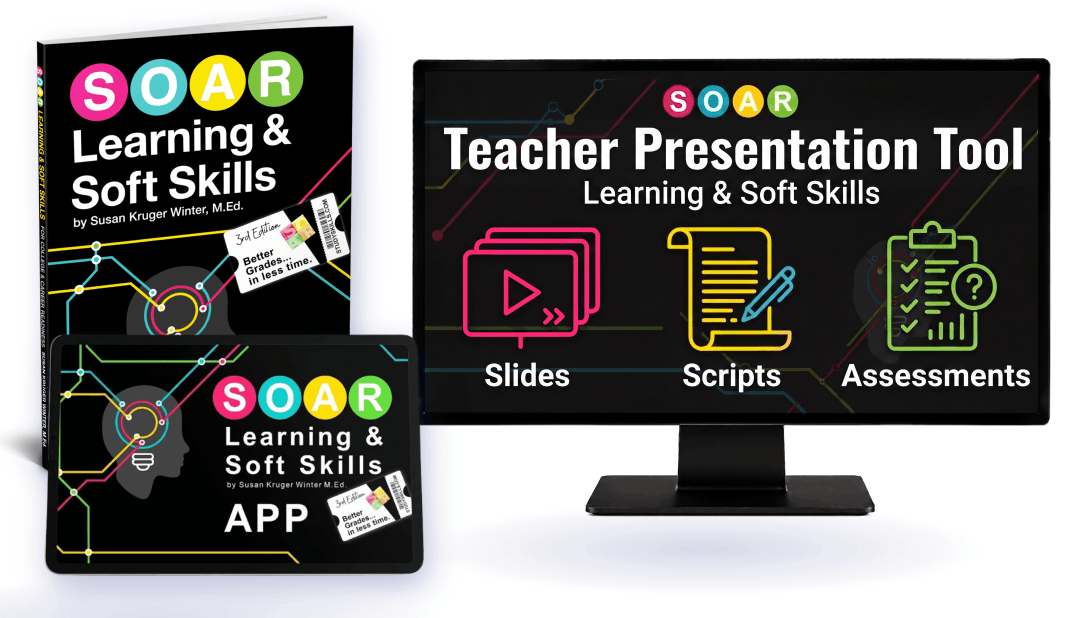
Student materials are modular — book, software, or both. The teacher presentation tool brings it together with slides, scripts, and assessments.
Get My Review CopyThe student workbook PDF is yours immediately — or look inside one live lesson first, no sign-up needed.
Why It's a No-Brainer
An ideal Tier I course for every student
SOAR gives every student the skills to manage school and handle increasingly complex loads. It can be delivered as core instruction for everyone, making it an ideal Tier 1 resource.
With its strong alignment to ELA standards, it easily earns its place as an ELA credit; it does the foundational work the rest of their education will stand on.
And when smaller segments of students need intervention support, SOAR scales up to support Tiers 2 & 3. Students learn one system deeper instead of the cognitive burden of learning more and different programs every time they need to “move up” the pyramid.
Looking for SOAR as a targeted intervention instead? That's its own conversation — explore the RTI/MTSS path.
The Part You Didn't Expect
It doesn't just “fit”. It fills gaps you've been carrying.
SOAR also quietly closes the gaps almost every ELA program carries, the ones tradition built in and The System never fixed:
ELA gaps SOAR closes
- Nonfiction barely taught — most programs spend around 90% of reading instruction on literature, with little explicit instruction in how to read informational text. SOAR balances the two and teaches nonfiction directly — the reading students do most for the rest of their lives — with simple, brain-friendly strategies!
- The literature imbalance — that same skew crowds out the other strands. SOAR teaches across all of them, literature fully included.
- Writing assigned, not taught — ELA programs notoriously give writing assignments without the explicit instruction in how to complete them. SOAR teaches the invisible thinking — planning, organizing, expressing — as one repeatable, AI-free process.
- Grammar that doesn't stick — in place of learning grammar as a list of isolated rules, SOAR teaches it in the context of students' own writing, maximizing the power of “connections” for long-term understanding.
- Speaking & listening treated as an afterthought — SOAR teaches it directly, and the standards themselves carry real social-emotional content: collaboration, communication, and conflict skills. SOAR makes that SEL work explicit — the human capacities no AI substitutes for.
The gaps in nearly all ELA programs are profound! Yet, they are hiding in plain sight and never discussed. We've put the full case, with the research and the standards breakdown, in one place.
What Students Carry
SOAR teaches the strategies. The maps make them transferable.
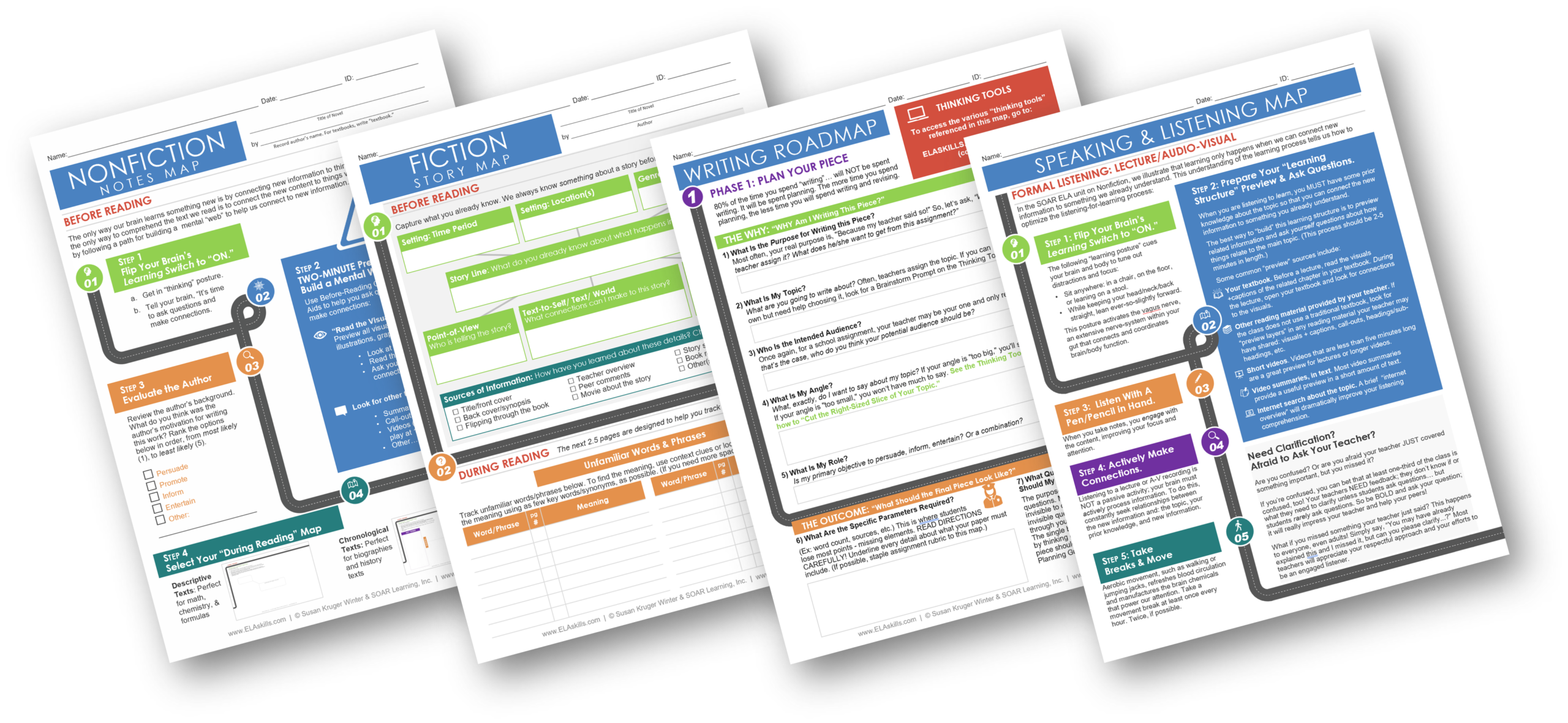
The four ELA Maps™ — one per ELA strand.
At the core, SOAR teaches the thinking strategies underneath every standard. What makes them stick is a small set of reusable ELA Maps™ — one per standards strand — that turn each strategy into something visible and portable:
- Nonfiction Notes Maps™ — reading for information, applied to students' own science, math, and social-studies texts.
- Fiction Story Map™ — the literature work, delivered in the Book Club module.
- Writing Roadmap™ — one six-phase process across argument, expository, and narrative writing.
- Speaking + Listening Map™ — formal communication plus the collaboration skills that make group work actually work.
Learn one map and you've learned the interface for all of them. A student who masters the structure carries it to every text, every genre, every grade… for life!
For the Curriculum Director
The questions you'll ask next
Does it cover all the standards?
Every strand — including literature once Book Club is added. SOAR teaches the skills underneath every ELA standard, with coverage documented strand-by-strand on the alignments page.
How long has SOAR been doing this?
Since 1998 — predating the modern anchor standards by several years. SOAR wasn't built to align to the standards; it was built from decades of practice on the skills students actually need. The standards described the destination; SOAR had already built the road.
What can you guarantee?
Three written outcomes when used with fidelity: a half-point GPA increase, 30% fewer missing assignments, and a measurable confidence gain. The credit is defensible on outcomes, not coverage alone. See the SOAR guarantee →
Independent Corroboration
And outside research backs this approach…
Two findings worth forwarding:
Writing quality moved from the 50th percentile to the 79th1, according to a meta-analysis of writing instruction for adolescent students, when teachers explicitly taught students how to plan, draft, and revise — instead of just assigning writing tasks. The most effective approaches in that research family — including Self-Regulated Strategy Development (SRSD) — pair explicit strategy instruction with modeling and scaffolded practice, which is precisely how SOAR’s writing instruction is built.
Reading comprehension jumped 18–24 percentile points for students with learning disabilities—a population whose outcomes are notoriously difficult to move—when interventions included explicit strategy instruction, according to a separate meta-analysis of reading comprehension interventions.2
Neither study evaluates SOAR. Both describe what explicit strategy instruction — the approach SOAR is built around — reliably does for writing and reading. They're checkable, by anyone, against peer-reviewed sources outside this site.
In the Classroom
What does SOAR ask of teachers?
SOAR was built to make a teacher's job more coherent, not heavier:
No teacher training required — and none assumed
Most teachers absorbed these skills automatically — so naturally they've never had to articulate them. Likewise, The System does not provide explicit training in how to teach them.
For this reason, SOAR was built in a way that allows teachers to comfortably learn the strategies along with students. They can project a lesson and run it right alongside their students — flip the switch and go. More prep is welcome; none is required.
Most teachers immediately recognize the logic and efficiency of SOAR's approach; they resonate with the rationale and say the strategies feel “intuitive.” For this reason, once the principles are visible, teachers are quickly enabled to layer in their own insight and expertise on top of them.
SOAR is flexible to be delivered in any format: whole-class or student-led, traditional or flipped, in person or remote — it fits the way they already teach. SOAR training and professional development is advised when implementing with 2 or more teachers, primarily to coordinate staff in launching from “the same page.”
Does the program have to be taught in order?
When SOAR carries the ELA credit, it follows a specific sequence so coverage is complete and defensible — the strands build in order, and the portfolio documents mastery standard-by-standard.
When SOAR is fitting into whatever time is available — an advisory block, a support period, a summer bridge — the lessons can stand alone and be taught in any order. So, you flex freely and prioritize what your students need most.
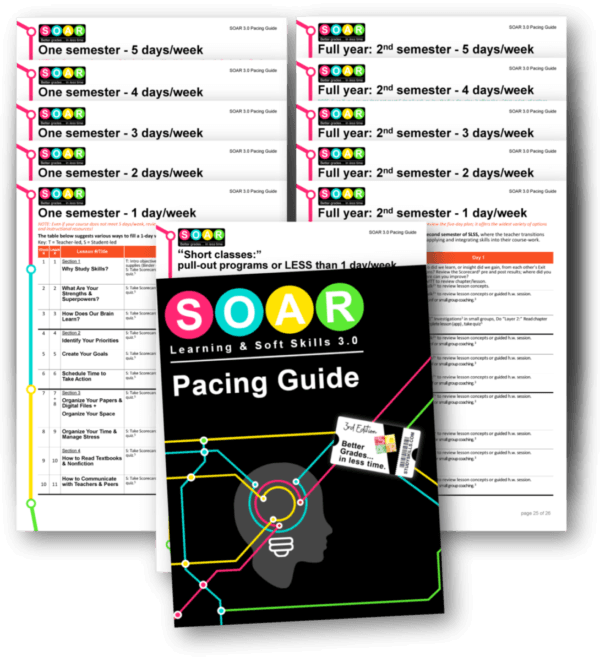
See the SOAR Pacing Guide → Jump to the end of the document for scheduling and pacing insights specific to SOAR as an ELA credit.
The Standards Alignments
The alignments are documented standard-by-standard. On the alignments page, SOAR shows what it teaches — not merely what it "aligns to." That distinction is the whole game for a credit-bearing course.
For an AI World
Students walk away with lifelong skills.
AI can now write the essay, summarize the chapter, and answer the question. What it can’t do is be the mind that knows whether the answer is any good.
The students who thrive in an AI world will be the ones who can think clearly, read for what matters, organize an idea, judge their own work… and the output of AI.
SOAR builds exactly the skills of cognitive discernment no AI can do… and they transfer to every subject, every year, and every job that doesn’t exist yet. That’s the real reason to bring SOAR in.
The ELA credit makes it easy. The long-term skills are what make it matter.
SOAR protects the brain that reads, writes, and thinks — in a world where AI makes it dangerously easy not to.

Free for Educators
Ready to look inside SOAR?
The student workbook PDF is yours immediately. Add the free 14-day software trial if you want all 18 lessons and the teacher portal.
Get My Review CopyNo credit card, either way.
Research Sources
1 Graham, S., & Perin, D. (2007). A meta-analysis of writing instruction for adolescent students. Journal of Educational Psychology, 99(3), 445–476. Reported effect size 0.82 for explicit strategy instruction on writing quality; plain-language translation: a move from the 50th to roughly the 79th percentile. ↩
2 Berkeley, S., Scruggs, T. E., & Mastropieri, M. A. (2010). Reading comprehension instruction for students with learning disabilities, 1995–2006: A meta-analysis. Remedial and Special Education, 31(6), 423–436. Reported effect sizes 0.94 for visually dependent strategies and 1.18 for auditory/language-dependent strategies; plain-language translation: an 18- to 24-percentile-point jump for students with learning disabilities. ↩


