
Brain-First Learning for an AI World
FOR EDUCATORS: EXECUTIVE FUNCTION IN AN AI WORLD
Executive Function Skills in the Age of AI: Future-Proofing Student Critical Thinking
AI didn’t break education. It pulled back the curtain on what’s really behind the finished assignment: the executive function skills that reveal whether a student is actually thinking — or just complying.
Administrators are losing sleep. Teachers are reconsidering their craft. Parents are asking questions nobody has good answers to yet. The instinct is to blame the tool.
But AI didn’t create this moment. It exposed it. For decades, schools have measured the visible product — the essay submitted, the project finished, the test passed.
There was no practical way to tell if a student was genuinely thinking or simply complying. We never questioned there might be a difference.
AI changed that.
EXECUTIVE FUNCTION IN AN AI WORLD
What’s Really Behind the Finished Assignment
Grades measure the product. Learning happens in the circuit behind it.
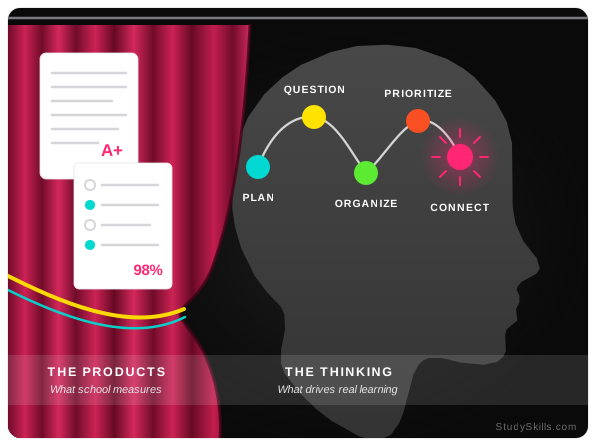
When a tool can generate the product in seconds, the product is no longer evidence that learning occurred. The curtain has been pulled back — exposing the skills that were always supposed to be driving the work, but rarely were:
- Planning before starting
- Asking questions when something doesn’t make sense
- Organizing information so it can be retrieved later
- Prioritizing what matters and filtering what doesn’t
- Monitoring their own understanding in real time
- Connecting new information to what they already know
These are Executive Function skills — the difference between completing work and managing thinking. And for most students, including many high-achieving ones, when these skills surface at all, it’s by accident — not intent.
That’s not an AI problem. It’s an EF problem. And it’s solvable.
The Foundation
What are executive function skills?
Executive function skills are those that allow you to plan, evaluate, decide, and organize. They are anything a mother might “nag” about… plus the ability to filter incoming information and decide how to respond to it. Executive function is run by our front brain. When we encounter new information from a textbook, conversation, AI output, or more…
It’s our front brain that decides:
- Is this relevant?
- Where does this fit with what I already know?
- What do I do with this?
Without that decision-making layer, information flows through. It doesn’t stick.
Students with strong executive function automatically:
- Plan their approach before they start
- Organize information for later recall
- Notice when something doesn’t make sense
- Manage their attention — deciding what to focus on and what to ignore
Students without it? They’re overwhelmed by the sheer volume of choices! Instead of asking, “Do I start here or there?” or “What do I do first?” they shut down — through avoidance, procrastination, or outsourcing their thinking entirely to a tool that will do it for them.
Executive function skills power the Learning Circuit
The Learning Circuit video, below, shows how learning works at the neuron level…
WATCH · THE BRAIN CIRCUIT SERIES
The Learning Circuit
Learning is different from memorizing. Memorizing is temporary; it’s the brain holding information in short-term memory, then letting it fade to make room for newer details. Learning is permanent; it’s the brain connecting new information —via neuron wires— to something it already understands. Executive function powers that connection.
Executive function powers the learning process — it’s the front brain deciding what to connect new information to and directing power to the correlating neuron wires. Watch the Learning Circuit, and you’re watching what executive function governs.
Executive function skills in an AI world
AI will happily take over our front-brain work. It will organize for us. Plan for us. Decide what matters. But every time it does, it bypasses the exact neural pathway that builds understanding — the connection between new information and what we already know.
And like any pathway in the brain, the less we use it, the weaker it gets. If we’re not learning, we’re consuming.
Here’s the good news: When students understand why they’re learning something and have the executive function skills to manage the work, shortcuts become unnecessary:
- The work has meaning.
- They have the tools.
- They engage.
See it in action
What’s inside?
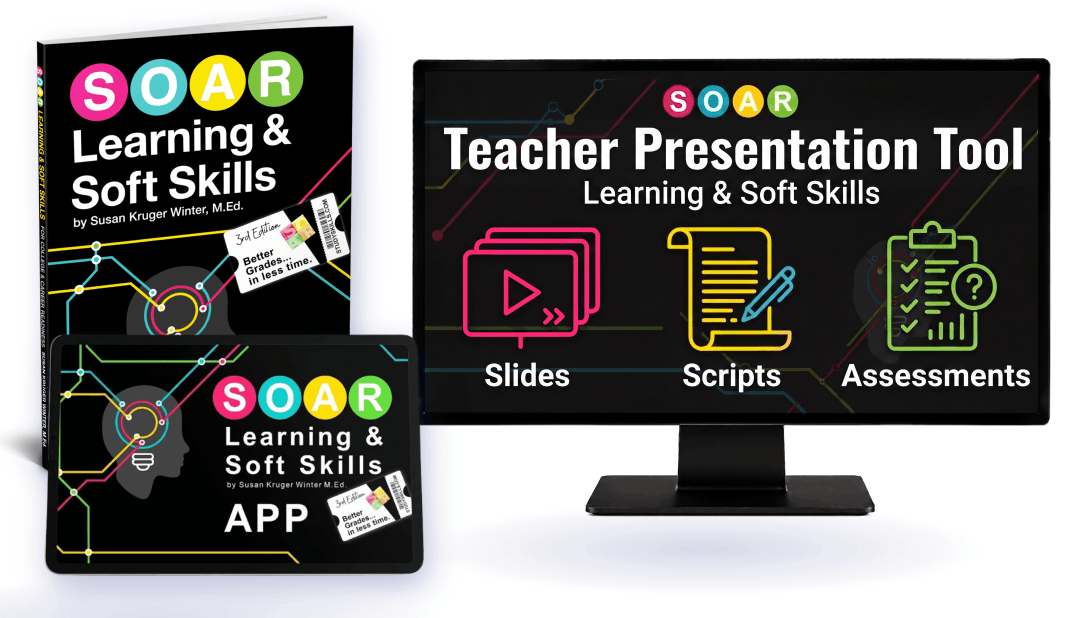
Student materials are modular — book, software, or both. The teacher presentation tool brings it together with slides, scripts, and assessments.
Get My Review CopyThe student workbook PDF is yours immediately — or look inside one live lesson first, no sign-up needed.
The Problem
The hidden threat of cognitive offloading in education
Cognitive offloading is not a modern problem.3 It’s what happens when two things collide:
- ✓ The work lacks an obvious purpose.
- ✓ The brain has no tools to access the information or task.
When the product is all that’s measured, producing it is all that matters. So students do what is rational and take the shortest path to “get it done.” (As adults, we do the same thing.) When AI makes that path free and instant, they take it. It’s not laziness. It’s efficiency in service of survival.
But when we don’t use our brains to think, our brains lose the ability to think. This isn’t metaphor; it’s neurology. Every time we work through a problem, organize information, or manage a decision, we’re building neural pathways that make thinking easier, faster, and more automatic. Offloading interrupts that construction — and every skipped rep leaves the student more dependent on the shortcut.
Executive function skills interrupt this cycle — with strategies for accessing information and directing their own thinking, the overwhelming assignment becomes approachable. Students stay in the arena long enough to build the capacity that makes the next challenge easier. Relevance amplifies this further (we’ll address it later in this page). But relevance is the next layer, not the prerequisite.
The Shift
The Universal Thinking Process
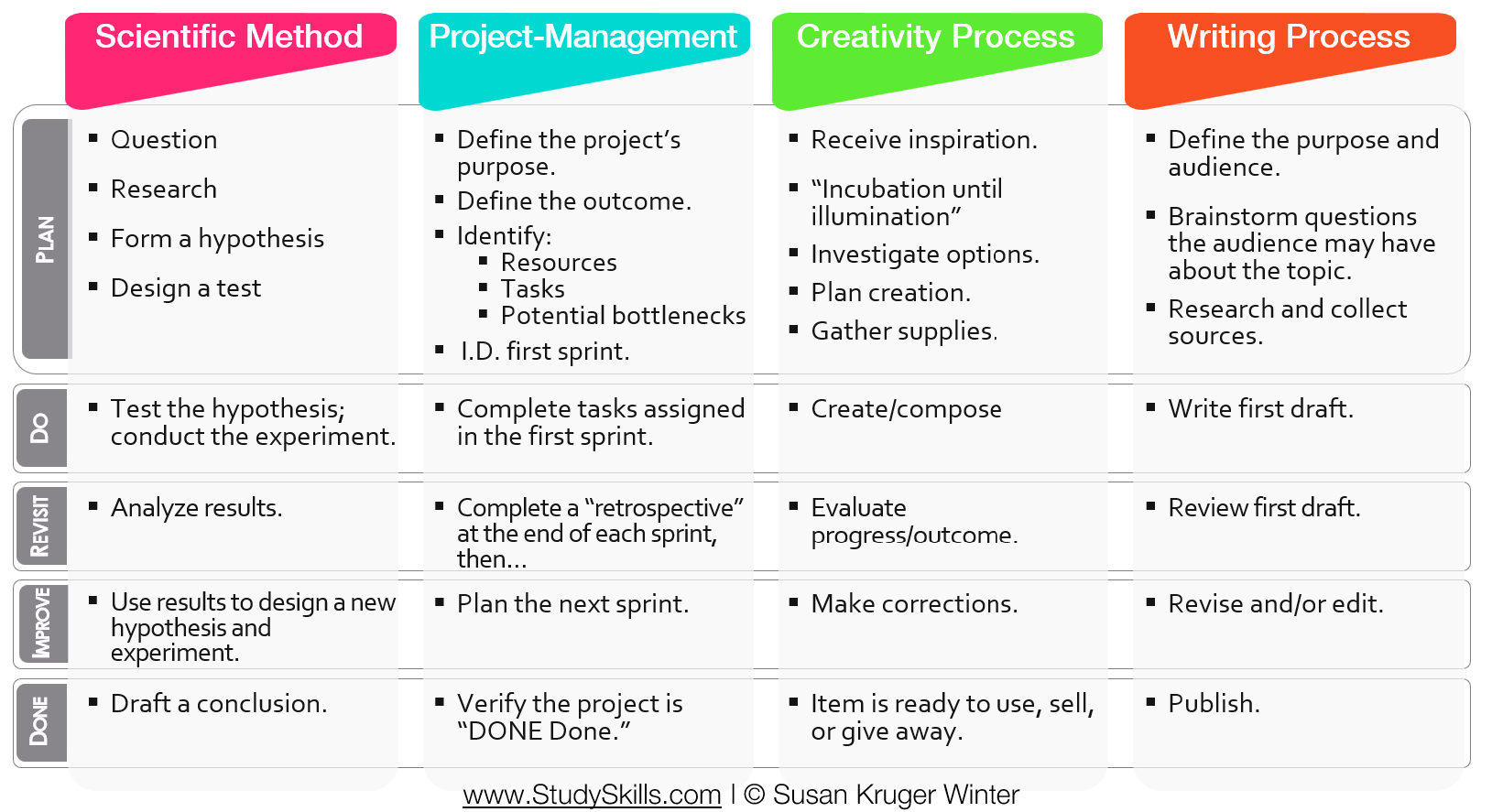
Executive function manages and powers the universal thinking process. Have you ever noticed that all of the “well-known” thinking models are essentially the same process, dressed in different words? For example:
- Scientific Method
- Project-Management
- Creativity Process
- Writing Process
…all share the same cognitive evolution. So when my students — and even my own teens — ask me, “Why do I need to learn how to write when I can have AI do it?” — I introduce the following:
CLASSROOM ACTIVITY
Card Sort: The Universal Thinking Process
As a card sort, I cut this matrix apart and challenge students to sort the pieces into the right columns — they soon realize that “learning to write” is about far more than “just writing.” It’s learning how to think!
The Response
Moving beyond banning: teaching AI as a thinking partner
For years, schools have attempted to: ban calculators, block websites, confiscate phones. Each time, the technology found a way through. Each time, the ban drove the problem underground.
And each time, schools missed the real opportunity: guiding students to use the tool intentionally and constructively.
The answer isn’t prohibition. It’s instruction.
Whatever the task — essay, experiment, project — the cognitive steps are identical: the Universal Thinking Process at work. The tool changes. The underlying thinking doesn’t.
Executive function is what determines whether AI becomes a thinking partner or a replacement for thinking. For example:
- Working memory keeps the goal in mind while the student evaluates AI output — does this match what I’m trying to say?
- Task initiation drives the student to engage with the material rather than hand it off entirely
- Prioritization lets the student decide which parts of the AI response are useful and which should be discarded
With EF skills: thinking partner
AI becomes a tool for clarifying and organizing their own thinking — the student stays in the driver’s seat.
Without them: replacement for thinking
Students default to passivity: the AI does the thinking, the student watches, and the neural pathways never fire.
Teach students how to think — give them the executive function tools to manage the Universal Thinking Process — and the shortcut becomes irrelevant.
Not banned. Simply not needed.
Every Learner
Supporting neurodiverse students & ADHD in an AI-driven classroom
AI is a tool. For any student, it can be a shortcut or a scaffold.
The neurodivergent student doesn’t need different thinking skills than anyone else. They simply need to understand how their brain works so they can build intentional detours around challenges.
All brains have strengths and weaknesses — a neurodivergent brain just makes that reality more visible: ADHD might mean weaker sustained attention but stronger creative problem-solving. Autism might mean processing language differently but seeing patterns others miss. A learning disability might block one pathway to information while another sits wide open.
Executive function skills are the great equalizer. They give every student the tools to build those detours intentionally — and turn AI from a shortcut around thinking into a genuine thinking partner.
Here’s how this plays out: A student with executive dysfunction finds a multi-step writing process overwhelming — but they have something they want to say. They use AI to clarify and organize that thinking while evaluating every suggestion: Does this match what I’m trying to say? A student with ADHD uses AI to gather information while they decide what matters, what connects, what the argument is. Both are building detours around the obstacle — not replacing their thinking.
The key word is intentional. Students have to understand their brain, know their strengths, and actively choose how to use the tool. That’s not learned by accident. It’s learned through instruction that names how the brain actually works — which is exactly what the Brain Circuit series does.
The brain biology of learning
The free SOAR® Brain Circuit video series shows how learning, ADHD, autism, learning disabilities, and motivation each work at the neuron level and how executive function skills build detours around challenges. The Learning Circuit model is neuroscience most teacher prep never covered. Six short videos. Plain English.
Or jump to a single video:
No email required · Watch in any order
The Method
SRSD: the bridge between EF and relevance
The skills AI exposed can be built intentionally. But that means teaching them the right way, not handing students a list of habits and hoping they adopt them.
Self-Regulated Strategy Development (SRSD) is the evidence-based instructional model that makes EF instruction effective, for transferable, life-long impact. Backed by decades of research12 and validated across grade levels, subject areas, and learner profiles.
The core principle: students don’t just learn what to do. They learn why it works, how it connects to their goals, and when to use it.
That distinction matters more than it sounds. A student who memorizes a note-taking format will forget it before they can use it. A student who understands why their brain needs an external organizational system will connect the process to the problem, establishing both the motivation and long-term recall to use it.
SRSD moves through six phases:
- Develop background knowledge — explore the relevant, real-life contexts where these skills — or lack of them — surface. Make the invisible problems that executive function can solve, visible.
- Discuss it — discuss why the problems matter, examine potential solutions, and explain why they work. This is where we begin making thinking “visible and sharable.”
- Model it — provide explicit instruction and examples of how to execute the strategies. Ensure “invisible” thinking is made visible.
- Memorize it — students internalize the steps so they’re available without cognitive load. (One differentiator where EF skills strengthen SRSD: when steps connect to prior knowledge, students don’t have to memorize — they intuitively follow the logical progression.)
- Support it — students practice applying strategies with scaffolding, getting feedback as they build fluency.
- Independent performance — students use the strategy on their own, adapting it as needed.
Together, these six phases do something traditional instruction rarely accomplishes: they build strategies students actually own.
The skills transfer across subjects and hold up when the work gets harder! That’s the EF foundation — deliverable within a semester.
Relevance is the next layer; it amplifies everything executive function enables.
The Architecture
What “relevant instruction” actually looks like
In a standard classroom, most students face three barriers at once:
- The reading level of most materials runs two or more grade levels above where they are — driven by the technical vocabulary density of nonfiction content
- They’re learning about something they don’t know much about — low background knowledge makes comprehension exponentially harder
- They’re learning about something they don’t care much about — the relevance gap
A handful of clear executive function tools can knock down the first two blockers. In most cases, that’s enough to dissolve the third — because once a student has the tools to access the material and build genuine understanding, engagement follows. The caring problem is often a competence problem in disguise.
But for optimal learning outcomes, we must bridge the relevance gap! While executive function skills can be dropped into an advisory period or semester course and applied across all current subjects, “relevance” requires a cultural shift in how a classroom, building, or district approaches instruction. This shift takes time… and not all mindsets will make the shift.
So what does that shift actually look like?
Self-regulated learning in action: the Learning Matrix
The clearest picture of the intersection of “executive function” and “relevance” that I can share comes from my own classroom…
We shifted our focus away from outcomes and turned our attention toward inquiry with a standards-based matrix system:
- Students chose their own proficiency target — so they owned the goal
- They demonstrated learning through multiple pathways — social learning labs, default activities that guaranteed evidence, or custom projects of their own design
- At the end of each unit, students created concept maps that drew explicit connections between standards — turning fragmented skills into an integrated web of understanding
That shift raises the question every educator asks: how do you measure “inquiry”? The matrix itself was the answer. Paired with rubrics, it let us evaluate each standard, each executive function skill, and the connection-based activities that served as our summative assessments.
The result: AI shortcuts were a non-issue. Not because we banned them; students freely used AI to research and fill in gaps. But the matrix measured thinking. AI can generate a product — it couldn’t replace students’ thinking.
(I’ve written extensively about this shift in my education reform series.)
The Lever
“Ask questions” as the linchpin
The key to success in an AI world hinges on one critical executive function skill… the ability to ask good questions. This is true whether students are using AI, reading a difficult text, or planning a project. In every context, the questions you ask determine the thinking you do:
- Ask a vague question — you get a vague answer
- Ask a question rooted in confusion — you get confusion back
- Ask a question with clarity about what you’re looking for — and the path forward becomes visible
The quality of AI research depends entirely on the quality of the questions. Do students know what they’re looking for? Can they articulate it? Can they refine it when the first answer isn’t right? That’s a skill — and it has to be built.
Asking good questions is thinking. When you’re formulating a question, you’re clarifying your own understanding, identifying gaps, and deciding what matters. That process — the questioning process — is where learning actually happens. Students who ask good questions don’t need AI shortcuts. They’re too busy thinking.
This is the bridge to SOAR…
Every lesson in the SOAR curriculum opens with an Investigation — a structured questioning activity delivered with minimal context. Students encounter the material as a problem to be explored, not a fact to be received. That discomfort is intentional: it builds the tolerance for ambiguity, the habit of inquiry, and the questioning reflex that makes every other skill in the curriculum more powerful.
When you teach students to ask good questions, you’re teaching them to think. And that’s the skill no tool can replace.
The Curriculum
How SOAR builds all of this
SOAR is a comprehensive executive function curriculum built on how the brain actually learns. It teaches through SRSD — so students don’t just learn strategies, they understand why each one works and how it connects to their goals. That’s what makes strategies stick.
The curriculum teaches students how their brain works — how memory works, how learning sticks, how decisions get made — and then gives them concrete strategies for:
- Managing time and organizing tasks
- Setting goals
- Taking notes, studying, and reading
- Learning new information
The assessment model is built to match. Eight different assessment types measure whether students actually understand and can apply the skills — not whether they can pick the right answer. Only two are multiple choice. The rest evaluate reasoning, application, and process.
And because executive function skills apply across all learning, SOAR teaches through four transferable maps that cover all ELA anchor standards:
- Reading nonfiction
- Writing and language
- Speaking and listening
- Reading literature
Each map explicitly teaches the strategies, then shows how they transfer to any context.
EF instruction takes one semester to one year to establish. Students start showing measurable growth almost immediately. The foundation is teachable. The timeline is realistic. The first step is always the same: teach students how their brain works and give them the tools to think for themselves.
AI didn’t change learning. It exposed the circuit that was there all along.
FAQs
How does AI affect students’ critical thinking?
AI itself doesn’t weaken critical thinking — unused thinking does. When AI handles the planning, organizing, and deciding, it bypasses the neural pathways that build understanding, and pathways that don’t fire get weaker. Students with executive function skills use AI as a thinking partner instead of a replacement, so those pathways keep firing.
What’s the difference between executive function skills and study skills?
Study skills are the visible strategies — taking notes, organizing materials, preparing for tests. Executive function is the brain system that manages those strategies: deciding what matters, planning the approach, and monitoring understanding along the way. SOAR teaches both together, which is why it is often described as a study skills curriculum built on an executive function foundation.
How can teachers tell whether a student used AI on an assignment?
The honest answer: it’s practically impossible. The more durable move is to measure thinking instead of outcomes: the questions students ask, the connections they draw, and the process they can explain. When assessment measures thinking, the question of who — or what — generated the product loses its power.
Is executive function part of AI literacy?
Yes — it’s the foundation layer. AI literacy is usually framed as knowing how to use the tools, but using them well depends on front-brain skills: keeping a goal in mind, evaluating output, and deciding what to keep. Executive function instruction is what turns tool access into tool judgment.

Free for Educators
Ready to look inside SOAR?
The student workbook PDF is yours immediately. Add the free 14-day software trial if you want all 18 lessons and the teacher portal.
Get My Review CopyNo credit card, either way.
Research Sources
1 Gillespie, A., & Graham, S. (2014). A meta-analysis of writing interventions for students with learning disabilities. Exceptional Children, 80(4), 454–473. ↩
2 Graham, S., & Perin, D. (2007). A meta-analysis of writing instruction for adolescent students. Journal of Educational Psychology, 99(3), 445–476. ↩
3 Risko, E. F., & Gilbert, S. J. (2016). Cognitive offloading. Trends in Cognitive Sciences, 20(9), 676–688. ↩


