
Brain-First Learning for an AI World
FOR DISTRICTS
The Executive Function Curriculum for Districts: Future-Proofing Students for an AI World
Executive-function skills are already embedded in the standards as K–12 graduation outcomes. Build that foundation district-wide: close today’s gaps and give students the one advantage AI can’t replicate.
The visual above reveals a simple opportunity. The skills students are expected to demonstrate by graduation—focus, organization, planning, self-management, and problem solving—are already embedded in the standards… as the destination.
SOAR® teaches those skills earlier, turning the destination into the tool that helps students reach every standard that follows.
The foundation already in your standards
Every standard schools are accountable for ultimately leads to a small set of graduation outcomes called the Anchor Standards. Most educators never hear them discussed because they’re buried at the top of the framework as end goals. But look closely and a surprising truth emerges:
The Anchor Standards aren’t content standards. They’re skill standards. Students are expected to focus, organize, manage information, analyze complex text, solve problems, and communicate effectively.
In other words, the Anchor Standards—the finish line—are executive function. Content is what students are taught. Executive-function skills are what allow students to learn, apply, and retain it. If the destination is a set of skills, why wait until graduation to discover whether students have them?
Teach those skills earlier—as early as middle school—and they become the tools students use to succeed in every class, every year that follows. When students develop those skills first, academic standards become more attainable because students finally have the tools to access them.
For districts, that means one common academic framework from grade 6 through graduation—regardless of teacher, subject, or building.
One foundation. One framework. Years of impact.
Why executive function is the critical filter in an AI era
Most learning struggles aren’t content problems—they’re executive-function gaps that show up every day, in every subject. AI can generate an essay, solve an equation, and summarize a text in seconds.
What AI cannot do is: decide what matters, assess consequences, monitor understanding, follow through, adapt to changing circumstances. Those are executive-function skills.
That’s what makes executive function the multiplier. It doesn’t improve one subject—it strengthens performance across all of them.
SOAR develops the human skills AI can’t replace—and your standards have been asking for all along, whether you’re implementing in one building or across an entire district. Why executive function is the essential skill for an AI world →
This alignment runs deeper than a list of standards…
The Science of Reading research driving literacy reform is built on the same cognitive architecture SOAR develops: self-regulation, metacognition, strategic processing. The skills reinforce each other. See how SOAR’s brain-based framework works →
One foundation, every setting: RTI/MTSS Tier 1 instruction across subjects
The foundation doesn’t change from setting to setting. But what it unlocks looks different depending on where you sit.
Career & Technical Education
A student can run the equipment and still stall on the written certification, the lab documentation, the follow-through a trade demands. SOAR builds the self-management that turns hands-on talent into a credential that holds up — and it carries 100% alignment to NACE standards — the career-readiness standards defined by the National Association of Colleges and Employers. SOAR × NACE career-readiness crosswalk →
Private & Independent Schools
Families are paying for an outcome, and “we have high standards” only holds if students have what it takes to meet them. SOAR is the part most rigorous programs assume and never actually teach — the difference between expecting more and equipping for it. SOAR for private & independent schools →
College-Prep & Early-College Programs
Acceptance was never the finish line. The students who struggle in post-secondary rarely lack intelligence — they lack the systems to manage workload with no one standing over them. SOAR builds that independence before it’s tested under real stakes. SOAR for college-prep & early-college →
The Students Furthest Behind
When a student is several steps back, the instinct is more content, more remediation, more hours. But the thing most often missing isn’t content — it’s the executive-function foundation to hold any of it. Build that, and the rest finally has somewhere to land. See how SOAR supports RTI/MTSS →
Whatever your setting, the question is the same: do your students have the foundation everything else depends on?
Executive function can be taught… and it predicts academic achievement
And the evidence that teaching it works is not new — but like the Anchor Standards, it hides in plain sight.
93%
In a 2024 study of secondary students, study skills accounted for roughly 93% of the variance in academic achievement.1 Not 93% of one outcome — 93% of the difference between students who succeed and students who struggle. Whether a student has these skills predicts their performance more reliably than almost anything else education research measures.
Then look at how reliably the gains repeat. When researchers reviewed 70 studies covering more than 2,400 students, teaching this category of skill produced a large average effect across the board — one of the bigger gains the research literature shows for any instructional approach.2 Not for a narrow group. Across students.
The same shows up in the real world, not just the lab. When Ohio State built a for-credit course in exactly these learning and motivation skills, the students who took it were far more likely to finish:3
- struggling first-year students were approximately 45% more likely to graduate
- average-ability students were 6× more likely to return for a second year.
Build the foundation, and the outcomes follow.
There’s an efficiency story here. Students using SOAR’s system:
- plan in 72% fewer steps,
- organize their work in 77% fewer steps, and
- improve reading speed and comprehension by 2×.
That’s instructional time handed back to your teachers — time currently lost to the friction of disorganization.
See it in action
What’s inside?
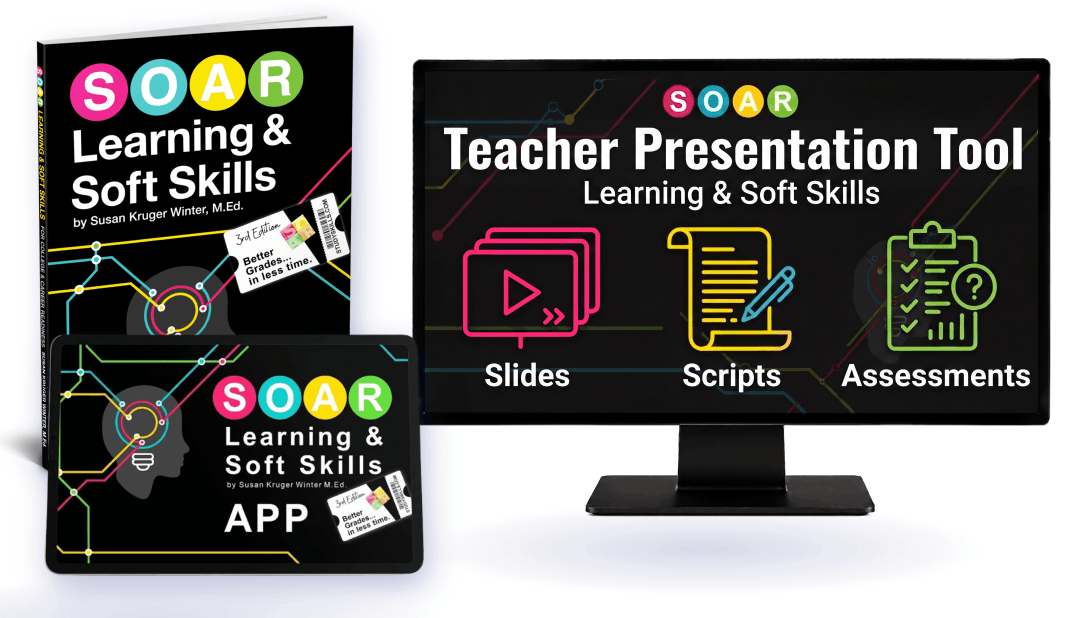
Student materials are modular — book, software, or both. The teacher presentation tool brings it together with slides, scripts, and assessments.
Get My Review CopyThe student workbook PDF is yours immediately — or look inside one live lesson first, no sign-up needed.
Why districts can defend this decision
SOAR doesn’t sit beside your standards. It teaches the skills underneath them while supporting the standards you’re already accountable for. See the full alignments / anchor-standards correlation →
In fact, SOAR can be used as a full ELA credit — offering one option for fitting it into the schedule. It doesn’t have to be one more thing to wedge into the day. It can be a course that already counts. How SOAR earns ELA credit →
And SOAR was built this way before it was required to be. SOAR was first published several years before the Anchor Standards existed, centered around the skills needed for success in school and career. This isn’t a program retrofitted to pass review. It was built for the same standard The Standards eventually captured.
It fits the schedule you already have.
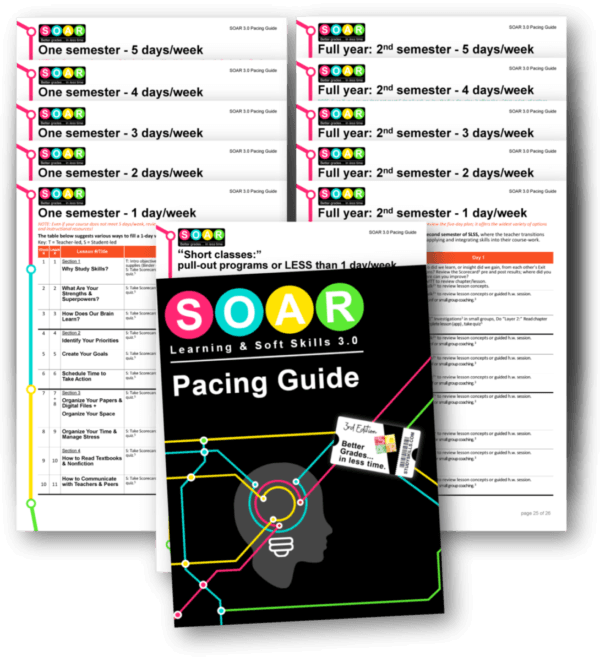
Schools run SOAR several ways:
- The Standalone Course — a dedicated elective or ELA-credit course.
- The Advisory Model — built into an existing advisory period.
- The Embedded Model — SOAR woven into a content-area course teachers already teach.
There’s no single right configuration; the curriculum flexes to the time you can give it. See the pacing guide →
How SOAR gets teachers — and districts — on board
Teachers were never trained to teach these skills; the strongest ones absorbed executive function skills (such as organization, focus, note-taking, studying) so automatically, they never had to name them. The skills were assumed, never assigned, never built into anyone’s preparation. That’s not a gap in your teachers. It’s a gap in how The System prepares teachers.
If teachers are reluctant, this is why: you can’t hand off what you were never handed yourself. Which is why these skills become a hot potato. They belong to no one, so everyone passes them on:
- Elementary assumes middle school will teach the skills.
- Middle school assumes elementary should have.
- High school assumes middle school did.
And inside a building, every subject passes the same potato — math says it isn’t theirs, science says the same, social studies, even ELA.
So SOAR is a turn-key solution that carries the expertise, itself. A teacher can project a lesson and learn it right alongside their students — flip the switch and go. More prep is welcome; none is required. The teacher who wants to make it their own has room to; the teacher who’s already stretched thin can lean on the curriculum to carry the load. Either way, for the first time, teachers can now “own” these skills — because SOAR provides the toolbox to teach them.
And there’s a natural home for that ownership. Because these skills are built on the ELA standards, they grow most naturally in ELA. Plus, SOAR gives teachers the tools to transition from the underlying skill instruction into Book Club and Writing Workshop, the two modes of instruction most ELA teachers envisioned when they chose their subject of expertise. See SOAR’s ELA tools →
And it’s built on the instructional framework your district already trusts.
SOAR’s curriculum is built on the six-stage Self-Regulated Strategy Development (SRSD) architecture — the explicit-instruction model recognized by the U.S. Department of Education’s What Works Clearinghouse, validated by federally funded randomized controlled trials, and already in use in roughly 10,000 U.S. classrooms.4
What that means for your building: if your teachers have been trained in SRSD for writing, they already know how to teach SOAR. Build Background, Discuss, Model, Memorize, Support, Independent Performance — same architecture, applied to executive function instead of writing alone. The professional development you’ve already paid for is additive, not redundant. See the full SOAR × SRSD alignment →
See SOAR’s training and professional development options →
When it’s adopted district-wide, the hot potato problem ends — permanently.
When SOAR is adopted district-wide, students carry the same academic framework from their first day of 6th grade through graduation — the same vocabulary, the same strategies, the same ownership of their own learning. No re-teaching between buildings.
No potato to pass. And with pre- and post-assessment data reportable across classrooms and groups — across eight assessment types — the data to demonstrate impact is built in.
Already in Your Budget
Districts commonly fund SOAR through two of the most widely used federal education programs, both authorized under the Every Student Succeeds Act (ESSA):
- Title I, Part A — supporting academic achievement for students in high-need schools
- Title IV, Part A — well-rounded educational opportunities, including college and career readiness
If your district is already allocating Title I or Title IV dollars, SOAR is a fundable use of those resources. Additional funding may be available through state programs and ESSA school improvement funds — ask your grants coordinator what applies to your district.
The one thing parents won’t fight you on
Every administrator knows parents can generate the hardest pushback, but they won’t push back on these skills. Parents live these struggles at the kitchen table every night — the missing assignments, the disorganization, the battles over homework, negative reports from school they don’t know how to fix — so when they hear their school is finally teaching the skills underneath all of it, they become champions for it!
One of the country’s most sought-after secondary schools—the kind with a years-long waitlist—uses SOAR as a selling point for earlier grades.
A program parents thank you for is not a risk.
It’s cover.
The Decision
The Bottom Line
The Anchor Standards have always named the destination. SOAR makes the path visible.
The skills that hold up every standard you’re accountable for have always been there—underneath the content, underneath the assessments, underneath the outcomes you’re measured by.
The risk is ours, not yours. SOAR backs its results with a written guarantee: a half-point GPA increase, a 30% reduction in missing assignments, and measurably stronger student confidence—or your money back.5
So the question isn’t whether these skills matter.
The question is whether your students are learning the foundation—or just being measured on the gap it left.
FAQs
How does executive function affect academic achievement?
Executive-function skills — focus, organization, planning, follow-through — are how students access and apply everything they’re taught. When they’re underdeveloped, even strong instruction stalls; when they’re built, achievement follows.
Is SOAR an RTI/MTSS intervention?
Yes — and unusually, SOAR supports all three RTI/MTSS tiers: universal Tier 1 instruction for every student, Tier 2 support for targeted groups, and Tier 3 intensive intervention. Few curricula thread cleanly through all three. See SOAR’s RTI/MTSS framework →
What evidence supports SOAR?
Study skills account for roughly 93% of the variance in academic achievement. SOAR is built on SRSD — recognized by the What Works Clearinghouse as an evidence-based practice — and one school reported its entire student body’s GPA rose a full point after implementing it. See more results from SOAR schools →
What grade levels is SOAR for?
SOAR is built for middle school and high school — grades 6–12 — and aligns with 100% of the 6–12 anchor standards. For 5th grade, a separate edition teaches the same executive-function foundation at that level: Study Skills & EF for Elementary – 5th Grade Literacy Lab.
How much teacher training does SOAR require?
Very little. SOAR was designed to train teachers right alongside their students — the curriculum is largely self-explanatory, asks for minimal prep, and still leaves room for teachers to make it their own. Formal training earns its keep when you’re aligning several teachers around a consistent approach — less a prerequisite, more a way to organize a team. (Teachers already familiar with SRSD will recognize the architecture.)
How do we bring SOAR to our school or district?
The best first step is to see it in action — get a review copy. If you’d rather talk it through first, you can schedule an Ask ’n Learn consult.

Free for Educators
Ready to look inside SOAR?
The student workbook PDF is yours immediately. Add the free 14-day software trial if you want all 18 lessons and the teacher portal.
Get My Review CopyNo credit card, either way.
Research Sources
1 “Analyzing the Impact of Study Skills on Academic Achievement: A Study among School Students” (2024), Education and Psychological Research; multiple correlation coefficient 0.964, F = 115.50, p < 0.01; combined predictive power = 92.90% of variance in academic achievement. ↩
2 Scruggs et al. (2010) meta-analysis of 70 studies, 2,400+ students; effect size ~1.00 — a large average effect for this instructional category. ↩
3 Tuckman, B. (Ohio State University), “Learning and Motivation Strategies” for-credit course; 351 vs. 351 matched students, 7-year follow-up. Independent corroboration; not a SOAR study. Struggling first-year students approximately 45% more likely to graduate; average-ability students 6× more likely to return for year two. ↩
4 Harris, K. R., & Graham, S. Self-Regulated Strategy Development (SRSD); recognized by the U.S. Department of Education’s What Works Clearinghouse; Harris et al. (2012) RCT, Elementary School Journal; approximately 10,000 U.S. classrooms. ↩
5 SOAR results-or-refund guarantee: half-point GPA increase, 30% fewer missing assignments, measurably stronger student confidence; subject to use-with-fidelity agreement. “Twenty years, never claimed” = Susan Kruger Winter’s verified verbal claim; fidelity-agreement condition applies. See studyskills.com/soar-study-skills-guarantee. ↩


