
Brain-First Learning for an AI World
Middle School
Study Skills for Middle School: The Executive Function Curriculum
The skills that look like motivation problems aren’t. They’re executive function gaps — and SOAR® makes the invisible visible.
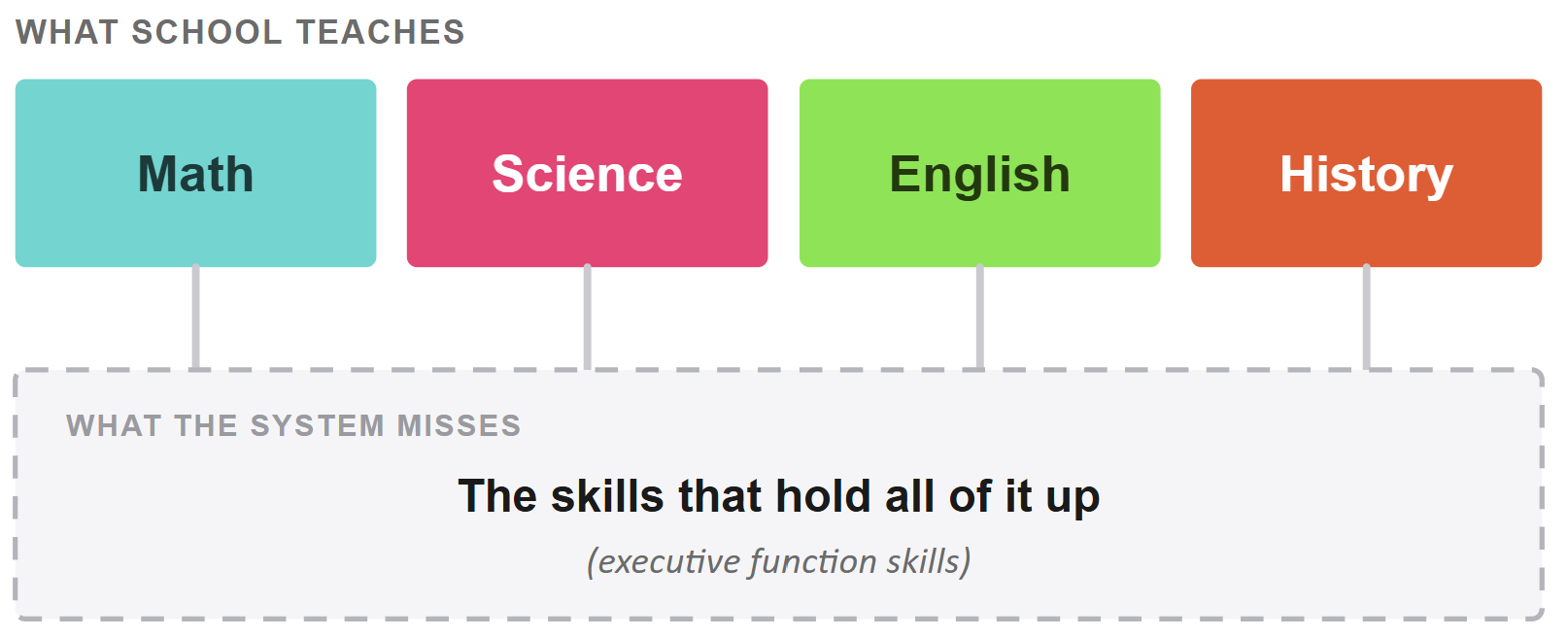
Middle school changes the rules before students know how to manage them
Sixth grade changes everything. Students move from a primary teacher who managed much of their school world to six different teachers — each with different expectations, assignments, routines, systems, and invisible rules. The external structure they relied on in elementary school suddenly disappears just as they are expected to become more independent.
Then school disappears into screens. Assignments, deadlines, resources, announcements, grades, and messages all live somewhere online. Adults say it should be easier because “everything’s right there.” But software flattens everything. It dematerializes it. Information becomes harder to see, prioritize, track, and connect — even though it is technically accessible.
Your students are drowning in digital noise while everyone around them assumes the system should feel effortless. One teacher becomes six. One paper planner becomes multiple online calendars, portals, folders, notifications, and assignment streams. The amount of information isn’t the only problem; students have to build the organizational pathways for managing it themselves.
What looks like laziness, carelessness, or lack of motivation isn’t. It’s invisibility. The missed assignments are visible. The poor grades are visible. What students often cannot see are the executive-function systems underneath them: prioritizing, organizing, initiating, estimating time, tracking tasks, monitoring progress, and knowing what to do next.
Once those invisible systems become visible, the story changes. Students can stop interpreting struggle as I’m bad at school and start asking, What system or strategy do I need here? Give them the tools to navigate the chaos, and the motivation that was blocked finally has room to emerge.
What is SOAR for middle school?
SOAR is a turn-key executive function and study skills curriculum for grades 6–8 that explicitly teaches students how to manage learning. Across 18 sequenced lessons, students develop the systems behind organization, time management, goal-setting, reading, note-taking, studying, writing, test-taking, communication, self-advocacy, and self-monitoring.
Sixth grade is the most natural entry point — but SOAR works throughout grades 6–8. Schools use it for middle-school transition and orientation, advisory, universal Tier 1 instruction, RTI/MTSS intervention, dedicated study-skills courses, ELA credit, and multi-year executive-function pathways.
SOAR reaches every student without requiring separate curricula for students who need additional support. Tier 1 establishes a common foundation and language; students needing Tier 2 or Tier 3 intervention deepen the same strategies with additional scaffolding and practice rather than starting over.
SOAR also meets 100% of the English Language Arts standards for grades 6–12. That means it can serve as an ELA credit for one of those years and/or anchor Tier 1 instruction, depending on how your school is structured.
And it arrives ready to teach. The Teacher Presentation Tool includes slides, scripts, activities, and assessments. Student materials are available as a workbook, software, or both.
When students can understand the struggle, they can change it
Students become more capable when invisible learning processes become visible. Instead of seeing a missing assignment as evidence that they are irresponsible, they can identify what actually happened: I forgot to check that teacher’s page. I underestimated the time. I saw the assignment but didn’t know where to start. I lost track of the deadline.
SOAR teaches students how their brain learns — then gives them explicit strategies for acting on that understanding. Students learn how to manage attention, time, materials, information, priorities, tasks, and communication across multiple classes instead of relying on reminders, willpower, or vague directions to “get organized.”
That turns struggle into useful information. A missing assignment becomes a tracking problem. Procrastination becomes a task-initiation problem. An overwhelming LMS becomes an organization problem. Poor test performance becomes a preparation problem. Once students can name the problem, they can choose a strategy for solving it.
That is how engagement becomes sustainable. Students move from I can’t do this to I know what went wrong, and I know what to try next. Competence begins replacing frustration — and motivation finally has somewhere to land.
See it in action
What’s inside?
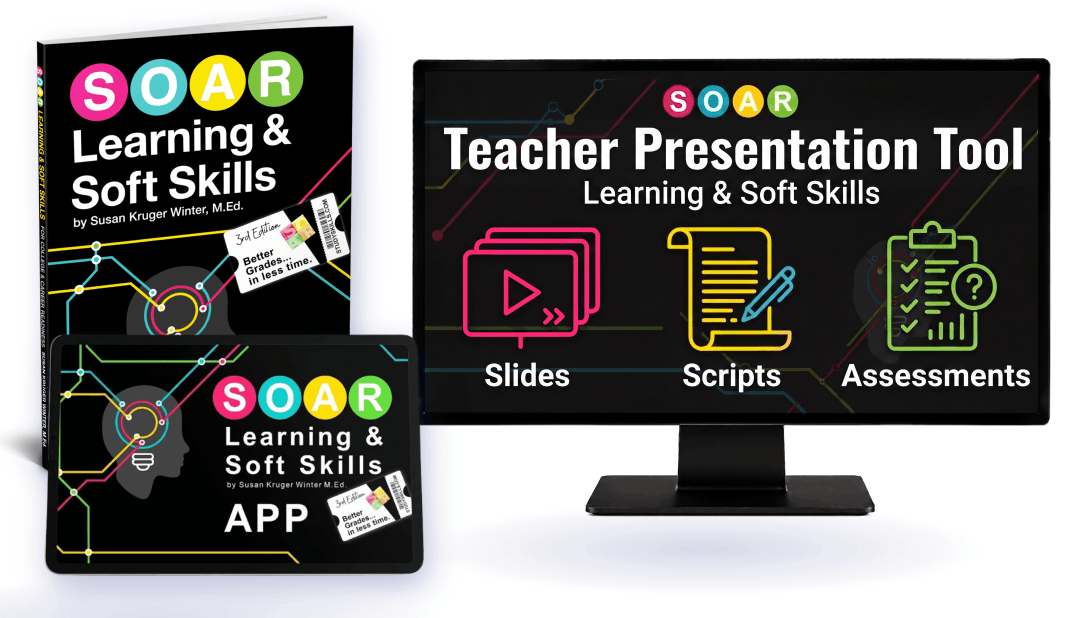
Student materials are modular — book, software, or both. The teacher presentation tool brings it together with slides, scripts, and assessments.
Get My Review CopyThe student workbook PDF is yours immediately — or look inside one live lesson first, no sign-up needed.
Executive function is the foundation. Everything else stacks on top.
When students can organize, manage time, prioritize, track assignments across multiple classes, navigate digital systems, regulate attention, and advocate for themselves, the rest of middle school becomes manageable. SOAR builds that foundation first — then allows schools to use it in multiple ways.
ELA Credit + Universal Tier 1
Every student benefits from explicit instruction in how to manage learning. SOAR’s ELA alignment means it can serve as an ELA credit for one of those years and/or anchor universal Tier 1 instruction.
RTI/MTSS Tiers 2 & 3
Students who need deeper intervention don’t have to start over with new content. SOAR scaffolds the same strategies for Tier 2 and Tier 3 support. The skills deepen; the learning continues.
Anchor Standards as Outcomes
Instead of teaching to standards, SOAR teaches the reusable skills the standards measure. Students learn how to comprehend, organize ideas, write clearly, listen, communicate, monitor their own understanding, and regulate thinking — foundational skills that make seventh grade, eighth grade, high school, and beyond progressively easier.
You’re teaching the end-game skills early, so mastery builds naturally.
AI-Ready Skills
AI changes the tools. The brain still does the learning. AI is changing how students access and generate information, but students still need comprehension, critical thinking, communication, self-management, judgment, and the ability to distinguish signal from noise.
Those are the human skills students will need in an AI world. SOAR delivers 100% alignment to NACE standards — the national professional standard for workplace career readiness — connecting the same executive-function and learning skills to long-term college, career, and workplace readiness.
Student Success
When students have a usable executive-function toolkit, motivation no longer has to carry the whole load. Students can see what needs to be done, decide where to begin, recover when something goes wrong, and manage themselves with increasing independence.
Confidence grows because competence grows.
This is what explicit executive-function instruction actually looks like
SOAR teaches 18 lessons that move students from self-awareness and motivation through organization, strategic learning, communication, and self-monitoring. Each lesson teaches an immediately usable study skill while strengthening the executive-function process underneath it.
| # | Lesson | The Study Skill | The Executive Function Benefit |
|---|---|---|---|
| Section 1 — How Are You Smart? | |||
| 1 | Why Study Skills? | Self-awareness & learning strategy | Metacognition — understanding why these skills matter |
| 2 | What Are Your Strengths & Superpowers? | Strengths identification | Motivation activation — unlocking the potential that’s already there |
| 3 | How Does Your Brain Learn? | Learning strategy & brain awareness | Metacognition — understanding how your own brain works |
| Section 2 — Set Goals | |||
| 4 | Identify Your Priorities | Priority-setting | Planning & task initiation |
| 5 | Create Your Goals | Goal-setting | Long-range planning & self-direction |
| 6 | Manage Time & Take Action | Time management | Prioritization & task initiation |
| Section 3 — Organize | |||
| 7 | Organize Your Papers & Digital Files | Organization systems | Reduced cognitive load; navigating LMS chaos |
| 8 | Organize Your Space | Environmental organization | Reduced distraction & improved focus |
| 9 | Organize Your Time & Manage Your Energy | Scheduling & energy management | Self-regulation & attention management |
| Section 4 — Ask Questions | |||
| 10 | How to Read Nonfiction | Active reading strategies | Working memory & information processing |
| 11 | How to Communicate with Teachers & Peers | Interpersonal communication | Social cognition & self-advocacy |
| 12 | How to Listen & Take Notes | Note-taking | Processing & retaining information across 6 teachers |
| 13 | How to Study & Learn New Terms | Memorization strategies | Long-term memory consolidation |
| 14 | How to Take Tests | Test preparation | Flexible thinking & performance under pressure |
| 15 | How to Write Paragraphs & Essays | Writing process | Sequential processing & communication |
| 16 | How to Learn Correct Grammar & Punctuation | Grammar & mechanics | Attention to detail & rule application |
| 17 | How to Give a Presentation | Presentation skills | Emotional regulation & executive communication |
| Section 5 — Track Progress | |||
| 18 | How to Track Progress & Keep Moving Forward | Self-monitoring | Self-evaluation & sustained motivation |
All 18 lessons build on one another, moving students from awareness to increasingly independent application.
The curriculum is already built. Your staff doesn’t have to invent it.
SOAR is a turn-key curriculum system — no prep necessary. The Teacher Presentation Tool provides the slides, scripts, activities, and assessment options needed to teach each lesson from day one.
Any teacher can deliver SOAR. Classroom teachers, advisory teachers, interventionists, counselors, and support staff can follow the prepared instruction, while teachers who want to customize still have room to make it their own.
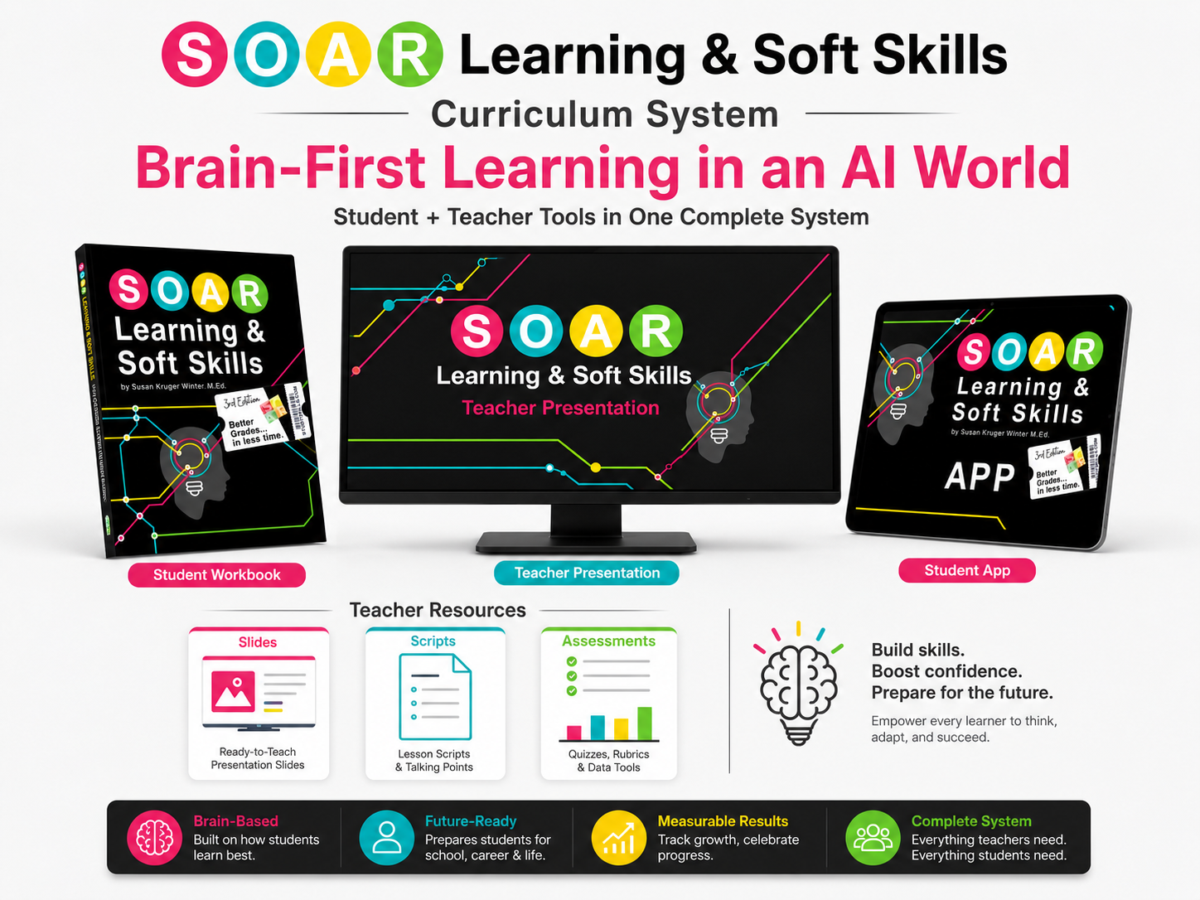
Student materials can be delivered in the format that works for your school. Choose the Student Workbook, Student App, or both; every package includes the Teacher Presentation Tool.
Assessment options are built in. Teacher materials include pre/post inventories, quizzes, rubrics, portfolios, observation checklists, a final exam, and an exit presentation.
SOAR is designed to fit into structures middle schools already have
The real implementation question is where to teach these skills. SOAR can flex across schedules, staffing models, intervention systems, and grade levels without requiring your school to build an entirely new structure.
- Sixth-grade transition and orientation — Teach incoming middle-school students how to manage multiple teachers, assignments, digital systems, and increased independence precisely when those demands arrive.
- Schoolwide first-year adoption — Introduce SOAR to students across grades 6–8 during the adoption year, establishing a common executive-function foundation and language throughout the school; then transition incoming students into the entry-level pathway in subsequent years.
- Advisory periods — Weave SOAR into existing advisory time, reaching all students through smaller recurring blocks of explicit skill instruction.
- Dedicated study-skills courses — Deliver the full curriculum in a semester or full-period structure.
- RTI/MTSS across all three tiers — Use one curriculum from universal Tier 1 through increasingly intensive Tier 2 and Tier 3 support, including students who need help with organization, follow-through, task initiation, and independent learning whether or not they receive formal services.
- Multi-year implementation — Continue SOAR across additional middle-school years for deeper skill development and increasingly independent application.
- ELA credit — SOAR can serve as an official ELA credit for one of the grades it covers. See the full ELA credit case →
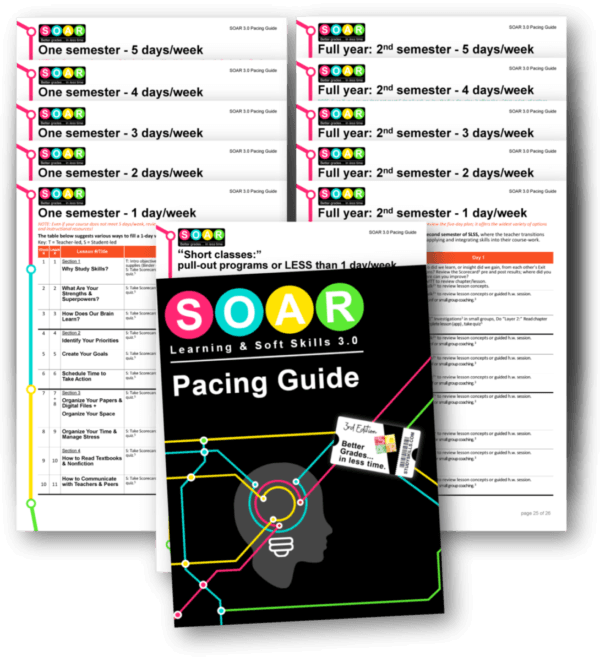
Whatever your schedule, the pacing can flex. Whether you have a full period, a 30-minute advisory slot, or a semester course, SOAR provides implementation options designed around the time you actually have.
Need the practical details?
| What exactly is included? | What Is SOAR? → |
| How do we fit it into the schedule? | Pacing Guide → |
| Can this count as ELA credit? | ELA Credit → |
| Can this support RTI/MTSS? | RTI/MTSS → |
| What proof do you have? | Proven Results → |
| What does it cost? | Pricing & Options → |
The instructional approach behind SOAR is supported by research — and SOAR brings its own implementation track record
Explicit study-skills instruction produces substantial academic gains. A meta-analysis of 70 studies involving more than 2,400 secondary students found that explicit study-skills instruction moved students up roughly one full letter grade compared with peers who didn’t receive it.1 On a 100-point test, that’s about a 20-point improvement — the difference between a C and an A-minus.
Strong executive-function and study habits are also associated with persistence. At Ohio State University, struggling students who developed strong executive-function and study habits were approximately 45% more likely to graduate than peers who struggled with these skills.2
SOAR-specific implementation adds another layer of evidence. One Utah school district implemented SOAR across its grades and documented an average +1.0 GPA improvement among students who completed the program.
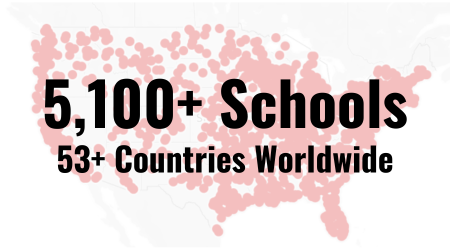
SOAR is now used in 5,100+ schools across 53+ countries. Schools use the curriculum across universal instruction, intervention, advisory, transition courses, and multi-year implementations.
See school results, educator stories, and testimonials →
Making the invisible visible
Your students arrive in middle school with potential — but suddenly lose much of the external structure that used to organize school for them. One teacher becomes six. Assignments scatter across systems. Deadlines overlap. Expectations change. And students are increasingly expected to manage all of it themselves.
When you teach executive function, you aren’t manufacturing motivation — you’re unblocking it.
Once students can see how organization works, how to track assignments, how to prioritize across classes, how to manage time, and how to decide what to do when they get stuck, the invisible becomes visible. The chaos becomes a system they can understand — and eventually manage for themselves.
Making the invisible visible gives middle-school students something reminders, consequences, and motivation speeches cannot: a system for managing school themselves.
FAQs
Is SOAR only for struggling middle-school students?
No. SOAR is designed as a universal foundation for every student. Tier 1 instruction gives all students explicit executive-function and study-skills strategies, while students who need additional support can deepen those same strategies at Tiers 2 and 3.
Can SOAR be used during advisory?
Yes. Advisory is one of the most natural middle-school placements for SOAR. Lessons can be delivered in recurring shorter blocks, allowing schools to teach executive function universally without creating another academic course.
Can SOAR support RTI/MTSS?
Yes. One curriculum can thread through all three tiers. Tier 1 establishes common language and strategies for all students; Tiers 2 and 3 provide deeper scaffolding, practice, and support without requiring students to begin again with unfamiliar content.
Can SOAR count as an ELA credit?
Yes. SOAR meets 100% of the English Language Arts standards for grades 6–12. That means it can serve as an official ELA credit for one of those years, depending on local requirements and how your school structures credit.
Who can teach SOAR?
SOAR does not require an executive-function or study-skills specialist. Classroom teachers, advisory teachers, interventionists, counselors, and other support staff can deliver it using the Teacher Presentation Tool, which includes lesson-by-lesson slides, scripts, activities, and assessments.
How much class time does SOAR take?
SOAR is designed to flex around the schedule you already have. It can be delivered in a full-period course, semester structure, 30-minute advisory block, orientation model, or other pacing configurations outlined in the SOAR Pacing Guide.

Free for Educators
Ready to look inside SOAR?
The student workbook PDF is yours immediately. Add the free 14-day software trial if you want all 18 lessons and the teacher portal.
Get My Review CopyNo credit card, either way.
More for Educators
Start Here·What Is SOAR?·Why SOAR Works·Executive Function·RTI/MTSS·Solutions by Focus·Training & PD·Pricing & Options
Research Sources
1 Scruggs, T. E., Mastropieri, M. A., Berkeley, S., & Graetz, J. E. (2010). Do special education interventions improve learning of secondary content? A meta-analysis. Remedial and Special Education, 31(6), 437–449. ↩
2 Tuckman, B. W. (Independent, Ohio State University). Study skills program corroboration — independent research, not a SOAR study. Struggling students ~45% more likely to graduate; results based on matched cohort over 7 years. ↩


