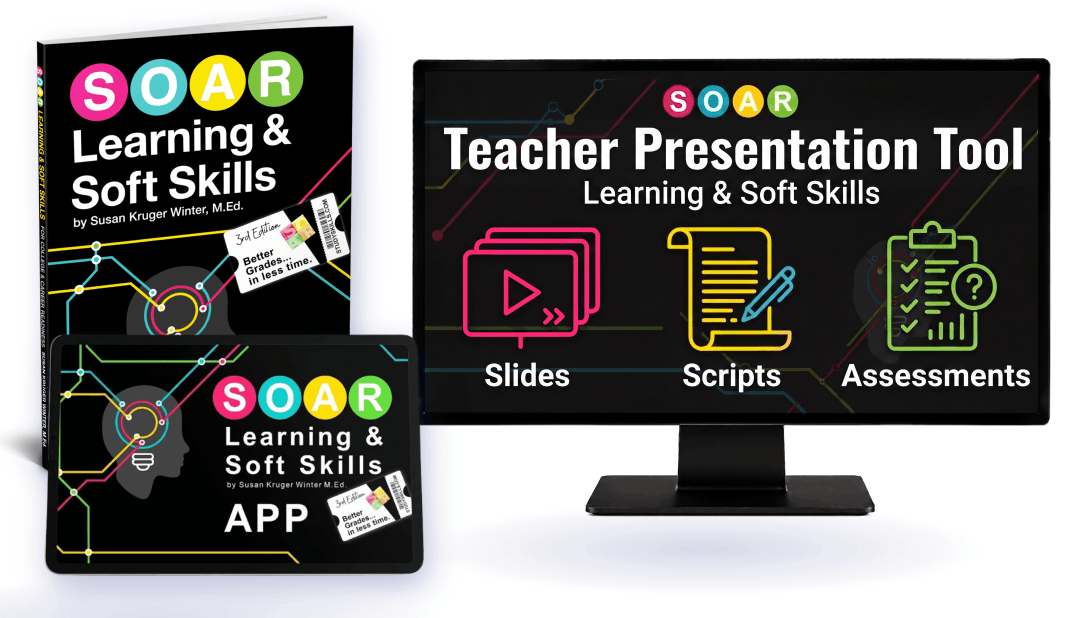
Brain First Learning in an AI World
EXECUTIVE FUNCTION: For parents of students · Grades 3–12
The school told you "executive function" is the problem.
Now you're not sure what that means or what to do about it. Your child or teen is bright. But somewhere between knowing it and using it, things keep falling apart.
You know what you're seeing. You're just not sure what to call it.
Your child or teen is bright. The grades just don't match the intelligence.
You've probably been seeing some version of this for a while:
- Assignments started but never finished
- Homework completed but never turned in
- The planner you bought is empty, ignored, or full of things that didn't get done
- Studied material that didn't show up on the test
- "Careless" mistakes on work they actually understood
- Long projects that turn into 11 PM crisis nights the day before they're due
- Backpack chaos — papers crumpled, deadlines missed, important emails buried
- You've taken over their organization to keep them afloat — and you can't keep doing it
The school has a name for what you're seeing. They probably said it to you in a meeting: executive function. And then they probably didn't explain what that actually means or what you're supposed to do about it.
What "executive function" actually means — in plain English
Think of executive function as the brain's project manager. It's not how smart your child or teen is. It's not how much they know. It's the set of skills that helps them access what they know and put it to use.
The simplest way to spot it: executive function is essentially anything a parent might nag a child or teen about. Starting homework. Finishing homework. Turning it in. Remembering the field trip form. Keeping track of the planner. Cleaning up after a project. Studying ahead instead of cramming.
More technically, executive function is what gets a student to:
- Start a task — instead of staring at it for an hour
- Hold instructions in memory long enough to follow them
- Plan ahead for a project that's due in two weeks
- Check their own work before turning it in
- Switch from one subject to another without losing focus
- Notice when something's not working and try a different approach
Here's the part nobody told you: these skills aren't taught directly in most schools. Schools teach content — math, science, history, reading. They expect executive function to develop on its own, in the background.
For some students, it appears to. But that's surface-level appearance. These are skills that can and should be taught explicitly — and in most schools, they aren't. When that explicit teaching is missing, the gap between knowing something and being able to access and use it gets blamed on motivation, attitude, or effort. None of those is the actual problem.
What the school calls a deficit...
is what the AI world calls foundational.
The deficits are real. What the school misses is why they exist — and what they could become with the right kind of teaching.
These are the exact skills that matter most, going forward.
How school frames it
A deficit to remediate.
The school sees the executive function gaps — missed assignments, scattered focus, disorganization, the projects that fall apart at the last minute — as a problem to manage. Accommodations. Extended time. Check-ins. Your child has a weakness; we'll work around it.
What the school doesn't do is teach these skills explicitly. So the gap stays, year after year — and the workarounds stack up instead of the skills.
What's actually true
The skills that build the future.
When executive function is taught explicitly — not assumed, not worked around — what gets built is self-direction. Planning. Working memory. Adapting when something isn't working. Knowing what to do when you don't know what to do.
These are the exact skills humans need to direct AI rather than be directed by it. They're not optional. They're the foundation of everything that comes next.
AI changes the tools. The brain still does the learning.
A student who can't direct their own attention, plan their own work, or notice when their approach isn't working is a student who will be passively used by AI tools instead of actively using them. That's the real long-term cost of leaving executive function underdeveloped — and it's what makes this not just a school issue, but a future-readiness issue.
So how do these skills actually develop?
Executive function isn't fixed, and it isn't automatic. It develops when the right brain systems are engaged in the right order — and that order is what most school instruction skips.
SOAR's framework for that order is called The Learning Circuit. It's based on how learning physically works in the brain — and once you see it, you can't unsee it.
There are four moves in this circuit, and they happen in this order:
1. Anchor
New information has to connect to something the brain already understands. No anchor, no learning — just memorization that fades.
2. Wire
When the connection lands, the brain physically builds new neural wiring around the existing knowledge. This is what learning actually is at the biological level.
3. Store
That wiring lives in long-term memory — permanently. Memorization parks information in short-term memory, which deletes itself to make room for new things. Learning lasts; memorization doesn't.
4. Compound
Because there's no limit to neural wiring, every new wire becomes potential anchor for the next one. Learning stacks. The brain that's been wired well gets faster, not slower, at learning new things.
Most school instruction skips Step 1. When your child or teen is told "just memorize these for the test," there's no anchor. The brain does what it's been told — parks the information temporarily, then clears it. The wiring never gets built.
The Learning Circuit fixes the order. And executive function develops as a natural consequence of going through this circuit again and again, with the right scaffolding in place.
Susan Kruger Winter, M.Ed.
30 years working with struggling readers and learners
Want to actually understand what's going on with your child or teen?
The Hidden Problem Schools Miss
You've just seen the four-step mechanism. The masterclass goes deeper: how the Learning Circuit connects to executive function specifically, what The Learning Success Pyramid adds, and what actually moves the needle.
Masterclass: Hidden Problems
Prefer to skip the email? Watch the masterclass directly →
Ready for ongoing support?
Executive function doesn't develop in a session. It develops in the daily moments — getting started, finishing, remembering, switching tasks. Those moments happen at home, not at school. Which means parents — not teachers, not tutors — are the leverage point.
SOAR Circle is the parent community where small, brain-based shifts become part of how your family already lives — usually within the first few weeks.

Parent community
SOAR Circle
Bringing joy back to your family. School success follows.
When a child or teen is struggling, school stress takes over the whole family. Dinner conversations turn into homework arguments. Weekends turn into makeup work. The bright, funny, curious version of your child or teen disappears under the pressure. Restoring joy in the family is the work — and the school success grows from there.
SOAR Circle gives you brain-based scripts, tools, and weekly community — so you know what to say, when to say it, and how to step back as your child or teen's skills come online. Less nagging. Less battling. Faster mornings. More of the family you actually want to be.
Your child or teen isn't unmotivated. They're under-equipped.
The skills that help a student access what they know — and put it to use under real-world demands — aren't optional accessories. They're the foundation of how every other skill gets used. And they're the exact skills that matter most in a world where the tools are getting more powerful by the month.
Reading is the gateway. Thinking is the outcome. Independence is the future.
Executive function is what builds the thinking and the independence. It's not a deficit to manage. It's a skill set to develop — and one that pays compounding dividends for the rest of your child or teen's life.