Brain-First Learning for an AI World
5th Grade Literacy Lab
Executive Function & Study Skills for Elementary: 5th Grade Literacy Lab
Two-thirds of students enter fifth grade reading below proficiency1 — and for most, the missing layer underneath is executive function. Literacy Lab is core fifth-grade instruction that teaches that executive function to every student, covering all the ELA anchor standards and bridging reading and writing gaps before middle school.
BRIDGE THE GAP
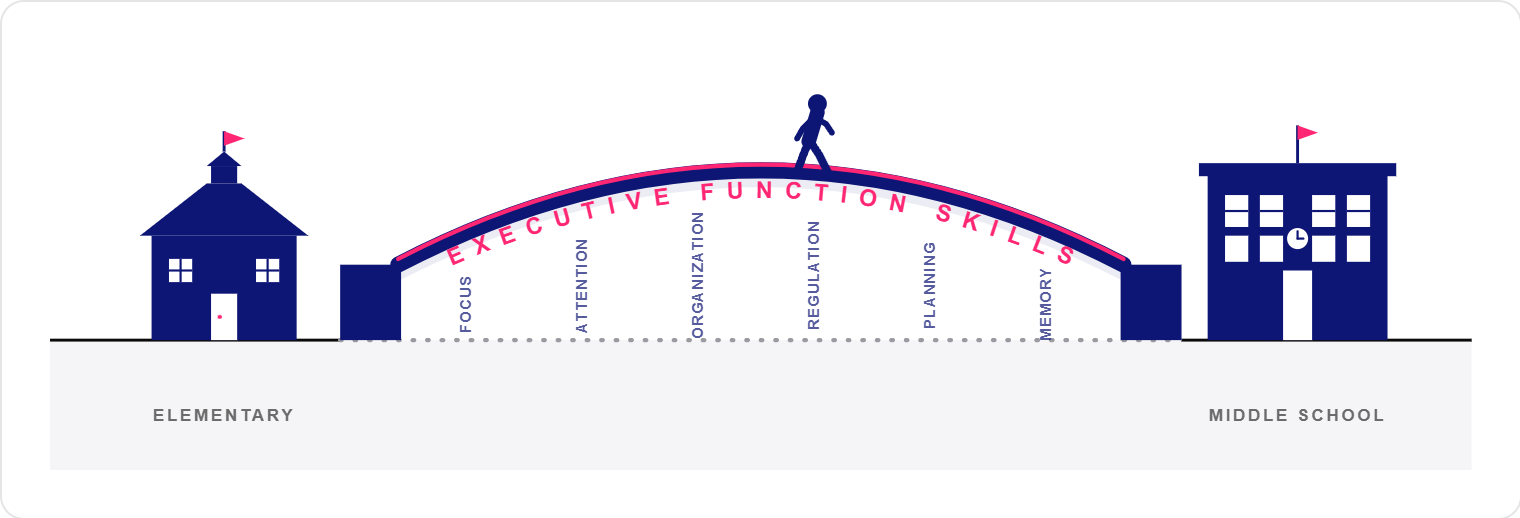
Executive function is the bridge.
Reading and writing rest on it. So does the middle school transition. Build executive function explicitly in fifth grade, and the leap becomes a comfortable walk.
The Shared Gap
Bridging the upper elementary literacy gap for every fifth grader
Every fifth grader is worried about middle school… yet each feels alone in their worry. They’ve heard the stories: Lockers. Changing classes. Teachers who don’t know their names…
But the gap isn’t only theirs — it’s yours, too. You carry your own stressors on their behalf. You want to close the literacy gap and send every student to middle school with authentic confidence — but you’re at a loss; you know what not to do. But in all of your training, no one ever showed you what you should do.
I know, because I was handed the same certificate. I was fully trained in elementary literacy — and only realized this same deficit in myself, years later. More on that later.
And it’s not just me — or you. In a national survey, only 11% of K–2 and special education teachers said they felt completely prepared to teach reading after finishing their training programs.2 Neuroscientist Mark Seidenberg puts it bluntly: with few exceptions, teachers are simply not taught to teach reading — and they “don’t know what they don’t know.”3
The gap was built into the system before any of us ever stepped into a classroom!
So Literacy Lab calls out the elephant in the room — for the fifth grader dreading the change, and for the teacher who was never shown how. Then it makes a promise to both: this year, we’re going on an adventure together to get ready for middle school.
Meet Literacy Lab
What is Literacy Lab?
Literacy Lab is a full-year, fifth-grade ELA curriculum built on executive function. It covers 100% of the K–12 ELA anchor standards — the transferable reading, writing, speaking/listening, and language skills behind them — starting where most programs never do: by teaching the underlying self-management and thinking skills that make reading, writing, and learning possible in the first place.
It doesn’t compete with your ELA block. It is your ELA block.
It’s core instruction for every fifth grader — not a pull-out, not an intervention. Strong readers go deeper. Students carrying gaps finally get the foundation no one ever built. Same room, same lessons, every student moving forward — because differentiation is the natural outcome when students can apply strategies to their own work.
By June, the change is visible. Students who arrived overwhelmed can organize their thinking, comprehend what they read, and write about what they’ve learned. The gaps that threatened to follow them for years into the future stop here! And the foundation carries them into middle school, high school, and beyond.
Literacy Lab at a Glance
- Grade
- 5
- Length
- Full year
- Lessons
- 18 foundation lessons (weekly, 1st semester) + 4 ELA Maps (transferable literacy skills, 2nd semester)
- Delivery
- Whole-class core (Tier 1) — replaces your ELA / literacy block
- Teacher prep
- Minimal — turn-key
- Materials
- For students: digital, workbook, or both
Implementation paths — from a full five-day model to blended schedules — plus minutes-per-week and lesson pacing — Literacy Lab Pacing Guide
The Foundation
An executive function framework: building a literacy infrastructure that works
The Learning Success Pyramid shows what learning actually rests on. Confidence forms the base, creating the emotional stability students need to engage. Executive function comes next, helping students manage attention, organize information, regulate thinking, and follow through. Learning sits at the top — built on the strength of those two layers underneath.
Traditional instruction often approaches learning from the top down. We deliver standards, textbooks, assignments, tests, and grades, then hope students can manage everything required to make that learning stick. But when the foundation underneath is weak, more content simply creates more friction.
THE LEARNING SUCCESS PYRAMID
Without the foundation, learning doesn’t stick.
Traditional instruction throws information at students from the top, down. SOAR® builds learning infrastructure from the bottom, up.
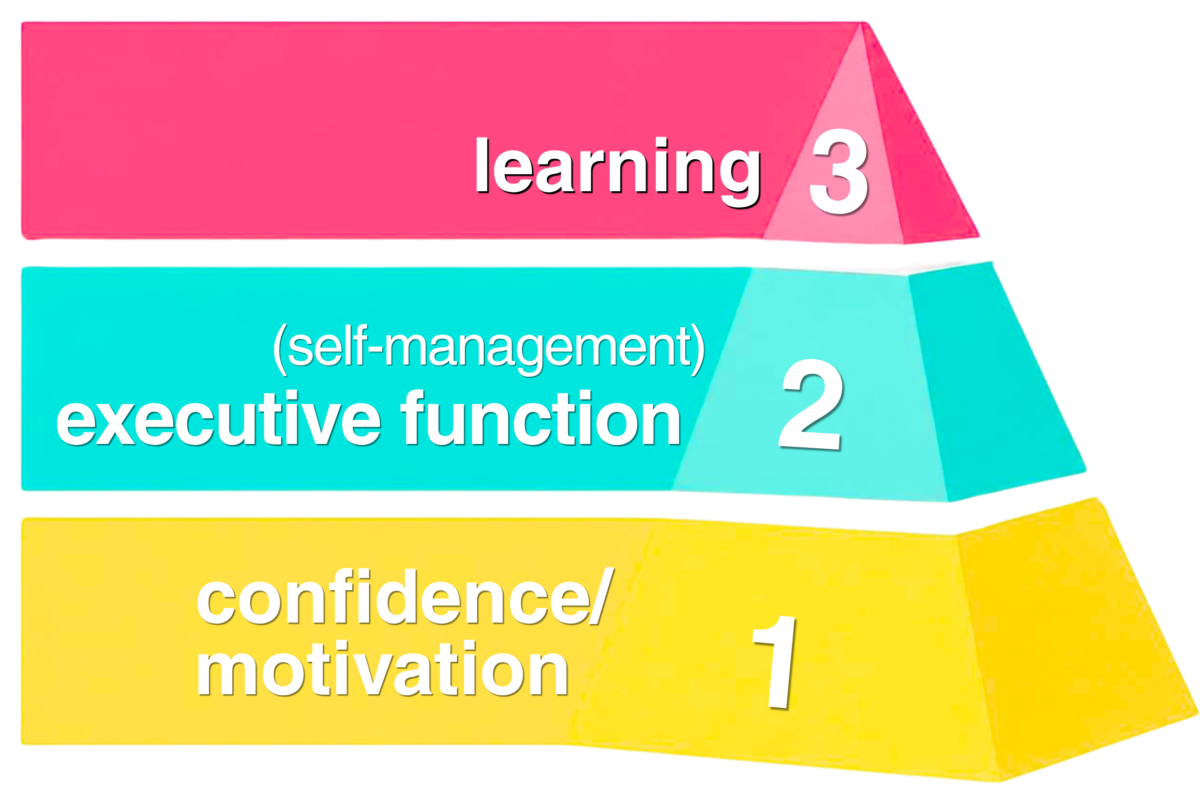
SOAR builds from the bottom up. First, students develop confidence and begin seeing themselves as capable learners. Then they build the executive function systems that help them manage attention, information, materials, time, and thinking.
When the foundation is solid, students have a way into the learning. They can focus on what matters, organize what they are taking in, monitor whether they understand it, and decide what to do when they get stuck. Comprehension becomes more accessible. Writing becomes more manageable.
Without that infrastructure, even capable students can look like struggling readers and writers. A page of nonfiction can feel like too much information with nowhere to put it. Attention drifts. Ideas stay disconnected. Writing stalls because the student cannot organize what they know well enough to express it.
The invisible layers — confidence and executive function — can be taught. They are not fixed traits. Students can learn how to regulate attention, organize information, manage themselves, and approach learning strategically.
That is the foundation Literacy Lab builds first. Once students can see and manage the systems underneath learning, the reading, writing, speaking, listening, and studying above them have something solid to stand on.
The Curriculum
How Literacy Lab works
Literacy is more than reading, writing, and language arts taught as separate subjects. It is the ability to take in information, make sense of it, and express ideas effectively across contexts.
First semester builds the foundation; second semester applies it. During the first half of the year, students develop confidence and explicit executive function skills for managing attention, materials, space, time, information, and thinking. These lessons prepare students to use literacy strategies with increasing independence rather than simply follow teacher directions.
By second semester, students are ready to apply those systems directly to ELA. Reading nonfiction for meaning, organizing ideas, writing through a thinking process, speaking, listening, and studying strategically all build on tools students already know how to use.
What Literacy Lab includes:
- Eighteen lessons that build the executive function foundation — organization, focus, planning, self-regulation, and strategic learning taught as one connected system
- Comprehension strategies optimized for nonfiction reading — with the cognitive groundwork established before students are asked to manage complex informational text
- Writing instruction focused on the thinking process — built around the inquiry strategy that runs through the curriculum
- Four ELA Maps that organize the transferable skills of the standards — Reading Literature/Fiction, Reading for Information/Nonfiction, Writing, and Speaking & Listening
- Built-in audio narration* — every lesson can be read aloud through the student software
- SEL support tools — including coping cards, an empathy map, and resources for the social-emotional demands of the middle school transition
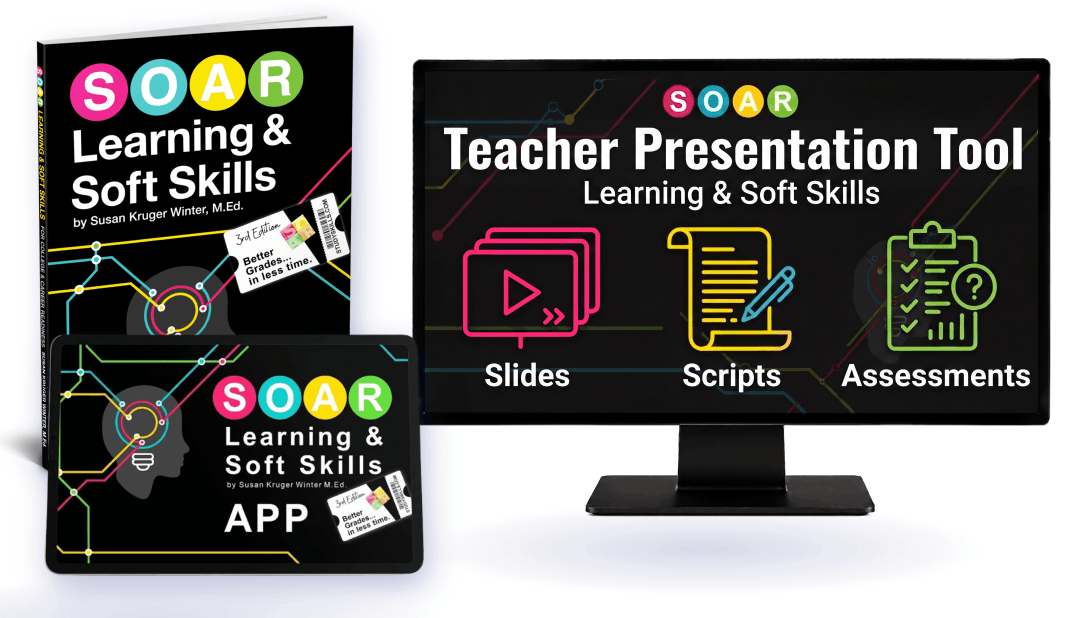
- Teacher Presentation Tool — slides, scripts, activities, and assessments already prepared
*In the student software. Student materials are available as software, workbook, or both.
Literacy Lab is intentionally not a phonics or decoding-intervention program. It does not include phonics instruction, decoding intervention, or leveled readers.
Students who genuinely need phonics or decoding support should receive it. Miscue analysis helps identify those students so they can be matched with the dedicated phonics resources they need.
Literacy Lab focuses on the layer most fifth-grade programs assume is already in place: comprehension, writing, executive function, and the learning infrastructure students need to use literacy skills independently.
Because those skills are transferable, they do not stop at fifth grade. The same strategies continue supporting students across the majority of ELA demands they will encounter in middle school and high school.
See it in action
What’s inside?
Student materials are modular — book, software, or both. The teacher presentation tool brings it together with slides, scripts, and assessments.
Get My Review CopyThe student workbook PDF is yours immediately — or look inside one live lesson first, no sign-up needed.
Read the Miscues
Why phonics alone isn’t enough: the science of reading comprehension
Phonics matters. Decoding matters. But reading isn’t phonics.
Reading is comprehension — and comprehension takes more than decoding words. By fifth grade, many struggling readers need more: help integrating word recognition, language, comprehension, and self-monitoring into one coordinated reading process.
Look closely, and the struggle usually follows one of two patterns. In the first, decoding succeeds but meaning fails — the student gets the word, then loses the sentence. In the second, decoding itself stumbles — but because the student is over-applying phonics rules to a word that doesn’t follow them, not because of a gap in phonics knowledge. Either way, they sound like they don’t know their phonics.
Most often, what they don’t know is how to integrate phonics with comprehension. Don’t take my word for it.
Your running records already hold the answer. In my own clinical and instructional work across hundreds of miscue analyses, I’ve found the same pattern in well over 80% of readers with low fluency: they sound rough when they read aloud — but when I check comprehension, it’s far stronger than their fluency scores would predict. When I then analyze the miscues, they trace back to overreliance on phonics — the student is leaning so hard on decoding that meaning-making can’t keep up.
Most often, that prescription to “double-down on phonics”… is the very one thing they don’t need. Of course, before you accept that diagnosis, check it!
You’re already doing running records — take one step further and analyze the miscues. I show you exactly how in a free video on my YouTube channel: twenty minutes, and you’ll know how to determine which camp each reader is in. The payoff goes beyond placement.
Share a miscue analysis with the student and you build their metacognition; they finally understand what their brain does when they read. Share it with parents and you’ll watch years of worry lift.
And for the students whose miscues show a genuine phonics gap? Get them phonics support — sincerely. Those programs exist everywhere, and those students deserve them. That was never the gap SOAR fills. The gap SOAR fills is the one almost nobody is addressing: the comprehension infrastructure everyone is missing.
Phonics opens the door. Comprehension walks through it. SOAR teaches students the executive function strategies that enable comprehension — strategies delivered using SRSD (Self-Regulated Strategy Development), the same evidence-based model that makes learning stick. Students internalize not just what to do, but how to regulate their own thinking as they read.
And the research points in the same direction; even when teacher training works, it only moves decoding. A 2023 study of 512 classroom teachers found that teachers’ knowledge of language and literacy predicted students’ foundational skills scores — but not their comprehension scores.4
Comprehension needs something more. Reading researchers Laurie Cutting and Hollis Scarborough — creator of the Reading Rope — have identified executive function, including working memory, planning, organization, and self-monitoring, as an important contributor to reading comprehension. Those are the same skills Literacy Lab teaches explicitly.5
SCARBOROUGH’S READING ROPE
Skilled reading is many strands woven into one.
Executive function is the hand that weaves these strands into skilled, fluent reading.
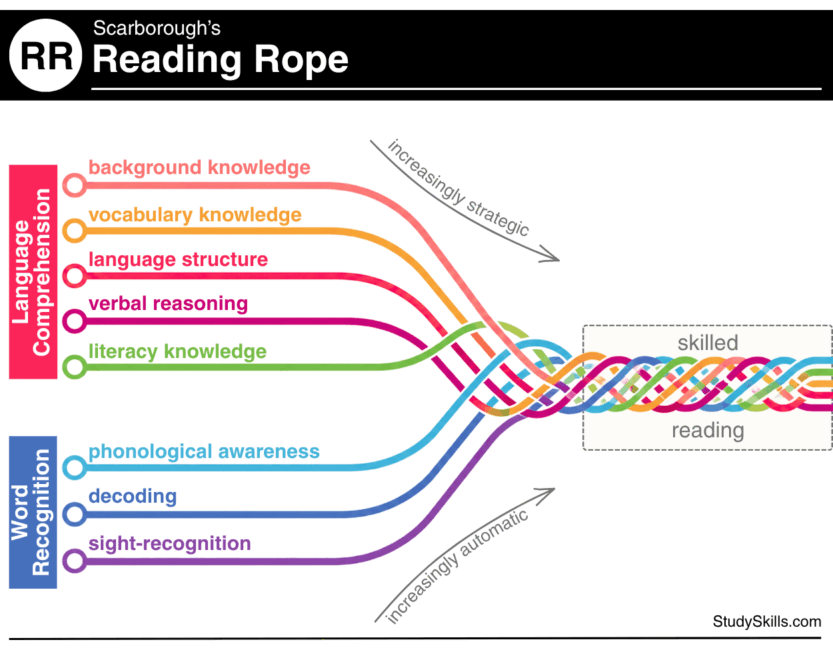
The Reading Rope shows the strands; executive function helps students coordinate them. Decoding, fluency, vocabulary, language, and comprehension strategies do not operate in isolation. Skilled readers have to integrate them while monitoring meaning.
Executive function is the hand that weaves the rope.
The Standards
Meeting 100% of K–12 ELA anchor standards in 5th grade
The skills students need to meet ELA standards are also study skills: reading comprehension, organizing ideas, writing clearly, listening, speaking, and regulating thinking — all sitting on top of executive function.
That’s how SOAR covers 100% of the K–12 anchor & ELA standards — we simply teach them starting at fifth grade.
How it works: The anchor standards define the endpoints — what students should be able to do by the end of twelfth grade. Literacy Lab flips those endpoints into teachable, reusable strategies, delivered through the study skills framework using SRSD.
So instead of waiting until tenth grade to teach “analyze how point of view shapes a text,” fifth graders learn the comprehension strategy that makes that analysis possible. Instead of waiting until eleventh grade to teach “develop and strengthen writing through revision,” fifth graders learn the thinking process behind revision — how to regulate their own writing development.
A full alignment shows exactly where each skill is taught, practiced, and applied.
The Method
Nonfiction reading strategies and writing workshops for 5th grade
Nonfiction carries all other subjects… and it’s where schools have the fewest resources. Most literacy materials center on narrative stories. The nonfiction side of the standards is sparse; what is labeled as “nonfiction instruction” rarely provides functional strategies for accessing information.
SOAR’s approach is comprehensive: during first semester, we focus on explicit instruction in executive function — the skills needed to access, organize, and process information. This time is not a warm-up before the “real” literacy instruction. It’s building the thinking infrastructure for comprehension (reading & listening) and expression (writing & speaking). This groundwork is an accelerator for 2nd semester…
In second semester, the ELA Maps take it deeper. The maps carry the reading and writing skills of the standards — through twelfth grade — in a form a fifth grader can follow, as a reusable guide. There’s one map — one set of skills — for each strand:
- Reading Literature/Fiction
- Reading for Information/Nonfiction
- Writing (expository, argument, narrative)
- Speaking & Listening
For each strand, students learn just one set of skills that applies across contexts. Because the maps align with first-semester executive function skills, “new” learning becomes a natural extension of what they already know — reducing friction and making application more automatic.
In Reading & Writing Workshops, students use their ELA Maps to read and write across a variety of genres. This is how the skills become “transferable.”
While this time is teacher-supported, it is largely student-directed, ensuring students develop the ownership and independence that will be expected of them in middle school.
All of this instruction is delivered through SRSD — so students internalize not only the strategies, but how to regulate their own thinking as they read and write.
The best news for teachers: there is minimal after-hours grading required. Feedback happens largely during class time, when it is most useful to students — reducing teacher workload while improving the immediacy of instruction.
The Proof
Does it work? The evidence
Literacy Lab teaches reading and writing the way the research says works: explicitly.
- Writing climbs from the 50th percentile to the 79th when students are explicitly shown how to plan, draft, and revise.6
- Comprehension jumps 18–24 percentile points for students with learning disabilities — where gains are notoriously hard to move — when struggling readers receive explicit comprehension-strategy instruction.7
And the strategy model Literacy Lab is built on — SRSD — is recognized by the U.S. Department of Education’s What Works Clearinghouse.8
The methods behind Literacy Lab are well-supported by research — and SOAR brings its own implementation track-record to match. After a school-wide SOAR implementation, one district measured a full-point GPA increase across its entire student body.
The Risk Is Ours, Not Yours
SOAR backs Literacy Lab with a written guarantee: a half-point GPA increase, 30% fewer missing assignments, and measurably stronger student confidence — or your money back, when used with fidelity. See the guarantee →
“The lessons are broken down and made relevant and practical for kids.”
— Teacher, grades 5–6 study-skills group
“Homework is getting done faster and there is much less fighting in our household!”
— Nancy V., elementary parent
“Once I learned how to get control over what I was supposed to learn before a test and what to do on a test, I was so much more confident!”
— Sachi I., student
The Adventure
Introducing Literacy Lab: a fifth-grade learning adventure to discover their superpowers
You made your fifth graders a promise: this year, we’re going on an adventure together — to discover what they’re capable of and get ready for what comes next. Literacy Lab gives that promise a structure, helping students understand how they learn, where they get stuck, and which strategies help them move forward.
First semester is about discovery. Across eighteen weekly lessons, students explore confidence, attention, memory, organization, time, materials, information, and thinking as parts of one connected system. They identify strengths, recognize challenges, and build a toolkit they can use when learning gets harder.
As students gain tools, they begin to see themselves differently. Successful learners aren’t simply “good at school” — they use strategies. I’m just bad at this becomes a much more useful question: What strategy could help me do this better?
Second semester turns discovery into application. Students use their ELA Maps to navigate deeper reading, writing, speaking, and listening, building on familiar strategies for asking questions, organizing information, monitoring understanding, and communicating ideas.
Along the way, students collect evidence of their own growth. Weekly portfolio time begins with a baseline reflection and builds into a record of progress. At intentional checkpoints, students look back at where they started and see how their work, habits, and independence have changed. Confidence is no longer something they’re simply told to have — they can see the evidence for themselves.
The adventure ends with destinations worth working toward. Students complete a mid-year “Level Up” presentation and finish the year with a culminating gallery showcasing what they’ve learned, how they’ve grown, and the strategies they can now use independently.
By the time they enter middle school, students aren’t simply being told they’re ready — they have proof. They leave with strategies they understand, tools they can use, and experience taking responsibility for their own learning: I know how to learn. I know what to do when I get stuck. And I know I can figure things out.
And you get to be the expedition guide — not the person carrying every student up the mountain. The route, strategies, maps, and reflection structures are already built into Literacy Lab. You model, coach, give feedback, and help students recognize their progress as responsibility gradually shifts to them.
Turn-Key — and You’re Not on Your Own
Literacy Lab arrives turn-key. The lessons, presentation tools, activities, and assessments are made. The curriculum supplies the plan. You create the experience. See the 5th Grade Literacy Lab pacing guide.
New for 2026–27: up to four live implementation webinars are planned — two in August–September 2026 and two in December 2026–January 2027 — for hands-on training and your questions about running Literacy Lab. Contact us for details →
The Payoff
A middle school transition curriculum that builds readiness
Middle school is where these skills stop being optional. One teacher becomes six or seven. One system becomes six or seven. Literacy Lab lets students practice managing their own learning before the adults around them stop managing it for them.
They cross that bridge with proof in hand — not terrified. Ready.
Looking Ahead
For an AI world
Your fifth graders will graduate into a world saturated with AI. Not eventually. Now. Generative AI is already changing how information is accessed, writing is produced, and thinking is outsourced. By high school, it will be a default tool.
That changes what matters.
When AI can answer almost any question instantly, the skill is no longer getting the answer; it’s knowing whether the answer is any good. Can students evaluate information, ask better questions, catch errors, and think a problem through for themselves? That’s the difference between a student who uses AI and a student AI uses.
In an AI world, comprehension matters more, not less. Students need to read critically, question deeply, think before writing, and regulate their own thinking.
Those are the human skills Literacy Lab teaches. Independent thinking. Comprehension. The ability to learn for yourself. Executive function — the infrastructure that makes it all possible.
Build those skills now, in fifth grade. Not as a reaction to AI, but as preparation for a world where independent thinking will matter more than ever.
The Track Record
Why SOAR
5,100+ schools across 53+ countries use SOAR.
I’m a certified K–12 learning & ELA specialist with 25+ years of experience, and the author of the bestselling study skills curriculum.
But here’s the credential that matters most: I was you.
I taught elementary with zero reading materials and zero writing materials. I had a certificate saying I was qualified, yet my training had taught me what not to do — never explicitly what I should do. My students needed help, and I didn’t have the tools to give it.
Then my husband said something that changed my career: “Maybe you hate teaching reading because you don’t know how to do it.” He was right. The next morning, I changed my graduate major to reading. Within a month, I knew it was the best decision of my life.
Because I discovered the problem wasn’t me — and I wasn’t alone. Teachers everywhere were being asked to teach complex skills without the methods, materials, pacing, or framework to do it confidently. So I spent years building what I wished I’d had.
That work ultimately became a curriculum covering 100% of the K–12 anchor standards. It was built before those standards existed, from the ground up around a principle the standards later confirmed: reading and writing don’t operate separately from executive function. They depend on it.
SOAR Literacy Lab is for fifth-grade teachers who are eager to stop improvising and start building.
The Promise
Making the invisible visible
Your fifth graders arrive carrying invisible literacy gaps that have been passed through elementary school like a hot potato.
And those gaps aren’t just in reading comprehension. They’re in executive function: organization, focus, self-regulation, and the confidence to believe they can learn.
SOAR Literacy Lab makes those invisible layers visible — then teaches them explicitly. Students build the foundation they need to enter middle school organized, focused, confident, and thinking like readers and writers instead of guessing.
That’s what happens when you build from the ground up instead of throwing more content at the top.
SOAR Literacy Lab makes the invisible visible — so students can finally build what was missing.
FAQs
Doesn’t skipping phonics ignore the Science of Reading?
Literacy Lab is grounded in reading science — it addresses the side of the Science of Reading that phonics programs don’t reach. Research from Laurie Cutting and Hollis Scarborough, creator of the Reading Rope, identifies executive function — working memory, planning, organization, self-monitoring — as a direct contributor to reading comprehension. Literacy Lab teaches those skills explicitly, using SRSD, the evidence-based strategy model recognized by the What Works Clearinghouse. Phonics and decoding intervention are deliberately not included; students who need them are identified through miscue analysis and served with dedicated phonics materials.
Does Literacy Lab replace or supplement our ELA block?
It replaces it. Literacy Lab is a full-year, Tier 1 core curriculum for every fifth grader — not a pull-out, not an intervention, not another block on the schedule. It covers 100% of the K–12 ELA anchor standards while building the executive function foundation that makes reading and writing work.
What about students who still need phonics?
Get them phonics support! The built-in miscue analysis identifies which readers have a genuine phonics gap and which are struggling with comprehension integration. Phonics programs exist everywhere, and students who need them deserve them.
Literacy Lab builds the comprehension, writing, and executive-function infrastructure that most fifth-grade programs assume students already have.
How does a study skills curriculum cover ELA standards?
Because the skills students need to meet ELA standards are also study skills: reading comprehension, organizing ideas, writing clearly, listening, speaking, and regulating thinking.
These skills all sit on top of executive-function skills, such as: attention, organization, inquiry, and self-monitoring.
Literacy Lab teaches those foundations explicitly in first semester. In second semester, four ELA Maps apply those same skills directly to reading literature, reading informational text, writing/language, and speaking/listening.
The standards define what students should ultimately be able to do; Literacy Lab turns those outcomes into teachable, reusable strategies. A full standards alignment shows exactly where each skill is taught, practiced, and applied.
What grade level does Literacy Lab serve?
Literacy Lab is built for fifth grade — it runs on the second edition of SOAR and is designed as core instruction for the year before the middle school transition. SOAR’s grades 6–12 curriculum continues the same executive function framework through middle and high school.

Free for educators
Ready to look inside SOAR?
The student workbook PDF is yours immediately. Add the free 14-day software trial if you want all 18 lessons and the teacher portal.
Get My Review CopyNo credit card, either way.
Research Sources
1 National Assessment of Educational Progress (NAEP), 2024 Reading Assessment, Grade 4. 31% of fourth-graders scored at or above NAEP Proficient — roughly two-thirds scored below it. (NAEP notes its Proficient level is not equivalent to grade-level proficiency.) National Center for Education Statistics / The Nation’s Report Card. nationsreportcard.gov ↩
2 EdWeek Research Center (2019). Early Reading Instruction: Results of a National Survey. In a survey of 674 K–2 and special education teachers, 11% reported feeling “completely prepared” to teach early reading after their preservice programs. edweek.org ↩
3 Seidenberg, M. (2017). Language at the Speed of Sight. Basic Books. ISBN 978-0-465-08065-6. ↩
4 Porter, S. B., Odegard, T. N., & Oslund, E. A. (2023). Effects of teacher knowledge of early reading on students’ gains in reading foundational skills and comprehension. Reading and Writing, Springer Nature. Teacher knowledge predicted students’ foundational-skills gains but not their comprehension gains. link.springer.com ↩
5 Cutting, L. E., & Scarborough, H. S. (2006). Prediction of reading comprehension: Relative contributions of word recognition, language proficiency, and other cognitive skills can depend on how comprehension is measured. Scientific Studies of Reading, 10(3), 277–299. doi.org ↩
6 Graham, S., & Perin, D. (2007). A meta-analysis of writing instruction for adolescent students. Journal of Educational Psychology, 99(3), 445–476. Reported effect size 0.82 for explicit strategy instruction on writing quality; plain-language translation: a move from the 50th to roughly the 79th percentile. ↩
7 Berkeley, S., Scruggs, T. E., & Mastropieri, M. A. (2010). Reading comprehension instruction for students with learning disabilities, 1995–2006: A meta-analysis. Remedial and Special Education, 31(6), 423–436. Reported effect sizes 0.94 (visually dependent) and 1.18 (auditory/language-dependent) strategies; plain-language translation: an 18- to 24-percentile-point jump for students with learning disabilities. ↩
8 Self-Regulated Strategy Development (SRSD; Harris, K. R., & Graham, S.) is recognized by the U.S. Department of Education’s What Works Clearinghouse; Harris et al. (2012) randomized controlled trial, Elementary School Journal; SRSD is in use in approximately 10,000 U.S. classrooms. ↩