
Brain-First Learning for an AI World
Private Schools
Study Skills for Private Schools: The Executive Function Curriculum
AI can produce the work. It cannot produce the thinker — and families have started shopping for the difference. SOAR® is how your school teaches it on purpose.
The opportunity
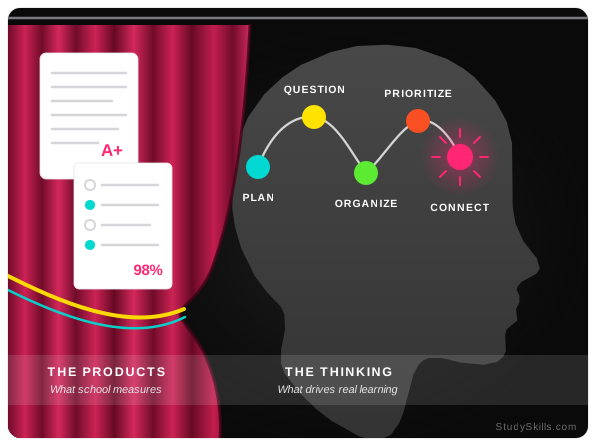
AI can now produce everything your school grades
The finished product stopped being proof that learning happened. So families and employers have moved on to what AI cannot hand anyone: managing your own time, thinking critically, communicating, following through, knowing how to learn something nobody has taught you yet. Those are executive function skills, and they are the most in-demand employability skills your graduates will carry.
Almost no school teaches them on purpose. The System assumes students absorb these skills somewhere along the way. Most never do — which is why capable students still lose assignments, and why driven students burn out carrying it all by force of will. The gap is invisible, and it sits under every student on your achievement curve.
The schools that close that gap, market it. One of the most selective schools in Michigan uses SOAR as a marketing hook — even though they already have a long waiting list. They teach it in their middle school and tell prospective parents so, because the waiting list starts in high school: SOAR gives families a reason to enroll years earlier. Other schools reach for SOAR for the students who struggle most. Same curriculum, opposite ends of the market, both using it to win.
That is the whole point: it levels the playing field, then tilts it. A school that explicitly teaches students how to learn is differentiated in a way no mission statement can match — not just from the free option down the road, but from every other private school on the same shortlist. Why this matters more in an AI world →
Meet SOAR
What private schools do with SOAR
SOAR is one turn-key curriculum that explicitly teaches students how to learn — the same one in all 5,100+ schools. Across 18 sequenced lessons, students build the systems behind organization, time management, reading, note-taking, studying, test-taking and self-monitoring. There is no separate private-school edition, because the skills do not change with the tuition.
It serves the whole range in your building. High achievers gain efficiency and breathing room; less engaged students gain tools they have never had. Advisory, seminar, a transition program, or a dedicated course — the format flexes to your schedule. See how the curriculum works →
The curriculum
This is what explicit executive-function instruction actually looks like
SOAR teaches 18 lessons that build from self-awareness and motivation through organization, strategic learning, communication, and self-monitoring. Each lesson teaches an immediately usable study skill while strengthening the executive-function process underneath it.
| # | Lesson | The Study Skill | The Executive Function Benefit |
|---|---|---|---|
| Section 1 — How Are You Smart? | |||
| 1 | Why Study Skills? | Self-awareness & learning strategy | Metacognition — understanding why these skills matter |
| 2 | What Are Your Strengths & Superpowers? | Strengths identification | Motivation activation — unlocking the potential that’s already there |
| 3 | How Does Your Brain Learn? | Learning strategy & brain awareness | Metacognition — understanding how your own brain works |
| Section 2 — Set Goals | |||
| 4 | Identify Your Priorities | Priority-setting | Planning & task initiation |
| 5 | Create Your Goals | Goal-setting | Long-range planning & self-direction |
| 6 | Manage Time & Take Action | Time management | Prioritization & task initiation |
| Section 3 — Organize | |||
| 7 | Organize Your Papers & Digital Files | Organization systems | Reduced cognitive load; navigating LMS chaos |
| 8 | Organize Your Space | Environmental organization | Reduced distraction & improved focus |
| 9 | Organize Your Time & Manage Your Energy | Scheduling & energy management | Self-regulation & attention management |
| Section 4 — Ask Questions | |||
| 10 | How to Read Nonfiction | Active reading strategies | Working memory & information processing |
| 11 | How to Communicate with Teachers & Peers | Interpersonal communication | Social cognition & self-advocacy |
| 12 | How to Listen & Take Notes | Note-taking | Processing & retaining information across multiple classes |
| 13 | How to Study & Learn New Terms | Memorization strategies | Long-term memory consolidation |
| 14 | How to Take Tests | Test preparation | Flexible thinking & performance under pressure |
| 15 | How to Write Paragraphs & Essays | Writing process | Sequential processing & communication |
| 16 | How to Learn Correct Grammar & Punctuation | Grammar & mechanics | Attention to detail & rule application |
| 17 | How to Give a Presentation | Presentation skills | Emotional regulation & executive communication |
| Section 5 — Track Progress | |||
| 18 | How to Track Progress & Keep Moving Forward | Self-monitoring | Self-evaluation & sustained motivation |
All 18 lessons build on one another, moving students from awareness to increasingly independent application.
See it in action
What's inside?
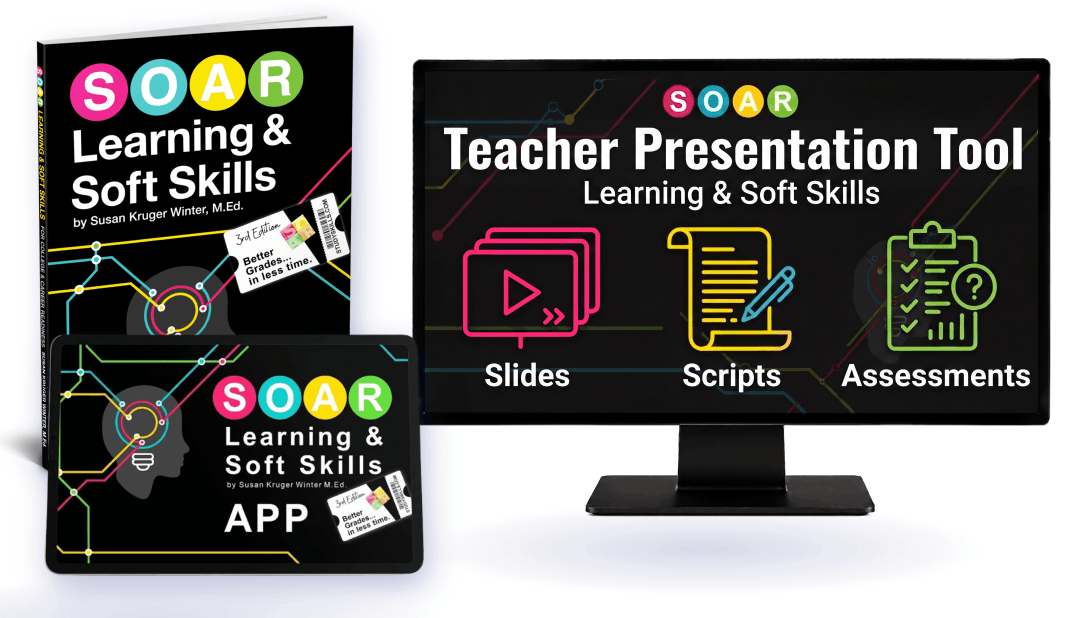
Student materials are modular — book, software, or both. The teacher presentation tool brings it together with slides, scripts, and assessments.
The student workbook PDF is yours immediately — or look inside one live lesson first, no sign-up needed.
Implementation
How can SOAR fit into our schedule?
The real question isn't whether your students need these skills — it's where to teach them. Private and independent schools rarely have a spare period to invent, and they rarely need one. SOAR flexes across the structures already on your schedule.
- Advisory or seminar — Build executive function in smaller recurring blocks while reaching every student, not only the ones already flagged.
- Transition programs — Give incoming students the skills to manage a jump in workload and independence at the moment it happens.
- A dedicated study skills course — Deliver the full curriculum in a semester or full-period structure.
- College-prep and capstone tracks — Send graduates out with the self-management skills that decide how their first year away actually goes.
- ELA credit — Where your standards and graduation requirements allow, SOAR can carry an official ELA credit for one year. See the full ELA credit case →
- Learning support and tiered intervention — Students who need more depth work the same framework rather than starting over in a separate system. See how SOAR works across RTI/MTSS →
- Multi-year implementation — Continue across grades for deeper application and increasingly independent use. Multi-year implementation guide →
- Schoolwide adoption — Introduce SOAR broadly in an adoption year, then sustain it with each incoming class.
Your staff does not have to build any of it. Every implementation includes the Teacher Presentation Tool — slides, scripts, activities, and assessment options — so classroom teachers, advisors, counselors or learning specialists can teach the lessons without becoming study-skills specialists first.
Need the practical details?
| What exactly is included? | What Is SOAR? → |
| How do we fit it into the schedule? | Pacing Guide → |
| Can this count as ELA credit? | ELA Credit → |
| Can this support tiered intervention? | RTI/MTSS → |
| Need help rolling it out? | Training & PD → |
| What proof do you have? | Proven Results → |
| What does it cost? | Pricing & Options → |
The evidence
The results are measurable — in research and in schools like yours
Explicit study-skills instruction moved students up roughly one full letter grade.1 That finding comes from a meta-analysis of 70 studies involving more than 2,400 secondary students. For a school measured on transcripts and placements, a full grade is not a marginal gain.
Graduation rates ran 50% higher for the students who started out struggling.2 Students of average ability had more than six times the odds of staying enrolled. That is independent research at Ohio State University — independent corroboration, not a SOAR study. Where your graduates land, and whether they stay there, is the number families quote back to you.
An average +1.0 GPA improvement among students completing the program, and standardized test scores up 5 basis points. Those are client-confirmed results from Karl G. Maeser Preparatory Academy, one of the top-ranked charter preparatory schools in the country — distinct from the research above, and measured in a real building.
5,100+ schools across 53+ countries, and teachers have declared it 98.5% effective. That reach spans independent, charter, magnet and public settings — classrooms, advisory programs and schoolwide models alike. See school results, educator stories, and testimonials →
Hear it from a principal who ran it. Robyn Ellis of Karl G. Maeser Preparatory Academy on what changed for her students:
What families hear
The message a touring family actually remembers
Parents recognize this immediately, because they have lived it. The homework battles, the lost assignments, the Sunday-night panic. A school that teaches students how to learn answers the question every touring parent is silently asking: will my child be okay here? — and then, will they be okay after they leave?
And the outcome is guaranteed. SOAR guarantees a half-point GPA increase, a 30% reduction in missing assignments, and measurably stronger student confidence — or your money back, subject to a use-with-fidelity agreement. Read the guarantee →
Questions
FAQs
Is SOAR only for students who are struggling?
No — SOAR is designed as universal, Tier 1 instruction that also scales up for the students who need more. Every student gets the same 18 lessons: high achievers use them to work in fewer steps and carry less stress, and disengaged students get a usable system for the first time. When a student needs deeper support, the same curriculum has built-in resources to intensify at Tier 2 and Tier 3, so nobody restarts in a separate program. That works whether or not your school runs a formal tiered system. See how SOAR scales across all three tiers →
Who teaches it? We don't have a study skills specialist.
Almost no school does — so SOAR teaches the teacher as the teacher teaches the students. The curriculum is written so an instructor learns the systems right alongside the class, with no prior expertise assumed. Every implementation includes the Teacher Presentation Tool: slides, scripts, activities and assessment options, ready to deliver. A classroom teacher, advisor, counselor or learning specialist can pick it up and run it. Optional training and PD are available if you want a stronger launch. See training & PD options →
How much time does it take?
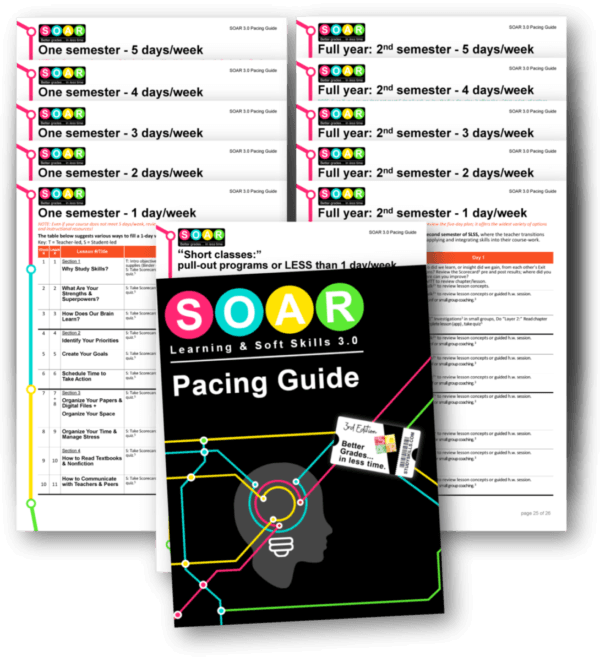
SOAR's pacing flexes to the time you have available. It runs as a full-period course, a semester course, or in shorter advisory or seminar blocks — the lessons stay in sequence either way. The Pacing Guide lays the schedule options out side by side. See the SOAR Pacing Guide →
Can SOAR count for academic credit?
Yes — SOAR counts as an ELA credit. The curriculum meets ELA standards across the board, including reading, writing, grammar, communication and presentation, so schools can award a full year of ELA credit for it. See the full ELA credit case →
Does it work for college-prep and capstone programs?
Yes — independent research at Ohio State University found graduation rates 50% higher for students initially in academic difficulty, and more than six times the odds of being retained for course-takers of average ability. That is independent corroboration, not a SOAR study, and it measures exactly what a college-prep program is promising families: that a graduate can manage their own time, track their own progress and ask for help once no adult is checking. See SOAR for college & career prep →
What does it cost, and what if it doesn't work?
Pricing is listed in full, and the results are guaranteed. SOAR guarantees a half-point GPA increase, a 30% reduction in missing assignments, and measurably stronger student confidence — or your money back, subject to a use-with-fidelity agreement. See pricing & options → · Read the guarantee →

Free for Educators
Ready to look inside SOAR?
The student workbook PDF is yours immediately. Add the free 14-day software trial if you want all 18 lessons and the teacher portal.
No credit card, either way.
More for Educators
Start Here · What Is SOAR? · Why SOAR Works · Executive Function · RTI/MTSS · Solutions by Focus · Training & PD · Pricing & Options
Research Sources
1 Scruggs, T. E., Mastropieri, M. A., Berkeley, S., & Graetz, J. E. (2010). Do special education interventions improve learning of secondary content? A meta-analysis. Remedial and Special Education, 31(6), 437–449. ↩
2 Tuckman, B. W., & Kennedy, G. J. (2011). Teaching learning strategies to increase success of first-term college students. The Journal of Experimental Education, 79(4), 478–504. Independent corroboration; not a SOAR study. ↩


