
Brain-First Learning for an AI World
RTI/MTSS: RESPONSE TO INTERVENTION
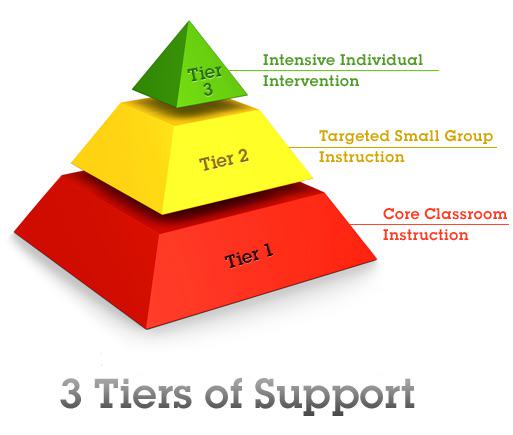
Response to Intervention: One Foundation Aligns Three Tiers
When executive function is the foundation, all three tiers work together instead of functioning as separate programs.
The Problem
“The wheels are falling off”
“I work in a middle school and see the severe lack of study and organizational skills. The wheels seem to fall off these students! Most have never been taught organizational skills. But, by middle school, are expected to be independent and organized.
One of my students has severe dyslexia. He is actually better-off in school than the unorganized child. By law, the school is providing him with many accommodations to assist. Those children that lack organizational skills simply fall through the cracks. They receive no help or sympathy!”
— Nancy Drake, Charleston, SCRTI was designed to solve exactly the problem Nancy described: to catch struggling students before they fall through the cracks and to prevent unnecessary special-education referrals by addressing the foundation first.
But there’s a fundamental gap in The System. The System holds educators and students accountable for learning content… but it does not teach how to access that content. The process of learning depends on a set of skills we commonly label as “executive function” — also known as “study skills.” They are the foundational layer to all aspects of learning. Which means they are the foundation supporting every tier of RTI.
When that foundation is missing, everything gets misaligned. It’s like standing in front of a window of horizontal blinds that are all wonky — slats twisted in several different directions, the whole thing a chaotic mess.
Tiers don’t connect. Interventions don’t add up. Students get stuck.
All because the foundational gap is invisible.
The Weight You Carry
And you’re the one holding it up
You didn’t choose this profession — it chose you. This is what makes special-education teachers different: you believe in your students, often more than they believe in themselves. You carry that belief through every tier, every meeting, every plan.
Meanwhile, general education isn’t trained or equipped to meet struggling students where they are — so the weight of supporting them often lands on you. If only you could find that one string that would instantly snap all that chaos into order…
The Solution
The one string that snaps it into alignment
That single string does exist. It’s the foundation that snaps everything into alignment: providing explicit instruction in executive function skills — the skills reshaping what it means to be prepared in an AI world → — the necessary foundation for every tier.
Years ago, school psychologists in Prince George County, Virginia turned to study skills to prevent 50% of special-ed referrals! This was before RTI was established; they told me they discovered that well over half of their special-education referrals were students who simply lacked organizational and study skills. So, they organized a committee, taught the skills at what we now call a “Tier 1 level,” and successfully met their objective.
A note on terminology: you may know this framework as MTSS — Multi-Tiered System of Supports. The language is newer; the principle is the same. SOAR®’s approach has always been built around the whole student, across all tiers, not just special education. Whether your school uses the RTI or MTSS label, the foundation we’re describing is identical.
See it in action
What’s inside?
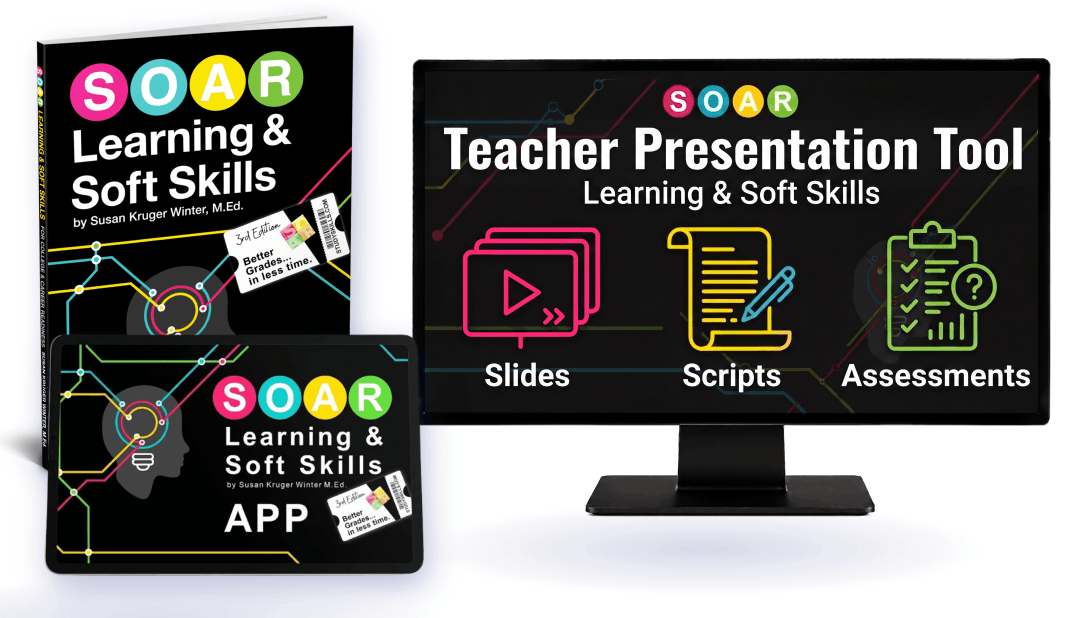
Student materials are modular — book, software, or both. The teacher presentation tool brings it together with slides, scripts, and assessments.
Get My Review CopyThe student workbook PDF is yours immediately — or look inside one live lesson first, no sign-up needed.
The 80/20 Principle
How can one solution serve all three tiers?
There’s a universal pattern that shows up across nearly every system: roughly 20% of the inputs drive 80% of the results. It’s true in business, in time management, in how students spend their effort.
Study and executive function skills are the 20% of academic skills that drive 80% of student outcomes. One 2024 study put the number even higher — finding that study skills account for 93% of the variance in academic achievement among secondary students.1 The cause-and-effect asymmetry is real, and it’s massive.
And when that foundation is clear, all three RTI tiers align — just like pulling that single string on a set of wonky horizontal blinds. Everything snaps into alignment fast.
Whether you’re teaching Tier 1, Tier 2, or Tier 3, the same principle applies: make the executive-function foundation visible, and suddenly the tier you’re in works better.
How each tier uses the same foundation
Tier 1
Teach executive function to every student. Whether it’s an orientation class, a freshman seminar, advisory, or homeroom — you can also deliver it as a full ELA credit for executive function skills.
SOAR’s alignment with SRSD — which carries ESSA Tier 1 Strong Evidence from the What Works Clearinghouse — makes the biggest impact here, extending explicit instruction across the full domain of executive function.
More on Tier 1 →Tier 2
The same foundation, taught more intensively. Tier 1 should have laid the groundwork in executive function for all students — but if it didn’t, or if some students need more support, Tier 2 lets you use the same foundation from the ground up, with more targeted, intensive instruction. You’re not bolting on a new program; you’re teaching the skills that matter.
More on Tier 2 →Tier 3
Same foundation as Tier 1, reinforced in Tier 2, now individualized. When students are escalated to Tier 3, they’ve either not had a solid foundation in Tiers 1 & 2 (most often), there’s an emotional block, or there’s a very specific learning challenge requiring deep intervention. In all cases, executive function is the foundation for effective intervention.
More on Tier 3 →Special Education
Special Education & RTI/MTSS
RTI was originally designed so general ed would teach the foundation in Tier 1, preventing a vast majority of referrals to special ed. But that’s not always how it plays out. General ed sometimes doesn’t own Tier 1 as originally intended — and it’s common for special-ed teachers to end up running all three tiers themselves.
One executive-function foundation, taught at whatever intensity your students need. No matter which tier you’re teaching, no matter what happened (or didn’t happen) before your students got to you: SOAR works exactly the same.
And the research backs this up for the students who need it most: students with learning disabilities who received explicit strategy instruction improved by one to two full grade levels.2 SOAR’s explicit instruction model also aligns with Science of Reading principles — making it a natural fit for schools integrating structured literacy across all three tiers.
For educators who want structured support getting started, SOAR offers training and professional development designed to meet teachers where they are.
The Research
Proven Across 70 Studies
The pattern shows up at scale, as well: across 70 studies and 2,400+ secondary students with disabilities, explicit study-skills instruction improved learning by roughly one full letter grade — about 20 points on a 100-point test.3
And the pattern is consistent: when the foundation is clear, all three tiers work better. See results from real schools →
We’ve spent 20 years refining how to make that teaching visible and teachable. SOAR is used in 5,100+ schools across 53+ countries — including district-wide RTI implementations. See how districts use SOAR →
The Payoff
One string. One foundation. Everything snaps into alignment.
RTI doesn’t have to feel clunky, like that set of wonky blinds.
Pull the string. Make the executive-function foundation visible to your students — at whatever tier they need.
When the foundation is visible, the tiers stop being a sorting machine. They become a path out.
Go Deeper
Explore the Tiers
Ready to dive deeper? Explore each tier:
SOAR’s core curriculum serves grades 6–12; for younger students, see Study Skills & EF for Elementary – 5th Grade Literacy Lab.
Tier 1
Avoid Differentiation at the Wrong Layer
The small set of skills with 80% impact across subjects — taught explicitly to every student.
Tier 1 Interventions →Tier 2
Elements of Effective Intervention Lessons
The same foundation in a smaller container — precision replaces guesswork.
Tier 2 Interventions →Tier 3
Take a Step Back Before Going Forward
Stop escalating and start diagnosing — find the exact place the learning circuit breaks down.
Tier 3 Interventions →Quick Answers
FAQs
How does SOAR work across all three RTI tiers?
SOAR provides a single executive function foundation that scales to whatever intensity a tier requires. Tier 1 delivers it as explicit whole-class instruction — preventing the cascade before it starts. Tier 2 uses the same foundation in smaller groups, more intensively. Tier 3 returns to it as the diagnostic starting point for individualized intervention.
One curriculum, one framework, three intensities — so teachers across all tiers share a common language and students are never starting over.
Can one curriculum serve Tier 1, Tier 2, and Tier 3?
Yes — and that’s the core argument. Most RTI implementations struggle because each tier runs a different program, so there’s no connective tissue between levels. SOAR’s executive function foundation is the same across all three tiers; what changes is the intensity and group size of instruction.
When the foundation is shared, the tiers stop functioning as separate silos and start functioning as a coherent system.
What executive function skills support RTI?
The executive function skills that matter most in an RTI framework are the ones that govern how students access and process learning itself: organization, time management, note-taking, reading comprehension strategies, memory techniques, and self-monitoring. These are the skills students need to benefit from any content instruction — which is why teaching them explicitly is the highest-leverage move at every tier.
SOAR covers all of them in a sequenced curriculum with student materials and a teacher presentation tool.
Does SOAR align with ESSA evidence requirements?
Yes. SOAR’s alignment with the SRSD (Self-Regulated Strategy Development) framework is significant here: SRSD carries ESSA Tier 1 — Strong Evidence designation from the What Works Clearinghouse, based on rigorous randomized controlled trials in general education classrooms.
Beyond SRSD, the broader research base includes a meta-analysis of 70 studies across 2,400+ secondary students with disabilities, finding an average effect size of approximately 1.00 — a large effect for this instructional category.

Free for Educators
Ready to look inside SOAR?
The student workbook PDF is yours immediately. Add the free 14-day software trial if you want all 18 lessons and the teacher portal.
Get My Review CopyNo credit card, either way.
1 “Analyzing the Impact of Study Skills on Academic Achievement: A Study among School Students” (2024), Education and Psychological Research; study skills account for 93% of variance in academic achievement among secondary students. ↩
2 Gillespie, A., & Graham, S. (2014). A meta-analysis of writing interventions for students with learning disabilities. Exceptional Children, 80(4), 454–473. Explicit instruction moves the needle on the most cognitively demanding EF task there is. ↩
3 Scruggs, T. E., Mastropieri, M. A., Berkeley, S., & Graetz, J. E. (2010). Do special education interventions improve learning of secondary content? A meta-analysis. Remedial and Special Education, 31(6), 437–449. 70 studies, 2,400+ students; effect size ~1.00 — a large average effect for this instructional category. ↩


