
Brain-First Learning for an AI World
TIER 1 INTERVENTIONS
RTI Tier 1 Interventions: Avoid Differentiation at the Wrong Layer
Teach What’s Universal, Honor What’s Individual

“Executive function is EVERYTHING. It’s the key to everything. And it’s our single, greatest challenge!”
— Elizabeth H., Administrator, Jacksonville, FLThe Universal Layer
The education system’s blind spot
Every student is unique. We know this. We see it every day in our classrooms — different interests, different backgrounds, different ways of being in the world.
But at the neurological layer, all brains learn the same way. That’s not opinion — that’s neurology. Individuality lives in preferences, interests, background experiences, and the context that flavors how learning gets expressed. Tier 1 is about teaching the universal layer — with explicit instruction in the executive function skills that serve every student.
The System has treated Tier 1 as though students need different mechanisms of learning, different ways their brains encode information. Different neural pathways.
That’s differentiation at the wrong layer... and it’s why Tier 1 has felt vague for so long. The System has never named executive function as the universal pathway; it flat out ignores it.
This includes neurodivergent learners. Paradoxically, “neurodivergent” doesn’t mean these learners learn differently than others, it means they are more sensitive to the neurological basis of learning. We know this because the interventions that work best for neurodivergent learners... are those most aligned to the universal design of how our brains learn.
When instruction aligns with how humans are built to learn, all students become more efficient learners. When they encounter a challenge, they have strategies to work through it. They can use their strengths to build detours around weaker areas.
“Differentiation” is real, but it happens a layer higher than the universal mechanisms of learning.
The Reframe
Here’s what changes everything
Once you see the universal layer, the nuance comes into focus; the place to differentiate is everywhere else:
- the content students learn about,
- the context that makes it stick,
- the interests and background experiences that give that learning meaning.
...these represent the “individual” layers.
And Tier 1 instruction can simultaneously teach the universal skills students need, while honoring the uniqueness of each individual.
“I don’t need you to teach them about debits and credits. I can teach them that. I need you to teach them how to show up for work on time and how to make even a simple decision.”
— Accountant, Oakland County CTE Advisory MeetingThe accountant quoted above was naming the universal layer — the executive function skills that serve every profession, every subject, every student.
Why RTI works: the 80/20 principle
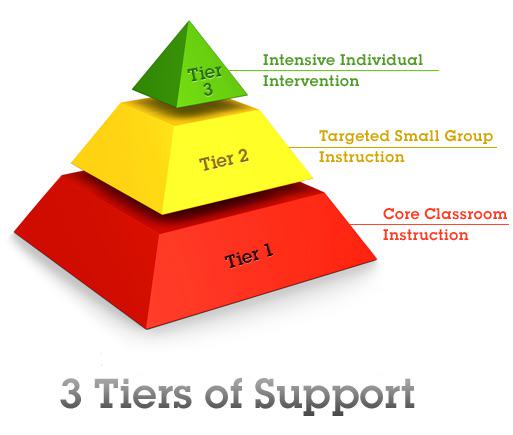
The 80/20 principle is a law of the universe; in any system, roughly 80% of outcomes come from 20% of the effort or causes. In education, this means roughly 80% of students will thrive with high-quality instruction targeted to the universal layer of learning. About 15% need additional targeted support. And about 5% need intensive intervention.
RTI is built on the 80/20 principle. “Tier 1 instruction” is where schools are expected to provide that high-quality instruction for the vast majority of students, explicit instruction in how to: manage responsibilities, organize information, and learn.
When Tier 1 effectively reaches “the 80%”, everyone benefits... student performance improves overall and the burden on special education and support staff lessens. For example, when Prince George County Public Schools examined their special education referrals, they discovered more than 50% were not students with learning disabilities, they were students with a study-skills gap. That discovery led them to redesign their Tier 1 instruction, focusing on the universal, executive function skills that benefit all learners.
Before long, they met their objective and dramatically reduced referral rates. When Tier 1 teaches the universal layer —explicitly and effectively— to all students, the whole RTI pyramid functions as it was designed. The System finally works with the brain instead of against it.
See it in action
What’s inside?
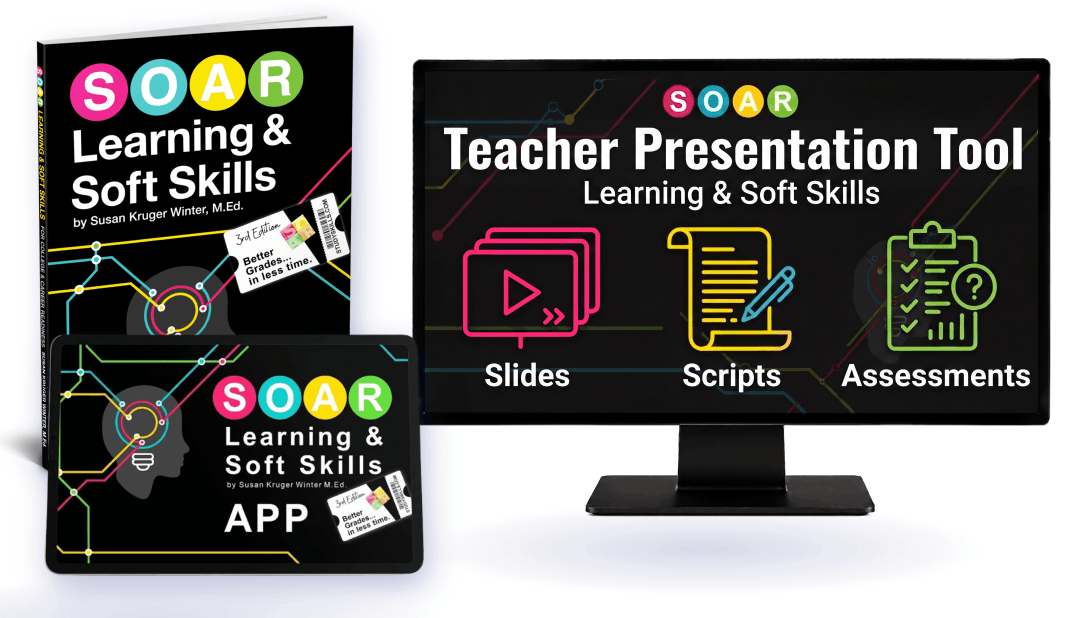
Student materials are modular — book, software, or both. The teacher presentation tool brings it together with slides, scripts, and assessments.
Get My Review CopyThe student workbook PDF is yours immediately — or look inside one live lesson first, no sign-up needed.
In Practice
What does this look like in a classroom?
It starts by honoring who students are. Their strengths. Their interests. Their backgrounds. Their individual ways of expressing themselves. This is where differentiation begins — not by customizing how their brains learn, but by celebrating what makes each student unique.
From there, the instruction moves toward the universal. Students learn the neurological mechanisms of learning... and discover that, despite all their differences, their brains work the same way! This is powerful for students to understand; it shifts the conversation from “I’m different” to “We’re all built the same... with different interests and levels of experience.”
Then comes explicit instruction in the universal skills of executive function:
- How to read for understanding
- How to organize information
- How to break a complex task into steps
- How to manage time and attention
We give students tools — real, tangible strategies they can put in their toolbox and use across every class, every subject, every situation.
Finally — and this is critical — students apply these skills immediately to their own lives. To their current assignments. To their interests. To their goals. They get feedback loops that reinforce what they’re learning. They see the skills work in real time. That’s how learning sticks.
When Tier 1 is structured this way — starting with the individual, moving to the universal, teaching explicitly, then anchoring in application — students don’t just learn skills. They understand how their own brains work. And that understanding changes everything.
Making Room
Where does this fit in our schedule?
There are several ways to fit SOAR® into the schedule as Tier 1 instruction:
Some schools embed this into an orientation course or freshman seminar, a natural home for teaching students how to be students. Executive function becomes part of the broader induction into middle or high school.
This instruction can even be delivered as an ELA credit. SOAR covers 100% of ELA standards for grades 6–12. Learn more about SOAR as ELA credit →
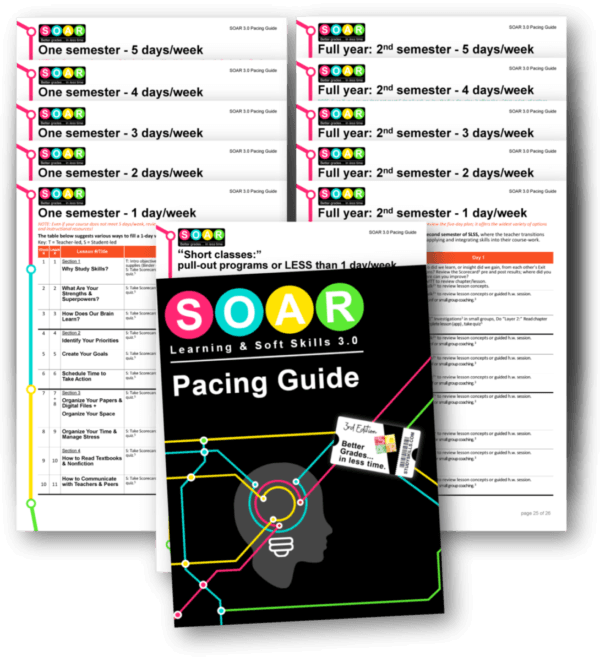
The Pacing Guide maps the schedule options — from short pull-out sessions to a full-year course. There are multiple ways to make room for what students actually need.
The barrier isn’t how to fit it in. The barrier is recognizing that it needs to be there at all!
The Evidence
What the research shows
When we:
- Make the neurological layer visible,
- recognize it as the universal layer of learning, and
- understand that executive function instruction is what serves that layer,
...we stop differentiating at the wrong level. A Tier 1 designed to serve the universal layer of learning becomes the intervention most students will ever need.
And this isn’t theoretical. It’s backed by rigorous research:
93%
Of the variance in academic achievement explained by study skills
Not 93% of one outcome — 93% of the difference between students who succeed and students who struggle, is determined by study skills. A 2024 study found that study skills predict academic performance more reliably than almost any other factor researchers measure. Whether or not a student has these skills is, by far, the biggest variable in how they do in school.1
SOAR’s instructional architecture aligns with Self-Regulated Strategy Development (SRSD), the explicit instructional framework that the Institute of Education Sciences and the What Works Clearinghouse have validated as the gold standard for Tier 1, general-education intervention.
See the full SOAR × SRSD alignment →
SRSD is built on a simple principle: explicit instruction in “how to learn” works. Harris et al. (2012) conducted a randomized controlled trial proving that explicit strategy instruction works for students with and without learning challenges, in regular classrooms, with regular teachers. No pull-outs. No special conditions. Just universal instruction done right.2
20 pts
Average test score gain from explicit study skills instruction
That’s the difference between failing and passing — or passing and honors. Across 70 studies and 2,400+ secondary students with learning disabilities, explicit study skills instruction produced a roughly 20-point gain on 100-point tests. Not a marginal improvement. A grade-level shift.3
FAQs
What is Tier 1 instruction in RTI?
Tier 1 is the universal layer of RTI — the core instruction every student in the general classroom receives, before any targeted or intensive intervention. Strong Tier 1 pairs quality content instruction with explicit teaching of the skills students use to learn: reading for understanding, organizing information, breaking tasks into steps, and managing time and attention.
What are examples of Tier 1 interventions?
“Tier 1 intervention” is a bit of a misnomer. The name comes from Response to Intervention, but Tier 1 isn’t a pull-out or a program layered on top — it’s general-level instruction. The real Tier 1 “intervention” is explicit instruction in the executive function skills students need to access everything else school asks of them — to take in new information, make sense of it, and respond the way their classes expect. Note-taking, reading strategies, task planning, and self-monitoring routines all qualify when every student receives them.
How is Tier 1 different from Tier 2 and Tier 3?
The difference is scope and intensity, not content. Tier 1 is whole-class instruction for every student. Tier 2 is about precision — the same foundation delivered to targeted small groups, so students who need more help get more direct coaching in applying the strategies. Tier 3 is intensive, individualized intervention. When all three tiers build on one executive-function foundation, students move between them without starting over.
When does a student move from Tier 1 to Tier 2?
When progress monitoring shows a student is not responding to strong universal instruction over time. Moving to Tier 2 isn’t a setback — it’s added help: more direct support in understanding and applying what the universal layer teaches. One check makes the move meaningful: confirm the skills were actually taught explicitly, because a student can’t apply strategies no one ever showed them.
The Full Framework
Explore the RTI cluster
Tier 1 is one part of a connected framework. Explore the full picture:
Introduction
Introduction to RTI/MTSS
One executive-function foundation that aligns all three tiers — and snaps everything into place.
Introduction to RTI/MTSS →Tier 2
Elements of Effective Intervention Lessons
The same foundation, delivered with precision — targeted support for students who need more.
Tier 2 Interventions →Tier 3
Take a Step Back Before Going Forward
Stop escalating and start diagnosing — find the exact place the learning circuit breaks down.
Tier 3 Interventions →
Free for Educators
Ready to look inside SOAR?
The student workbook PDF is yours immediately. Add the free 14-day software trial if you want all 18 lessons and the teacher portal.
Get My Review CopyNo credit card, either way.
Research Sources
1 Analyzing the Impact of Study Skills on Academic Achievement: A Study among School Students. (2024). Education and Psychological Research. Multiple Correlation Coefficient = 0.964 (92.9% of variance), F = 115.50, p < 0.01. ↩
2 Harris, K. R., Lane, K. L., Driscoll, S., Graham, S., Wilson, K., Sandmel, K., Brindle, M., & Schatschneider, C. (2012). Tier 1, Teacher-Implemented Self-Regulated Strategy Development for Students with and without Behavioral Challenges: A Randomized Controlled Trial. The Elementary School Journal, 113(2), 160–191. ↩
3 Scruggs, T. E., Mastropieri, M. A., Berkeley, S., & Graetz, J. E. (2010). Do special education interventions improve learning of secondary content? A meta-analysis. Remedial and Special Education, 31(6), 437–449. 70 studies, 2,400+ students; effect size ~1.00. ↩


