
Start Here | SOAR for Educators
Brain First Learning in an AI World
Start here: For educators · Grades 6–12
The skills that matter most?
The System does not teach.
School expects students to manage themselves, organize their work, and learn on their own. SOAR® is the curriculum that actually teaches them how — in a brain-friendly, friction-free way.
Classroom-tested in 5,100+ schools across 53 countries.
By middle and high school, students are expected to be independent and organized — to keep track of their work, manage their time, read closely, and learn without someone walking them through every step.
But The System doesn’t teach them how — and very few pick it up on their own. Some get sophisticated at winging it. Some hobble along. And for many, the wheels come off and the effort drops; from the front of the room, it reads as apathy.
And here’s what’s new. In an AI world, this stops being only the strugglers’ problem. The students who look most successful — the ones who’ve gotten by on raw ability, winging it brilliantly — are often the most exposed, because no one ever built the capacity underneath. When the tool that does the thinking is one tap away — every student reaches for it, unless someone teaches them to think for themselves first.
It’s the most pervasive problem in education, and the hardest to see — because it’s an assumption, not a subject. Nobody schedules a class for it.
SOAR makes the invisible, visible.
We give these hidden skills a name, a structure, and a sequence — so students can finally see what learning actually requires, and do it on purpose.
SOAR is a curriculum for grades 6–12 that teaches the assumed-but-never-taught skills underneath every subject — and it teaches them the way the brain actually builds them, not as habits to drill:
- Organize work, materials, and digital files
- Manage time and plan ahead
- Read nonfiction for meaning
- Take usable notes
- Study effectively
- Think and learn independently
These are the human capacities that become more important in an AI world, not less.
The name for all of itThese skills are executive function. It’s the most talked-about gap in education — and the least understood. It’s also the thread that runs through everything below. Most programs that promise to build executive function treat it as a set of habits to drill, not skills the brain must be taught to do. SOAR is built the other way around: it maps how the brain learns, then explicitly teaches executive function skills aligned to that pattern. It serves grades 6–12.
So where does a class like this even fit?
It’s the first question every administrator asks — and the answer is the part most don’t expect. SOAR doesn’t ask for a new slot in the schedule. It fits the ones you already have.
SOAR fits straight into intervention — and the first-year course you already run.
It drops into RTI — Tier I instruction, Tier II intervention, or Tier III support — without rebuilding the schedule or sacrificing electives. It also slots directly into a freshman seminar, orientation, or any first-year course built around student readiness. No electives sacrificed, no schedule rebuilt.
Start with the RTI hub →And it can even fit as an ELA credit. The skills SOAR teaches are your ELA standards — so it can fill a year-long ELA course, or a first-year orientation that meets ELA standards — while building the focus, independence, and thinking skills that carry into every other class. SOAR doesn’t replace ELA. It unlocks ELA. See how SOAR counts as an ELA credit →
And students actually engage.
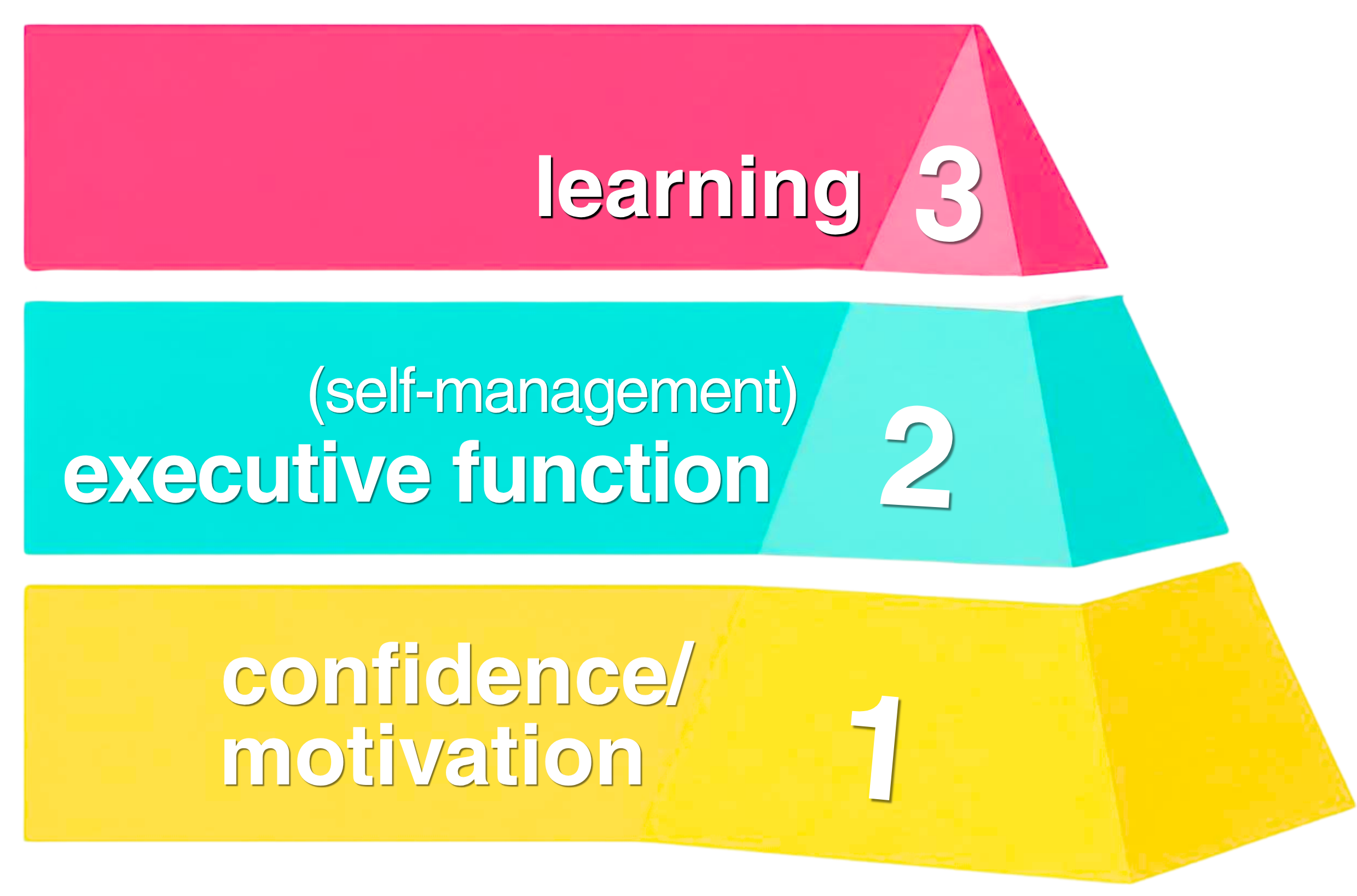
Most teaching starts at the top — throw the content at students and hope it sticks. But learning can’t stand alone. It rests on two layers underneath, and when those are missing, the content slides off.
The Learning Success Pyramid is the model SOAR is built on. It builds confidence first, then executive function, and only then optimizes learning itself. That order is why students engage instead of resist — and why the skills transfer to every subject.
In practice, that means a student plans an assignment, reads for meaning, takes notes, and studies for a test using the same repeatable steps — in science, in history, in English. One structure, every class.
One curriculum. Start with the door that fits your focus…
SOAR is a curriculum for grades 6–12 — flexible enough to meet the challenge that’s most pressing in your world. Each page is a short read that shows how SOAR fits. They’re different doors into the same work.
Response to Intervention (RTI)
How SOAR fits across the tiers — Tier I instruction, Tier II interventions, and Tier III support — without rebuilding the schedule. Start here if intervention is the pressing need.
Explore the RTI hub →Executive Function
The skills underneath every subject — organization, time, focus, independent thinking — taught explicitly, the way the brain actually builds them. The executive function curriculum schools keep looking for.
Explore executive function →By grade level
How SOAR works in your setting — with specifics for each level. Jump straight to yours:
Literacy & ELA Credit
The reading, writing, and thinking skills behind your ELA standards — built for an AI world. And the part most schools miss: SOAR can count as your ELA credit, not in addition to it.
See how SOAR counts as ELA →Thinking beyond one year?
SOAR works as a single-year course… and grows to an optional 2–4 year pathway if you ever want more. Advanced modules, SEL, and deeper ELA are all options — customized to meet your larger objectives.
Explore multi-year options →For administrators
Adoption, scheduling, standards alignment, and ROI — the questions leaders ask. Includes how SOAR works in alternative settings: CTE, private and college-prep, and beyond.
For school leaders →The +1.0 GPA lift comes from a school’s own measured data following a school-wide SOAR implementation, shared with us.
Want to look inside SOAR?
Click above to: see the software in action, get a digital review copy of the student book, and start a free 14-day trial — no credit card needed.